SCRAMSPACE - the next frontier
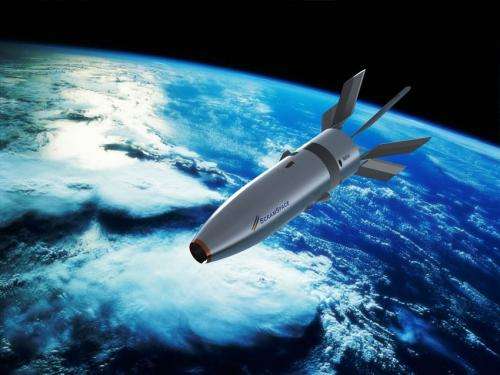
A talented new team of young scientists and engineers at The University of Queensland (UQ) is building a hypersonic scramjet which will fly at 8600 km/h in South Australia next year.
The research is the first phase of SCRAMSPACE - the development of a high-tech Australian capability set to revolutionise the way the world launches satellites into space.
“A scramjet is an airbreathing engine for hypersonic craft that travel at many times the speed of sound, for high speed transport in Earth's atmosphere or along trajectories to space, Professor Russell Boyce said.
"They improve the efficiency and reliability and reduce the cost of inserting satellites into orbit."
Professor Boyce is the SCRAMSPACE director and DSTO Chair for Hypersonics at UQ.
“Australia is a world leader in scramjet development," he said.
"We now have an opportunity to build a scramjet-based industry in this country, in international partnership.
"The SCRAMSPACE project is building capacity and capability towards such an industry.
“The flight team is supported by scramjet specialists at UQ's Centre for Hypersonics and the Defence, Science and Technology Organisation's (DSTO) Applied Hypersonics Branch in Brisbane.
"Several PhD students are contributing to the technology."
Professor Boyce said the SCRAMSPACE project had been established with Commonwealth funding to form the hub of a capability for ongoing space-access flight programs and to contribute to the talent pool for a future Australian space industry.
In line with that, the Australian aerospace industry was playing a key role in the project.
He said that including new researchers in support activities around the country, nine professional positions had resulted already.
The next phase of SCRAMSPACE is already on the drawing board.
If funded, graduating students will be channelled into the team to bring it to the critical mass necessary to develop the capability, and to assist Australia's aerospace industry to eventually corner part of the world's multi-billion dollar space market.
"In the meantime, it establishes partnership with the key players internationally from whom other space-related technologies can be accessed," he said.
"Very importantly, it gives us a voice in the international space arena, to be able to participate in discussions on space regulations and activity that will affect us.”
Professor Boyce said that Australia depended heavily on space-based technologies.
“In the coming years and decades, Australia needs secure and assured access to the space environment and to the workhorse applications of space, for satellite communications, remote sensing, and timing and positioning information,” he said.
“These will play important roles in Australia's future development.
“We are dependent on space, yet far from self-sufficient, and the fragile space environment is congested and cluttered with debris. For both reasons, we are vulnerable.
“We need to be able to provide leadership in the councils which regulate the space environment and space activities, in order to minimise our current vulnerabilities in space.
“This access and leadership will depend on Australia's international space credentials, the prerequisites for which will be demonstrable capability and commitment in the space arena.
“Building capacity for a scramjet-based small satellite launch capability and industry will assist Australia's credentials enormously.”
Today the scramjet, SCRAMSPACE I, is on track for launch at Woomera in South Australia late next year, having just passed a major design review.
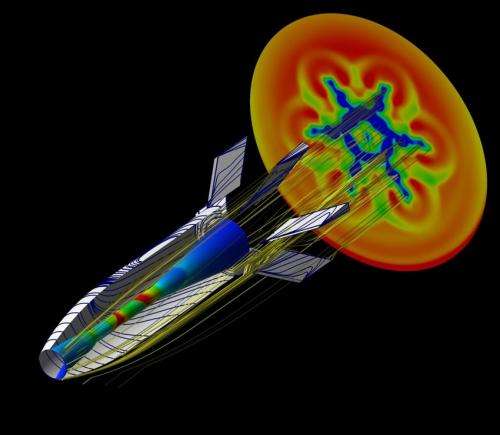
According to Dr Sandy Tirtey, the Technical Lead and focal point of the new team, the scramjet has passed its preliminary concept development phase.
“We have another design review set for July and are aiming at the Critical Design Review in October this year," Dr Tirtey said.
"After that, we start the process of manufacture, assembly, and extensive pre-flight tests.”
The 1.8 metre long scramjet vehicle will be boosted by two rockets to about 340km above the Earth.
After leaving the atmosphere, the scramjet will be separated from the rocket, and the fins that will keep it stable on its return through the atmosphere will be deployed and locked.
On its way down, the bullet-shaped vehicle will be accelerated by gravity to Mach 8, and the experiment will take place between 32km and 27km above the Earth.
The flight will include experimental diode laser flight instrumentation and advanced high temperature materials with embedded sensors.
In parallel, scramjet concepts will be tested at even greater speeds — up to Mach 14 — in UQ's world-class hypersonic ground-test facilities, and simulated with supercomputers.
This first phase of SCRAMSPACE is the largest project, “Scramjet-based Access-to-Space Systems”, to be funded under the Commonwealth government's Australian Space Research Program (ASRP).
SCRAMSPACE has attracted 5 million dollars of ASRP funding and is also supported by nine million dollars from an international partnership consortium.
The 13-member international consortium is led by UQ.
Partners in the program include four Australian universities — UQ, the University of New South Wales, the University of Adelaide, and the University of Southern Queensland; and a US university, the University of Minnesota.
It also includes space agencies and research organisations from Germany, Japan and Italy respectively ; DSTO; the Australian Youth Aerospace Association; and industry partners including Brisbane firm Teakle Composites Pty Ltd, Cairns firm AIMTEK Pty Ltd, and BAE Systems.
Professor Boyce said the project was 12 months old and "going like a scramjet".
Provided by University of Queensland


