Revealing the inner workings of cells with newly developed Raman microscopy technique
May 27, 2011
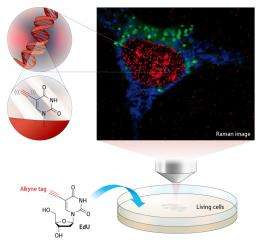
Raman imaging reveals that a molecule known as EdU, colored red in this image, gathers in the cell nucleus. Cytochrome c and lipid are colored in blue and green respectively. Credit: Ref. 2011 American Chemical Society

Living cells are virtuosos of chemistry. At any one time, countless chemical reactions are taking place within each cell. For researchers trying to understand how cells function, unraveling this complex chemistry is an ongoing challenge. The process, however, could soon become a little more straightforward. Mikiko Sodeoka and colleagues at the RIKEN Advanced Science Institute at Wako, in collaboration with a team led by Katsumasa Fujita and Satoshi Kawata at Osaka University, have demonstrated how to tag molecules in a way that promises to be much more versatile than current methods.

Traditionally, researchers looking to study the role of a particular small molecule within a cell have tagged it with a fluorescent marker. Using a , the tagged substance can be followed as it moves around the cell. However, fluorescent tags are bulky, and so can disrupt the molecule’s normal cellular interactions. To get around this problem, can sometimes be tagged after reaching their destination within the cell, but this technique only works in a limited number of cases.

Sodeoka and her team have now shown that a simple chemical substituent called an alkyne, which consists of just two carbon atoms joined together by a triple bond, can replace the bulky fluorescent tag. Their imaging technique relies on the fact that alkynes scatter a particular wavelength of light when irradiated with a laser—a process known as Raman scattering—which can be detected using a Raman microscope. No other cellular components scatter light at this wavelength, giving a clear picture of the molecule within the cell.

To demonstrate the potential of their technique, the researchers used an alkyne-tagged component of DNA known as EdU. They then used a Raman microscope developed by Fujita and his team to follow a group of replicating as they incorporated EdU into their DNA (Fig. 1). The technique took some work to optimize, says Sodeoka. “We were very happy when we could finally see the time-series pictures of the incorporation of EdU into DNA.”

The EdU experiment is just a proof of principle, Sodeoka adds. “At this point, the sensitivity of the alkyne tag using Raman microscopy is lower than fluorescent imaging,” she says. To improve the sensitivity, the team is working to optimize the attachment of the alkyne tag, and also to improve the Raman microscope itself. “If the sensitivity problem is solved, Raman imaging using alkynes as a small tag could become a powerful tool,” she concludes.

Explore further: Reading the unreadable

More information: Yamakoshi, H., et al. Imaging of EdU, an alkyne-tagged cell proliferation probe, by Raman microscopy. Journal of the American Chemical Society 133, 6102–6105 (2011).

Related Stories

Shedding new light on cancer

Jan 22, 2010

(PhysOrg.com) -- Researchers at the University of St Andrews have developed a powerful technique that could allow earlier cancer detection.

Light games with DNA

Dec 10, 2010

The diagnosis of hereditary diseases and the identification of genetic fingerprints hinge on high-sensitivity DNA imaging biotechnologies. These imaging tools detect specific genes in cells using fluorophores—fluorescent ...

Harnessing Nanoparticles To Track Cancer Cell Changes

Jul 03, 2009

The more dots there are, the more accurate a picture you get when you connect them. Cancer researchers adopting that philosophy have developed a new imaging technology that could give scientists the ability to simultaneously ...

Recommended for you

New method for producing clean hydrogen

9 hours ago

Duke University engineers have developed a novel method for producing clean hydrogen, which could prove essential to weaning society off of fossil fuels and their environmental implications.

Making ice-cream more nutritious with meat left-overs

17 hours ago

Food industries are now turning meat left-over into high-protein content ingredients for food supplements, or to be added to processed food. But a EU-wide regulation covering them is still lacking.

Non-wetting fabric drains sweat

May 20, 2013

(Phys.org) —Waterproof fabrics that whisk away sweat could be the latest application of microfluidic technology developed by bioengineers at the University of California, Davis.

Protein study suggests drug side effects are inevitable

May 20, 2013

A new study of both computer-created and natural proteins suggests that the number of unique pockets – sites where small molecule pharmaceutical compounds can bind to proteins – is surprisingly small, meaning drug side ...

Attacking MRSA with metals from antibacterial clays

May 17, 2013

In the race to protect society from infectious microbes, the bugs are outrunning us. The need for new therapeutic agents is acute, given the emergence of novel pathogens as well as old foes bearing heightened antibiotic resistance.

User comments : 0

More news stories

New method for producing clean hydrogen

Duke University engineers have developed a novel method for producing clean hydrogen, which could prove essential to weaning society off of fossil fuels and their environmental implications.

Protein study suggests drug side effects are inevitable

A new study of both computer-created and natural proteins suggests that the number of unique pockets – sites where small molecule pharmaceutical compounds can bind to proteins – is surprisingly small, meaning drug side ...

Beautiful 'flowers' self-assemble in a beaker

By simply manipulating chemical gradients in a beaker of fluid, materials scientists at Harvard have found that they can control the growth behavior of crystals to create precisely tailored structures—such ...

Attacking MRSA with metals from antibacterial clays

In the race to protect society from infectious microbes, the bugs are outrunning us. The need for new therapeutic agents is acute, given the emergence of novel pathogens as well as old foes bearing heightened antibiotic resistance.

Encouraging signs for bee biodiversity

Declines in the biodiversity of pollinating insects and wild plants have slowed in recent years, according to a new study. Researchers led by the University of Leeds and the Naturalis Biodiversity Centre in the Netherlands ...

If you can remember it, you can remember it wrong

(Medical Xpress)—Native peoples in regions where cameras are uncommon sometimes react with caution when their picture is taken. The fear that something must have been stolen from them to create the photo ...

B vitamins could delay dementia

(Medical Xpress)—Despite spending billions of dollars on research and development, drug companies have been unable to come up with effective treatments for dementia and Alzheimer's Disease (AD). Now, A. ...