How plants self heal
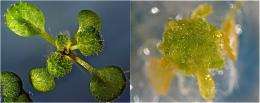
Arabidopsis plants grown without plant hormones. Compared to the wild-type plants (left) those over expressing WIND1 (right) can exhibit a range of developmental abnormalities including dedifferentiated callus-like cells masses instead of roots and shoots. Credit: Akira Iwase and Keiko Sugimoto
Many animals and plants regenerate tissues or even whole organs after injury. Typically, specialized cells at the wound site revert to a pluripotent statevia a process called dedifferentiationwhich means they regain the ability to develop into the various cell types required for regeneration. The dedifferentiated cells rapidly divide to form a callus from which the damaged tissue or organ will regenerate. Now, a research team from the RIKEN Plant Science Center in Yokohama has identified a master regulator of the response of plants to injury.
Developmental biologists have evidence that the mammalian wound response is genetically programmed, involving transcription factorsproteins that regulate gene expression. However, the precise molecular mechanisms underlying the cell dedifferentiation and redifferentiation are poorly understood for both animals and plants, explains team leader Keiko Sugimoto.
Akira Iwase, a senior postdoctoral researcher in Sugimotos laboratory, previously identified the transcription factor WIND1 that was expressed in cultured Arabidopsis cells but not in healthy seedlings. His findings suggested that WIND1 might be involved in the wound response. Using transgenic seedlings, Iwase along with Sugimoto and their colleagues have now demonstrated that WIND1 expression increases markedly at wound sites within hours of injury and continues throughout callus development.
Iwase, Sugimoto and colleagues further showed that Arabidopsis seedlings that were genetically engineered to over express WIND1 exhibited a range of developmental abnormalities (Fig. 1). They found that the most severe defects were associated with particularly high levels of WIND1 expression. These included aborted development after germination and the growth of undifferentiated callus-like cell masses at the places where roots or shoots would normally form.
In addition, the researchers found that the callus-like cell masses continued to proliferate rapidly when removed from the plant and grown in culture. This occurred even in the absence in the culture medium of auxin and cytokinin, two plant hormones long known to be involved in the normal regeneration process. Further experiments also confirmed the importance of WIND1 in callus formation in vivo.
The researchers then investigated the mode of action of WIND1. They found that wounding induced a cytokinin response involving increased expression of the so-called B-type Arabidopsis response regulator (ARR). Further experiments confirmed that WIND1 acts via the ARR-dependent signaling pathway to promote cell dedifferentiation.
Our findings clearly demonstrate that WIND1 functions as a key molecular switch triggering cell dedifferentiation in Arabidopsis, explains Sugimoto. The discovery of WIND1 should allow us to establish specific role of transcriptional regulators in cell dedifferentiation.
More information: Iwase, A., et al. The AP2/ERF transcription factor WIND1 controls cell dedifferentiation in Arabidopsis. Current Biology 21, 508514 (2011)
Provided by
RIKEN
-
From lemons to lemonade: Reaction uses carbon dioxide to make carbon-based semiconductor,
32 comments
-
Thioridazine kills cancer stem cells in human while avoiding toxic side-effects of conventional cancer treatments,
3 comments
-
SpaceX private rocket blasts off for space station (Update),
42 comments
-
Climate scientists say they have solved riddle of rising sea,
31 comments
-
Research team claims to have found evidence Lake Cheko is impact crater for Tunguska Event,
18 comments
-
What would stain as translucent on light-coloured fabric?
13 hours ago
-
How do I identify different bacteria on culture plates?
23 hours ago
-
Why Do Dogs do Strange things...
May 25, 2012
-
What does exophillic and endophillic mean in terms of mosquito and their control?
May 24, 2012
-
Semen stains glows under black lights (uv light)?
May 23, 2012
-
Question on Human Chromosome 2
May 23, 2012
- More from Physics Forums - Biology
More news stories
Scientist: Evolution debate will soon be history
(AP) -- Richard Leakey predicts skepticism over evolution will soon be history. Not that the avowed atheist has any doubts himself.
12 hours ago |
3.5 / 5 (11) |
30
Thousands of shellfish found dead in Peru
Thousands of crustaceans were found dead off the coast of Lima following the mystery mass death of dolphins and pelicans, the Peruvian Navy said Friday.
22 hours ago |
4.8 / 5 (4) |
7
More plant species responding to global warming than previously thought
(Phys.org) -- Far more wild plant species may be responding to global warming than previous large-scale estimates have suggested.
May 22, 2012 |
4.6 / 5 (14) |
18
|
For monogamous sparrows, it doesn't pay to stray (but they do it anyway)
It's quite common for a female song sparrow to stray from her breeding partner and mate with the male next door, but a new study shows that sleeping around can be costly.
May 22, 2012 |
5 / 5 (1) |
7
|
Study uncovers secret to speedy burrowing by razor clams
(Phys.org) -- If you look at a razor burrowing clam sitting in a bucket, youd never guess that it could burrow itself down into the soil, much less do it with any speed. Razor clams look like fat straws, ...
Nvidia trumpets Tegra 3 phone design wins for 2012
(Phys.org) -- Nvidias competitive war paint has a name, Tegra 3. On the heels of Nvidia announcements about lowering costs of its Tegra 3 processors and Nvidia-enabled tablets running Android Ice Cream ...
Browser wars flare in mobile space
The browser wars are heating up again, but this time the fight is for dominance of the mobile Internet.
Dell tablet leak: 10.1-inch display, two-battery choice
(Phys.org) -- Headline after headline talks about vendors tablets in the wings as likely number-one contenders for the iPad. Such claims have justifiably been taken with a grain of salt, considering ...
SpotterRF debuts Radar Backpack Kit (w/ Video)
(Phys.org) -- SpotterRF has announced a special radar backpack kit designed to enhance situational awareness for soldiers on the ground. The company says its special radar is designed for warfighters as part ...
SpaceX capsule has 'new car' smell, astronauts say (Update)
SpaceX's Dragon cargo vessel smells like a new car, said astronauts at the International Space Station after opening the hatches Saturday following the spacecraft's landmark mission to the orbiting lab.
Australia hails surprise super-telescope decision
Australia has hailed a surprise decision giving it a role in a radio telescope project aimed at revolutionising astronomy, vowing to draw on its decades of experience in space science.
May 20, 2011
Rank: not rated yet