Most powerful millimeter-scale energy harvester generates electricity from vibrations
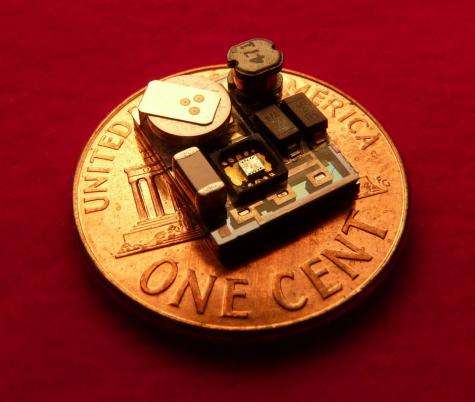
A new energy harvester developed by University of Michigan researchers can harness energy from vibrations and convert it to electricity with five to ten times greater efficiency and power than other devices in its class. Credit: Erkan Aktakka
(PhysOrg.com) -- Electrical engineers at the University of Michigan have built a device that can harness energy from vibrations and convert it to electricity with five to ten times greater efficiency and power than other devices in its class. And it's smaller than a penny.
"In a tiny amount of space, we've been able to make a device that generates more power for a given input than anything else out there on the market," said Khalil Najafi, one of the system's developers and chair of Electrical and Computer Engineering.
This new vibration energy harvester is specifically designed to turn the cyclic motions of factory machines into energy to power wireless sensor networks. These sensor networks monitor machines' performance and let operators know about any malfunctions.
The sensors that do this today get their power from a plug or a battery. They're considered "wireless" because they can transmit information without wires. Being tethered to a power source drastically increases their installation and maintenance costs, said Erkan Aktakka, one of the system's developers and a doctoral student in Electrical and Computer Engineering.
Long-lasting power is the greatest hurdle to large-scale use of pervasive information-gathering sensor networks, the researchers say.
"If one were to look at the ongoing life-cycle expenses of operating a wireless sensor, up to 80 percent of the total cost consists solely of installing and maintaining power wires and continuously monitoring, testing and replacing finite-life batteries," Aktakka said. "Scavenging the energy already present in the environment is an effective solution."
The researchers have built a complete system that integrates a high-quality energy-harvesting piezoelectric material with the circuitry that makes the power accessible. (Piezoelectric materials allow a charge to build up in them in response to mechanical strain, which in this case would be induced by the machines' vibrations.)
"There are lots of energy sources surrounding us. Lightning has a lot of electricity and power, but it's not useful," Najafi said. "To be able to use the energy you harvest you have to store it in a capacitor or battery. We've developed an integrated system with an ultracapacitor that does not need to start out charged."
The active part of the harvester that enables the energy conversion occupies just 27 cubic millimeters. The packaged system, which includes the power management circuitry, is in the size of a penny. The system has a large bandwidth of 14 Hertz and operates at a vibration frequency of 155 Hertz, similar to the vibration you'd feel if you put your hand on top of a running microwave oven.
"Most of the previous vibration harvesters operated either at very high frequencies or with very narrow bandwidths, and this limited their practical applications outside of a laboratory environment," Aktakka said.
The new harvester can generate more than 200 microwatts of power when it is exposed to 1.5g vibration amplitude. (1g is the gravitational acceleration that all objects experience by Earth's gravity.) The harvested energy is processed by an integrated circuitry to charge an ultracapacitor to 1.85 volts.
In theory, these devices could be left in place for 10 or 20 years without regular maintenance. "They have a limitless shelf time, since they do not require a pre-charged battery or an external power source," Aktakka said.
A novel silicon micromachining technique allows the engineers to fabricate the harvesters in bulk with a high-quality piezoelectric material, unlike other competing devices.
The market for power sources for wireless sensor networks in industrial settings is expected to reach $450 million by 2015, Aktakka said.
These new devices could have applications in medicine and the auto industry too. They could possibly be used to power medical implants in people or heat sensors on vehicle motors, Najafi said.
The researchers will present this work next at the 16th International Conference on Solid-State Sensors, Actuators, and Microsystems (TRANSDUCERS 2011) in Beijing in June.
Provided by
University of Michigan
-
From lemons to lemonade: Reaction uses carbon dioxide to make carbon-based semiconductor,
32 comments
-
Thioridazine kills cancer stem cells in human while avoiding toxic side-effects of conventional cancer treatments,
3 comments
-
SpaceX private rocket blasts off for space station (Update),
42 comments
-
Climate scientists say they have solved riddle of rising sea,
30 comments
-
Research team claims to have found evidence Lake Cheko is impact crater for Tunguska Event,
18 comments
-
Need a rigid insulation material???
7 hours ago
-
magnets or EMF in car bumpers to protect from fender bender
23 hours ago
-
length of wire in a coil of known dimensions?
May 25, 2012
-
India Engineering Powerhouse
May 25, 2012
-
electromagnet core dereference between hard and soft iron
May 25, 2012
-
Measuring water pressure in an open tank
May 24, 2012
- More from Physics Forums - General Engineering
More news stories
SpotterRF debuts Radar Backpack Kit (w/ Video)
(Phys.org) -- SpotterRF has announced a special radar backpack kit designed to enhance situational awareness for soldiers on the ground. The company says its special radar is designed for warfighters as part ...
Probability of contamination from severe nuclear reactor accidents is higher than expected: study
Catastrophic nuclear accidents such as the core meltdowns in Chernobyl and Fukushima are more likely to happen than previously assumed. Based on the operating hours of all civil nuclear reactors and the number ...
Technology / Energy & Green Tech
May 22, 2012 |
3.6 / 5 (21) |
56
|
Delphi gasoline-injection engine technique rivals hybrid's edge
(Phys.org) -- Running a diesel like engine on gasoline is something Delphi is doing in notable fashion. They claim they are on to a promising way to enjoy an engine that gives the vehicle owner high efficiency ...
HyperSolar shows dirty water no barrier to power world
(Phys.org) -- The Santa Barbara, California, company, HyperSolar, is set to transparently share the ups and downs of its research experiences toward the companys ultimate vision, successfully producing ...
Tesla to launch electric sedan in US on June 22
Tesla Motors said Tuesday it would begin deliveries of "the world's first premium electric sedan" on June 22, slightly ahead of schedule.
Technology / Energy & Green Tech
May 22, 2012 |
4.5 / 5 (11) |
18
Scientist: Evolution debate will soon be history
(AP) -- Richard Leakey predicts skepticism over evolution will soon be history. Not that the avowed atheist has any doubts himself.
Dell tablet leak: 10.1-inch display, two-battery choice
(Phys.org) -- Headline after headline talks about vendors tablets in the wings as likely number-one contenders for the iPad. Such claims have justifiably been taken with a grain of salt, considering ...
SpaceX capsule has 'new car' smell, astronauts say (Update)
SpaceX's Dragon cargo vessel smells like a new car, said astronauts at the International Space Station after opening the hatches Saturday following the spacecraft's landmark mission to the orbiting lab.
Thousands of shellfish found dead in Peru
Thousands of crustaceans were found dead off the coast of Lima following the mystery mass death of dolphins and pelicans, the Peruvian Navy said Friday.
Astronomers seize last chance in lifetime for Venus Transit
Astronomers are gearing for one the rarest events in the Solar System: an alignment of Earth, Venus and the Sun that will not be seen for another 105 years.
Australia hails surprise super-telescope decision
Australia has hailed a surprise decision giving it a role in a radio telescope project aimed at revolutionising astronomy, vowing to draw on its decades of experience in space science.
Apr 26, 2011
Rank: 4 / 5 (1)
Apr 26, 2011
Rank: not rated yet
Uri Geller glued spoons to his car..
Apr 26, 2011
Rank: not rated yet
Apr 26, 2011
Rank: not rated yet
Apr 26, 2011
Rank: not rated yet
Apr 26, 2011
Rank: 5 / 5 (1)
And the spam is gone.. But your comments are not. Just ignore span and let the moderators do their job. Flood control is in place now too so lighten up.
(!)