Nanopolymer shows promise for helping reduce cancer side effects
Apr 05, 2011 by Brian Wallheimer
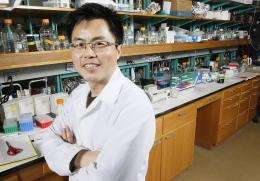
W. Andy Tao's nanopolymers can better assess whether cancer drugs are reaching their targets, a development that may reduce the side effects of those drugs. (Purdue Agricultural Communication photo/Tom Campbell)

(PhysOrg.com) -- A Purdue University biochemist has demonstrated a process using nanotechnology to better assess whether cancer drugs hit their targets, which may help reduce drug side effects.

W. Andy Tao, an associate professor of biochemistry , developed a nanopolymer that can be coated with drugs, enter cells and then removed to determine which proteins in the cells the drug has entered. Since they're water-soluble, Tao believes the nanopolymers also may be a better delivery system for drugs that do not dissolve in water effectively.

"Many cancer drugs are not very specific. They target many different proteins," said Tao, whose findings were published in the early online in the journal Agnewandte Chemie International Edition. "That can have a consequence - what we call side effects."

In addition to the drug, the synthetic nanopolymer is equipped with a chemical group that is reactive to small beads. The beads retrieve the nanopolymer and any attached proteins after the drug has done its work. Tao uses to determine which proteins are present and have been targeted by the drug.

Knowing which proteins are targeted would allow drug developers to test whether target only desired proteins or others as well. Eliminating unintended targets could reduce the often-serious side effects associated with .

Tao said there currently is no reliable way to test drugs for off-targeting. He said drugs are often designed to inhibit or activate the function of a biomolecule associated with cancer, but those drugs tend to fail in late-stage clinical tests.

Tao also believes his nanopolymers could better deliver drugs to their targets. Since they are nanosized and water soluble, the nanopolymers could gain access to cells more effectively than a standalone drug that is only minimally water-soluble.

Tao demonstrated the nanopolymer's abilities using human cancer cells and the drug methotrexate. The nanopolymers were tracked using a fluorescent dye to show they were entering cells. Then, Tao broke the cells and retrieved the nanopolymers.

Tao has shown the nanopolymer's ability using a metabolic drug, which are small, low-cost drugs but are less target specific and have more side-effects. He now plans to do the same using drugs that are based on synthetic peptides, which are larger and more expensive but more specific and with fewer side effects.

Explore further: Single-cell transfection tool enables added control for biological studies

Related Stories

New Way To Predict Drug Side Effects

Nov 11, 2009

Predicting the side-effects of a drug is not simple task. The human body has more than 1,500 molecules that are known to be involved in various diseases, and often a drug designed to hit one of these targets will also hit ...

New 'bubble' targets only cancer cells

Feb 19, 2009

For millions of Americans with cancer, the side effects of chemotherapy and other treatment drugs can be devastating. But new drug-delivery research based on nano- and microtechnology from Tel Aviv University might provide ...

Teaching old drugs new tricks

Jul 10, 2008

Researchers from the European Molecular Biology Laboratory discovered a new way to make use of drugs' unwanted side effects. They developed a computational method that compares how similar the side effects of different drugs ...

Recommended for you

Radioactive nanoparticles target cancer cells

7 hours ago

Cancers of all types become most deadly when they metastasize and spread tumors throughout the body. Once cancer has reached this stage, it becomes very difficult for doctors to locate and treat the numerous tumors that can ...

How gold nanoparticles can help fight ovarian cancer

8 hours ago

Positively charged gold nanoparticles are usually toxic to cells, but cancer cells somehow manage to avoid nanoparticle toxicity. Mayo Clinic researchers found out why, and determined how to make the nanoparticles effective ...

Advance in nanotech gene sequencing technique

May 20, 2013

(Phys.org) —The allure of personalized medicine has made new, more efficient ways of sequencing genes a top research priority. One promising technique involves reading DNA bases using changes in electrical ...

User comments : 0

More news stories

How gold nanoparticles can help fight ovarian cancer

Positively charged gold nanoparticles are usually toxic to cells, but cancer cells somehow manage to avoid nanoparticle toxicity. Mayo Clinic researchers found out why, and determined how to make the nanoparticles effective ...

Radioactive nanoparticles target cancer cells

Cancers of all types become most deadly when they metastasize and spread tumors throughout the body. Once cancer has reached this stage, it becomes very difficult for doctors to locate and treat the numerous tumors that can ...

If you can remember it, you can remember it wrong

(Medical Xpress)—Native peoples in regions where cameras are uncommon sometimes react with caution when their picture is taken. The fear that something must have been stolen from them to create the photo ...

B vitamins could delay dementia

(Medical Xpress)—Despite spending billions of dollars on research and development, drug companies have been unable to come up with effective treatments for dementia and Alzheimer's Disease (AD). Now, A. ...

Reducing caloric intake delays nerve cell loss

Activating an enzyme known to play a role in the anti-aging benefits of calorie restriction delays the loss of brain cells and preserves cognitive function in mice, according to a study published in the May ...