On the way to hydrogen storage?
April 19, 2011

On the way to hydrogen storage?

(PhysOrg.com) -- The car of the future could be propelled by a fuel cell powered with hydrogen. But what will the fuel tank look like? Hydrogen gas is not only explosive but also very space-consuming. Storage in the form of very dense solid metal hydrides is a particularly safe alternative that accommodates the gas in a manageable volume. As the storage tank should also not be too heavy and expensive, solid-state chemists worldwide focus on hydrides containing light and abundant metals like magnesium.

Sjoerd Harder and his co-workers at the Universities of Groningen (Netherlands) and Duisburg-Essen (Germany) now take the molecular approach. As the researchers report in the journal Angewandte Chemie, extremely small clusters of molecular magnesium hydride could be a useful model substance for more precise studies about the processes involved in hydrogen storage.

Magnesium hydride (MgH2) can release hydrogen when needed and the resulting magnesium metal reacts back again to form the hydride by pressurizing with hydrogen at a "gas station". Unfortunately, this is an idealized picture. Not only is the speed of hydrogen release/uptake excessively slow (kinetics) but it also only operates at higher temperatures (). The hydrides, the negatively charged (H-), are bound so strongly in the of magnesium cations (Mg2+) that temperatures of more than 300 ˚C are needed to release the .

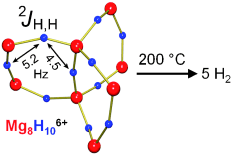
Particularly intensive milling has made it possible to obtain nanocrystalline materials, which, on account of its larger surface, rapidly release or take up hydrogen. However, the high stability of the magnesium hydride still translates to rather high release temperatures. According to recent computer calculations, magnesium hydride clusters of only a few atoms possibly could generate hydrogen at temperatures far below 300 °C. Clusters with less than 20 Mg2+ ions are smaller than one nanometer and behave differently from the bulk material. Their hydride ions have fewer Mg2+ neighbors and are more weakly bound. However, it is extremely difficult to obtain such tiny clusters by milling. In Harder's "bottom-up" approach, magnesium hydride clusters are made by starting from molecules. The challenge is to prevent such clusters from forming very stable bulk material. Using a special ligand system, they could trap a cluster that resembles a paddle wheel made of eight Mg2+ and ten H- ions. For the first time it was shown that molecular clusters indeed release hydrogen already at the temperature of 200 °C.

This largest magnesium hydride cluster reported to date is not practical for efficient hydrogen storage but shines new light on a current problem. It is easily studied by molecular methods and as a model system could provide detailed insights in .

More information: Sjoerd Harder, Hydrogen Storage in Magnesium Hydride: The Molecular Approach, Angewandte Chemie International Edition 2011, 50, No. 18, 4156–4160, http://dx.doi.org/ … ie.201101153

Provided by Wiley search and more info website

3.8 /5 (8 votes)  

Filter


Move the slider to adjust rank threshold, so that you can hide some of the comments.


Display comments: newest first

flying_finn
Apr 20, 2011

Rank: 1 / 5 (1)
What ever happened to dried hydrogen pellets? It was featured in Popular Mechanics years ago.
wwqq
Apr 26, 2011

Rank: 5 / 5 (1)
The best hydrogen storage possible to ever device, which is attaching the hydrogen to carbon atoms, is already known and in widespread use.

The easiest and cheapest, by far, way to make hydrogen is to dig hydrocarbons out of the ground and use gasification and the water gas shift reaction to turn it into hydrogen gas and carbon dioxide.

Hydrogen makes little sense in a post-carbon world. The longer we cling to hydrogen, the longer we'll cling to fossil fuels. We're going to use fossil fuels for quite some time, but lets at least skip the pretense.
ZephirAWT
Apr 26, 2011

Rank: 1 / 5 (1)
I hope, the progress in cold fusion will eliminate hydrogen based economy faster, then in could establish itself in the industry.

http://newenergya...rmation/
Rank 3.8 /5 (8 votes)
Relevant PhysicsForums posts
  • Schwartz reagent-- NMR/MS/IR
    created18 hours ago
  • High school chemistry EEI
    createdMay 25, 2012
  • oxidation of I- by KMnO4
    createdMay 25, 2012
  • Inversion temp
    createdMay 25, 2012
  • Hybridization of SnCl3 -
    createdMay 25, 2012
  • Electrons And Radiation
    createdMay 25, 2012
  • More from Physics Forums - Chemistry

More news stories

From lemons to lemonade: Reaction uses carbon dioxide to make carbon-based semiconductor

(Phys.org) -- A materials scientist at Michigan Technological University has discovered a chemical reaction that not only eats up the greenhouse gas carbon dioxide, it also creates something useful. And, by ...

Chemistry / Materials Science

created May 21, 2012 | popularity 4.7 / 5 (88) | comments 32 | with audio podcast

New CO2-removing catalyst can take the heat

(Phys.org) -- The current method of removing the greenhouse gas carbon dioxide (CO2) from the flues of coal-fired power plants uses so much energy that no one bothers to use it. So says Roger Aines, principal ...

Chemistry / Materials Science

created May 24, 2012 | popularity 5 / 5 (7) | comments 7 | with audio podcast

High-speed method to aid search for solar energy storage catalysts

Eons ago, nature solved the problem of converting solar energy to fuels by inventing the process of photosynthesis.

Chemistry / Materials Science

created May 25, 2012 | popularity 5 / 5 (3) | comments 4 | with audio podcast

Researchers demonstrate possible primitive mechanism of chemical info self-replication

(Phys.org) -- When scientists think about the replication of information in chemistry, they usually have in mind something akin to what happens in living organisms when DNA gets copied: a double-stranded molecule ...

Chemistry / Materials Science

created May 25, 2012 | popularity 5 / 5 (4) | comments 2 | with audio podcast

Castor oil: Action mechanism of one of the oldest drugs known to man elucidated

Castor oil is known primarily as an effective laxative; however, it was also used in ancient times with pregnant women to induce labour. Only now have scientists at the Max Planck Institute for Heart and Lung ...

Chemistry / Biochemistry

created May 21, 2012 | popularity 3 / 5 (2) | comments 3 | with audio podcast


Scientist: Evolution debate will soon be history

(AP) -- Richard Leakey predicts skepticism over evolution will soon be history. Not that the avowed atheist has any doubts himself.

Dell tablet leak: 10.1-inch display, two-battery choice

(Phys.org) -- Headline after headline talks about vendors’ tablets in the wings as likely number-one contenders for the iPad. Such claims have justifiably been taken with a grain of salt, considering ...

SpotterRF debuts Radar Backpack Kit (w/ Video)

(Phys.org) -- SpotterRF has announced a special radar backpack kit designed to enhance situational awareness for soldiers on the ground. The company says its special radar is designed for warfighters as part ...

SpaceX capsule has 'new car' smell, astronauts say (Update)

SpaceX's Dragon cargo vessel smells like a new car, said astronauts at the International Space Station after opening the hatches Saturday following the spacecraft's landmark mission to the orbiting lab.

Thousands of shellfish found dead in Peru

Thousands of crustaceans were found dead off the coast of Lima following the mystery mass death of dolphins and pelicans, the Peruvian Navy said Friday.

Astronomers seize last chance in lifetime for Venus Transit

Astronomers are gearing for one the rarest events in the Solar System: an alignment of Earth, Venus and the Sun that will not be seen for another 105 years.