Putting a fuel cell 'in your pocket'
April 15, 2011 by Pete Wilton

Putting a fuel cell 'in your pocket'

Enlarge

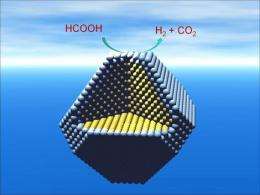
The core-shell particle (palladium atoms on a silver nanoparticle).

(PhysOrg.com) -- Technology using catalysts which make hydrogen from formic acid could eventually replace lithium batteries and power a host of mobile devices.

Edman Tsang of Oxford University’s Department of Chemistry and colleagues are developing new catalysts which can produce at room temperature without the need for solvents or additives.

Their initial results, reported in a recent paper in Nature Nanotechnology, are promising and suggest that a hydrogen in your pocket might not be that far away.

The new approach involves placing a single atomic layer of palladium atoms onto silver nanoparticles. ‘The structural and electronic effects from the underlying silver greatly enhance the catalytic properties of palladium, giving impressive activity for the conversion of formic acid to hydrogen and carbon dioxide at room temperature,’ Edman told us.

He explains that the storage and handling of organic liquids, such as , is much easier and safer than storing hydrogen. The catalysts would enable the production of hydrogen from liquid fuel stored in a disposable or recycled cartridge, creating miniature fuel cells to power everything from mobile phones to laptops.

Another advantage of the new technology is that the gas stream generated from the reaction is mainly composed of hydrogen and carbon dioxide but virtually free from catalyst-poisoning carbon monoxide; removing the need for clean-up processes and extending the life of the fuel cells.

The chemists have worked closely with George Smith, Paul Bagot and co-workers at Oxford University’s Department of Materials to characterise the catalysts using atom probe tomography. The underlying technology is the subject of a recent Isis Innovation patent application.

‘There are lots of hurdles before you can get a real device, but we are looking at the possibility of using this new technology to replace battery technology with an alternative which has a longer lifespan and has less impact on the environment,’ explains Edman.

More information: http://www.nature. … 2011.42.html

Provided by Oxford University search and more info website

Filter


Move the slider to adjust rank threshold, so that you can hide some of the comments.


Display comments: newest first

rgwalther
Apr 15, 2011

Rank: 5 / 5 (1)
If Mae West were alive today;
"Is that a fuel cell in your pocket, or are you just glad to see me?"
Eikka
Apr 15, 2011

Rank: 5 / 5 (1)
Right, but isn't formic acid kinda dangerous anyways if you have to have it in high concentrations? Liver and kidney damage, allergic reactions and blindness etc.

After all, it has only 4.3% of its weight in hydrogen. If you dilute it to levels where it's merely an "irritant", you still have to carry around a kilogram of liquid for the same amount of power that you'd get out of a kilogram of laptop batteries today.
kaasinees
Apr 15, 2011

Rank: 2 / 5 (2)
Like current batteries are not bad for your health?
stealthc
Apr 15, 2011

Rank: not rated yet
education, not just for the good of the community but owned and operated by huge conglomerate corporations. Of course they are getting a patent, no need for us to have education institutions that discover things for the public domain.
Skepticus
Apr 15, 2011

Rank: not rated yet
My nose starts bleeding when i come to the "paladium catalyst". No wonder the Chinese are hoarding rare earths. Their researchers must be going full steam on probable imminent major discoveries.
EWH
Apr 16, 2011

Rank: not rated yet
My nose starts bleeding when i come to the "paladium catalyst". No wonder the Chinese are hoarding rare earths. Their researchers must be going full steam on probable imminent major discoveries.


Palladium is a platinum group metal, not a rare earth. PGMs are commonly used in catalysts (of huge economic importance) and tend to be much, much more expensive than rare earths (which despite the name aren't all that rare). Improving catalysts is just about the most potentially profitable area of research there is, with payoffs in production of plastics, drugs, specialty chemicals as well as energy.
Norezar
Apr 16, 2011

Rank: 5 / 5 (1)
If Mae West were alive today;
"Is that a fuel cell in your pocket, or are you just glad to see me?"


...I came here just to post this.
saladdin
Apr 16, 2011

Rank: not rated yet
Portable fuel sources will be part of the human future,now weather we decide on "the electric automobile or the one that burns that cheap slug out back in the pond". Is entirely up to us.
fixer
Apr 16, 2011

Rank: not rated yet
Formic acid?
An ant powered fuel cell now!
Yeah right...
Eikka
Apr 17, 2011

Rank: not rated yet
Like current batteries are not bad for your health?


But they're sealed units. You don't have to put in new chemicals, so you don't have the risk of handling them.
rgwalther
Apr 18, 2011

Rank: not rated yet
Like current batteries are not bad for your health?


The batteries or the current?
nanoman
May 02, 2011

Rank: not rated yet
you know i think this could be kinda dangerous cuz isnt acid really hurtful or something? y dont u find a way to not use acid?
Ramael
May 13, 2011

Rank: not rated yet
Doesn't this still release co2 when the formic acid is converted to hydrogen? Whats the point of clean energy if its not clean?
Rank 4 /5 (13 votes)
Relevant PhysicsForums posts
  • microstructure of titanium
    created12 hours ago
  • Steam in My Espresso Machine
    created18 hours ago
  • Density question
    createdMay 24, 2012
  • Mass transport originating from a point source at a solid gas interface
    createdMay 22, 2012
  • Ammonia dispersion in Air
    createdMay 22, 2012
  • Multi Choice Help
    createdMay 21, 2012
  • More from Physics Forums - Materials & Chemical Engineering

More news stories

Dopant gives graphene solar cells highest efficiency yet

(Phys.org) -- By taking advantage of graphene’s favorable electrical and optical properties, and then adding an organic dopant, researchers have achieved the highest power conversion efficiency yet for ...

Nanotechnology / Nanophysics

created May 21, 2012 | popularity 5 / 5 (10) | comments 14 | with audio podcast feature

Nanomedicine: Quantum dots appear safe in pioneering study on primates

A pioneering study to gauge the toxicity of quantum dots in primates has found the tiny crystals to be safe over a one-year period, a hopeful outcome for doctors and scientists seeking new ways to battle diseases ...

Nanotechnology / Bio & Medicine

created May 20, 2012 | popularity 4.3 / 5 (3) | comments 8 | with audio podcast

In nanorod crystal growth, nanoparticles seen as artificial atoms

In the growth of crystals, do nanoparticles act as "artificial atoms" forming molecular-type building blocks that can assemble into complex structures? This is the contention of a major but controversial theory ...

Nanotechnology / Nanophysics

created May 24, 2012 | popularity 4.8 / 5 (6) | comments 0 | with audio podcast

First direct observation of oriented attachment in nanocrystal growth

Berkeley Lab researchers have reported the first direct observation of nanoparticles undergoing oriented attachment, the critical step in biomineralization and the growth of nanocrystals. A better understanding ...

Nanotechnology / Nanophysics

created May 24, 2012 | popularity 4.7 / 5 (3) | comments 0 | with audio podcast

Synthetic nano-waste does not disappear

(Phys.org) -- Tiny particles of cerium oxide do not burn or change in the heat of a waste incineration plant. They remain intact on combustion residues or in the incineration system, as a new study by Swiss ...

Nanotechnology / Bio & Medicine

created May 25, 2012 | popularity 5 / 5 (2) | comments 1 | with audio podcast


Scientist: Evolution debate will soon be history

(AP) -- Richard Leakey predicts skepticism over evolution will soon be history. Not that the avowed atheist has any doubts himself.

Dell tablet leak: 10.1-inch display, two-battery choice

(Phys.org) -- Headline after headline talks about vendors’ tablets in the wings as likely number-one contenders for the iPad. Such claims have justifiably been taken with a grain of salt, considering ...

SpotterRF debuts Radar Backpack Kit (w/ Video)

(Phys.org) -- SpotterRF has announced a special radar backpack kit designed to enhance situational awareness for soldiers on the ground. The company says its special radar is designed for warfighters as part ...

SpaceX capsule has 'new car' smell, astronauts say (Update)

SpaceX's Dragon cargo vessel smells like a new car, said astronauts at the International Space Station after opening the hatches Saturday following the spacecraft's landmark mission to the orbiting lab.

Thousands of shellfish found dead in Peru

Thousands of crustaceans were found dead off the coast of Lima following the mystery mass death of dolphins and pelicans, the Peruvian Navy said Friday.

Astronomers seize last chance in lifetime for Venus Transit

Astronomers are gearing for one the rarest events in the Solar System: an alignment of Earth, Venus and the Sun that will not be seen for another 105 years.