Researchers urge more prominent role for zoos
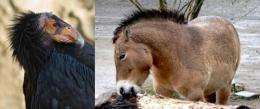
Two examples of the success of captive breeding in supporting species protection: the Asiatic wild horse (Przewalskis horse) and the Californian condor, both whose risk status has been downgraded thanks to breeding at zoos. Credit: Wikipedia Chuck Szmurlo / BS Thurner Hof
Of around seven land vertebrate species whose survival in the wild is threatened one is also kept in captivity. These and other data on the protection of species in zoos and aquaria have now been revealed by scientists at the Max Planck Institute for Demographic Research (MPIDR) in Rostock. Writing in the journal Science, the team of researchers and the International Species Information System (ISIS) advocate the establishment of targeted captive breeding programmes to supplement the protection of animals in the wild. To do this, zoos should team up in networks and shelter these animals, as a form of life insurance, until they can be released back into the wild.
The researchers used data from the International Species Information System (ISIS) to calculate how many of the endangered species can already be found at zoological gardens: 20 to 25 percent of all endangered mammal species are kept at zoos. The overall figure for birds is only slightly less than that, but is much lower for avian species that are acutely at risk of extinction: only nine percent of these are found in captivity. Only three percent of endangered amphibian species are kept in captivity.
The role of zoos for species conservation must not be underestimated, Dalia Conde and Alexander Scheuerlein have stressed. "While it is true that the number of endangered species and individual animals at any one zoo is small", say the biologists, who conduct their research at the MPIDR's Laboratory of Evolutionary Biodemography, "if several institutions link up, zoological gardens will have a considerable collective potential to breed endangered animal species."
Specialist zoos for greater breeding success
The Science authors advocate the establishment of "specialist zoos" that concentrate on breeding just one or a small number of species: "Specialisation generally increases breeding success", say Conde and Scheuerlein. "The animals can be 'parked' at these zoos until they have a chance of survival in the natural environment and can then be returned to the wild." Nate Flesness, who is the scientific director of largest data holdings of zoos (ISIS), and is also co-author of the paper stressed hat it also makes a lot of sense to include animals in breeding programmes at an early stage, before their stocks in the wild decline too much. "Zoos should not be regarded as a last-resort emergency ward, because the chances of successful breeding are decreased if the last surviving, weakened individuals of a species need to be used for this purpose."
Recently, the International Union for Conservation of Nature (IUCN) has also determined how successful captive breeding is at supporting species protection: breeding at zoos has played a key role in 17 of the 68 vertebrate species whose risk status has now been downgraded by the organisation. Examples of these success stories include the Asiatic wild horse (Przewalski's horse), the black-footed ferret (a member of the mustelid family) and the Californian condor.
Breeding programmes at zoos also deliver new demographic data which are useful in species conservation: When is the onset of sexual maturity in an animal species? What is its litter or clutch size? At what intervals does a species reproduce? "Such fundamental data on their demographic development are unknown for many species", say Dalia Conde and Alexander Scheuerlein. "However, they are urgently needed to allow us to estimate the future fate of a species and its chances of survival in the wild".
Provided by
Max-Planck-Gesellschaft
-
From lemons to lemonade: Reaction uses carbon dioxide to make carbon-based semiconductor,
32 comments
-
Thioridazine kills cancer stem cells in human while avoiding toxic side-effects of conventional cancer treatments,
3 comments
-
SpaceX private rocket blasts off for space station (Update),
42 comments
-
Climate scientists say they have solved riddle of rising sea,
30 comments
-
Research team claims to have found evidence Lake Cheko is impact crater for Tunguska Event,
18 comments
-
What would stain as translucent on light-coloured fabric?
9 hours ago
-
How do I identify different bacteria on culture plates?
19 hours ago
-
Why Do Dogs do Strange things...
May 25, 2012
-
What does exophillic and endophillic mean in terms of mosquito and their control?
May 24, 2012
-
Semen stains glows under black lights (uv light)?
May 23, 2012
-
Question on Human Chromosome 2
May 23, 2012
- More from Physics Forums - Biology
More news stories
Scientist: Evolution debate will soon be history
(AP) -- Richard Leakey predicts skepticism over evolution will soon be history. Not that the avowed atheist has any doubts himself.
8 hours ago |
3.4 / 5 (8) |
21
Thousands of shellfish found dead in Peru
Thousands of crustaceans were found dead off the coast of Lima following the mystery mass death of dolphins and pelicans, the Peruvian Navy said Friday.
18 hours ago |
4.8 / 5 (4) |
6
More plant species responding to global warming than previously thought
(Phys.org) -- Far more wild plant species may be responding to global warming than previous large-scale estimates have suggested.
May 22, 2012 |
4.6 / 5 (14) |
18
|
Totally rad: Scientists create rewritable digital data storage in DNA
(Phys.org) -- Scientists from Stanford's Department of Bioengineering have devised a method for repeatedly encoding, storing and erasing digital data within the DNA of living cells.
May 21, 2012 |
4.9 / 5 (17) |
11
|
For monogamous sparrows, it doesn't pay to stray (but they do it anyway)
It's quite common for a female song sparrow to stray from her breeding partner and mate with the male next door, but a new study shows that sleeping around can be costly.
May 22, 2012 |
5 / 5 (1) |
7
|
Dell tablet leak: 10.1-inch display, two-battery choice
(Phys.org) -- Headline after headline talks about vendors tablets in the wings as likely number-one contenders for the iPad. Such claims have justifiably been taken with a grain of salt, considering ...
SpotterRF debuts Radar Backpack Kit (w/ Video)
(Phys.org) -- SpotterRF has announced a special radar backpack kit designed to enhance situational awareness for soldiers on the ground. The company says its special radar is designed for warfighters as part ...
SpaceX capsule has 'new car' smell, astronauts say (Update)
SpaceX's Dragon cargo vessel smells like a new car, said astronauts at the International Space Station after opening the hatches Saturday following the spacecraft's landmark mission to the orbiting lab.
Astronomers seize last chance in lifetime for Venus Transit
Astronomers are gearing for one the rarest events in the Solar System: an alignment of Earth, Venus and the Sun that will not be seen for another 105 years.
Keep food safety in mind this memorial day weekend
(HealthDay) -- Picnics, parades and cookouts are as much a part of Memorial Day weekend as tributes to the United States' war veterans.
Australia hails surprise super-telescope decision
Australia has hailed a surprise decision giving it a role in a radio telescope project aimed at revolutionising astronomy, vowing to draw on its decades of experience in space science.