Mapping human vulnerability to climate change
March 3, 2011

Mapping human vulnerability to climate change

Enlarge

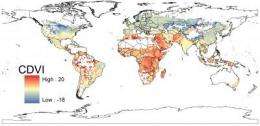
Local vulnerability of human populations to climate change based on ecological and demographic models. The regions in red are expected to be most negatively impacted by climate change. White regions correspond to human density values of zero in the global population database. Credit: Jason Samson

(PhysOrg.com) -- Researchers already study how various species of plants and animals migrate in response to climate change. Now, Jason Samson, a PhD candidate in McGill University's Department of Natural Resource Sciences, has taken the innovative step of using the same analytic tools to measure the impact of climate change on human populations. Samson and fellow researchers combined climate change data with censuses covering close to 97 per-cent of the world's population in order to forecast potential changes in local populations for 2050.

Samson's team found that if populations continue to increase at the expected rates, those who are likely to be the most vulnerable to climate change are the people living in low-latitude, hot regions of the world, places like central South America, the Arabian Peninsula and much of Africa. In these areas, a relatively small increase in temperature will have serious consequences on a region's ability to sustain a growing population."It makes sense that the low latitude tropical regions should be more vulnerable because the people there already experience extremely hot conditions which make agriculture challenging. An increase in temperature over the next few decades will only make their lives more difficult in a variety of ways," says Samson.

This contrasts with Samson's predictions about the impact of climate change on in the high-latitude more temperate zones of the world, where the is expected to be greater. Because the spread of human populations along with their activities are already more constrained by the cooler conditions in these regions, the researchers expect that climate change will have less of an impact on people living in these areas.

The study also points to clear inequities in the causes and consequences of climate change: the countries that have contributed the least to climate change, based on their average per-capita , are nevertheless predicted to be the most vulnerable to its impacts. "Take Somalia for instance," suggests Samson."Because it's so hot there, it's already very difficult to grow things, and it will only become more difficult if the temperature rises. It's also clear that Somalia is not a big contributor of greenhouse gas to the atmosphere. Now thanks to this map, we have concrete quantitative evidence of the disparity between the causes and the consequences of climate change at a national level."

Samson anticipates this data could be useful for decision makers around the world in the ongoing international negotiations around climate change.

More information: On online version of the article was recently published by the journal Global Ecology and Biogeography. For an abstract of the article: http://onlinelibra … 2.x/abstract

Provided by McGill University search and more info website

2.6 /5 (5 votes)  

Filter


Move the slider to adjust rank threshold, so that you can hide some of the comments.


Display comments: newest first

Modernmystic
Mar 03, 2011

Rank: 2 / 5 (5)
How about a map of where and how many people would benefit from a warmer climate?

The whole idea behind this map is a false zero sum game. According to it the best you can do is "break even" and "not be affected". BS...
Jimee
Mar 06, 2011

Rank: 1 / 5 (1)
The "not be affected" is measured how? The consequences will be visited upon us all, whether or not our particular corner of the planet happens to be adversely affected.
Howhot
Mar 09, 2011

Rank: 1 / 5 (1)
How about a map of where and how many people would benefit from a warmer climate?

Nawww, you don't want to know that. Rich folk might see it.
Rank 2.6 /5 (5 votes)
Relevant PhysicsForums posts

More news stories

SpaceX capsule has 'new car' smell, astronauts say (Update)

SpaceX's Dragon cargo vessel smells like a new car, said astronauts at the International Space Station after opening the hatches Saturday following the spacecraft's landmark mission to the orbiting lab.

Space & Earth / Space Exploration

created 15 hours ago | popularity 4.5 / 5 (19) | comments 0

Astronomers seize last chance in lifetime for Venus Transit

Astronomers are gearing for one the rarest events in the Solar System: an alignment of Earth, Venus and the Sun that will not be seen for another 105 years.

Space & Earth / Astronomy

created 15 hours ago | popularity 5 / 5 (2) | comments 2

Australia hails surprise super-telescope decision

Australia has hailed a surprise decision giving it a role in a radio telescope project aimed at revolutionising astronomy, vowing to draw on its decades of experience in space science.

Space & Earth / Astronomy

created 15 hours ago | popularity 5 / 5 (3) | comments 1

Astronauts enter world's 1st private supply ship

(AP) -- Space station astronauts floated into the Dragon on Saturday, a day after its heralded arrival as the world's first commercial supply ship.

Space & Earth / Space Exploration

created 15 hours ago | popularity 5 / 5 (5) | comments 0

Dragon arrives at space station in historic 1st (Update 2)

The privately bankrolled Dragon capsule made a historic arrival at the International Space Station on Friday, triumphantly captured by astronauts wielding a giant robot arm.

Space & Earth / Space Exploration

created May 25, 2012 | popularity 5 / 5 (10) | comments 19


Dell tablet leak: 10.1-inch display, two-battery choice

(Phys.org) -- Headline after headline talks about vendors’ tablets in the wings as likely number-one contenders for the iPad. Such claims have justifiably been taken with a grain of salt, considering ...

Scientist: Evolution debate will soon be history

(AP) -- Richard Leakey predicts skepticism over evolution will soon be history. Not that the avowed atheist has any doubts himself.

SpotterRF debuts Radar Backpack Kit (w/ Video)

(Phys.org) -- SpotterRF has announced a special radar backpack kit designed to enhance situational awareness for soldiers on the ground. The company says its special radar is designed for warfighters as part ...

Thousands of shellfish found dead in Peru

Thousands of crustaceans were found dead off the coast of Lima following the mystery mass death of dolphins and pelicans, the Peruvian Navy said Friday.

Keep food safety in mind this memorial day weekend

(HealthDay) -- Picnics, parades and cookouts are as much a part of Memorial Day weekend as tributes to the United States' war veterans.

Family history of Alzheimer's affects functional connectivity

(HealthDay) -- Cognitively normal individuals with a family history of late-onset Alzheimer's disease (AD) may display lower resting state functional connectivity in the default mode network (DMN) of the brain, ...