Positive ecological change could stem from invasive plants
A team of scientists has discovered that human-introduced, invasive species of plants can have positive ecological effects. Tomás Carlo, an assistant professor of biology at Penn State University, and Jason Gleditsch, a graduate student in the Department of Biology, have studied how invasive fruiting plants affect ecosystems and how those effects, contrary to prevailing ideas, sometimes can be beneficial to an ecological community. The team's research, which will be published in the journal Diversity and Distributions, is expected to affect the way environmental resource managers respond to ecosystem maintenance.
"Among conservation biologists, ecologists, and managers, the default approach is to try to eliminate and root out non-native, invasive shrubs -- anything that seems to change an ecosystem," Carlo said. "The fundamental goal is to return a natural area to its original, pristine state, with the native species occupying the dominant position in the community. But the problem is that most native communities already have been changed beyond recognition by humans, and many native species are now rare." Carlo explained that his team wanted to test whether certain well-established, invasive fruiting species have negative or positive effects on bird and fruiting-plant communities. "We wondered: Are we sometimes doing more harm than good when we eradicate plants that, despite being introduced recently, have formed positive relationships with native animals?" To be considered invasive, a species of plant must have been introduced by humans, and it must be dominant numerically in the new environment.
To test the impact of an invasive fruiting-plant species on native bird communities, Carlo and Gleditsch sectioned off an area of central Pennsylvania known as the Happy Valley region, where honeysuckle -- a non-native fruiting plant that is considered invasive -- grows in abundance. They then assessed the abundance of bird species and fruiting plants -- including honeysuckle -- within the area. After comparing their data with similar data from urban, agricultural, and forested areas, they determined that the abundance of honeysuckle predicted the numbers and diversity of birds within the region and even beyond the region. That is, the honeysuckle and bird communities had formed a relationship known as mutualism -- a term that describes how two or more species interact by benefiting mutually from each other's existence.
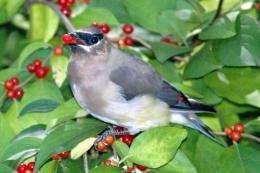
"The abundance of fruit-eating birds in the Happy Valley region is linked to the abundance of honeysuckle," Carlo explained. "Honeysuckle comprises more than half of all the fruits available in the landscape, and it benefits birds by providing them with a source of food in the fall. Meanwhile, birds benefit honeysuckle by dispersing the plant's seeds across a wider geographical area, helping the species to occupy more and more territory in areas already affected by human activities." Carlo explained that returning this particular ecosystem to its honeysuckle-free state could harm many species of native birds that now seem to rely on honeysuckle as a major food source in the fall.
The team also tested the honeysuckle's influence, not just on birds, but on other species of fruiting plants. First, they grew native fruiting plants known as American nightshades in pots in a greenhouse. When the fruits were ripe on each plant, they then placed them into both honeysuckle-dense areas and areas area without honeysuckle but dominated by other native and non-native fruiting species. "We chose the American nightshade because it is native and common in the Happy Valley region," Carlo said. "Also, it is easy to manipulate experimentally, and its fruits are eaten -- and thus dispersed -- by native birds."
In the area in which honeysuckle grew in abundance, the rate of fruit-removal of Carlo's American nightshades was 30-percent higher than in the areas without honeysuckle. Carlo explained that in the honeysuckle-rich area, birds were present in abundance. These birds allowed the nightshades to receive more seed-dispersal services -- an ecological process known as facilitation. "The newly introduced plants piggybacked on the success of the honeysuckle, which is a common phenomenon because fruit-eating birds usually feed on a variety of fruit -- whatever happens to be available to them," Carlo explained. "The same birds that ate the honeysuckle also ate the American nightshade, dispersing the seeds of both plants. It's a win-win-win for all three: the birds, the honeysuckle, and the nightshades."
Carlo also explained that in Pennsylvania there are now three to four times more fruit-eating birds such as robins and catbirds than there were just 30 years ago, especially in landscapes of high human presence. So scientists should conclude that, while some invasive, human-introduced plants are definitely problematic, others could serve to restore ecological balance by providing essential food resources to native migratory birds that populate areas affected by humans. "Invasive species could fill niches in degraded ecosystems and help restore native biodiversity in an inexpensive and self-organized way that requires little or no human intervention," Carlo said.
In addition, Carlo explained, while eliminating an invasive species could result in harm to the newly formed balance of an ecosystem, large-scale attempts to remove species also could be a waste of time and tax dollars. He explained that when managers and agencies attempt to eradicate an invasive plant from a particular ecosystem, the species often ends up growing back anyway. "Nature is in a constant state of flux, always shifting and readjusting as new relationships form between species, and not all of these relationships are bad just because they are novel or created by humans," Carlo said. "We need to be more careful about shooting first and asking questions later -- assuming that introduced species are inherently harmful. We should be asking: Are we responding to real threats to nature or to our cultural perception and scientific bias?"
Provided by Pennsylvania State University


