Pollution triggers genetic resistance mechanism in a coastal fish
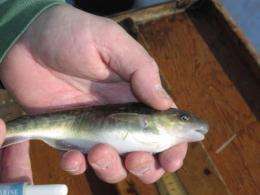
For 30 years, two General Electric facilities released about 1.3 million pounds of polychlorinated biphenyls (PCBs) into New York's Hudson River, devastating and contaminating fish populations. Some 50 years later, one type of fish—the Atlantic tomcod—has not only survived but appears to be thriving in the hostile Hudson environment.
Researchers from Woods Hole Oceanographic Institution (WHOI) have joined colleagues from New York University (NYU) and NOAA to investigate this phenomenon and report that the tomcod living in the Hudson River have undergone a rapid evolutionary change in developing a genetic resistance to PCBs.
Although this kind of reaction has been seen when insects develop resistance to certain insecticides, and bacteria to antibiotics, "This is really the first demonstration of a mechanism of resistance in any vertebrate population," said Isaac Wirgin of NYU's Department of Environmental Medicine and leader of the study. Moreover, he said, the team has found that "a single genetic receptor has made this quick evolutionary change possible."
The findings, reported online in the Feb. 17 issue of Science, provide a first look at "natural selection going on over a relatively short time, changing the characteristics of a population," said WHOI Senior Scientist Mark E. Hahn, who, together with WHOI biologist Diana Franks, collaborated with Wirgin on the study. "It's an example of how human activities can drive evolution by introducing stress factors into the environment."
Looking at the ability of the fish to respond to the contaminants, the researchers found the primary changes occurred in a receptor gene called AHR2, which is important in mediating toxicity in early life stages and can control sensitivity to PCBs. In his work over the last 16 years in the Acushnet River Estuary near New Bedford, Mass., biologist Hahn has found the same gene involved in controlling other fishes' responses to PCBs.
The AHR2 proteins in the Hudson Rover tomcod, he said, appear to be missing two of the 1,104 amino acids normally found in this protein. This causes the receptor to bind more weakly with PCBs than normal, suggesting a reason why the contaminant does not affect the tomcod in this location as much as it does tomcod in other locations. The Hudson River tomcod "are not as sensitive to PCBs," Hahn said. "The mechanism by which PCBs cause toxicity is dampened in this population."
While this may be good news for the tomcod, it may bode not so well for their predators, and even humans. "The tomcod survive but they still accumulate PCBs in their bodies and pass it on to whatever eats them," Hahn said.
Wirgin noted that tomcod spawn in the winter, and in the summer become "a major component of the diets of striped bass and other fish." This can lead to "an abnormal transfer of contaminants up the food chain," perhaps all the way to humans who may consume them.
In addition, the tomcod's genetic changes "could make them more sensitive to other things," and affect their ability to break down certain other harmful chemicals, such as PAHs (polycyclic aromatic hydrocarbons), Hahn said. "So it's conceivable that the Hudson River tomcod could be more susceptible to PAHs because it cannot degrade them properly," he said.
Also, he added, these receptors are involved in normal development, and a genetic change could lead to a change in a fish's health. "There could be evolutionary costs," Hahn said. "We don't know yet what they are but it's something that needs to be considered."
"Hudson River tomcod have experienced rapid evolutionary change in the 50 to 100 years since release of these contaminants," the researchers say in their paper. Added Wirgin: "Any evolutionary change at this pace is not a good thing."
Ironically the recently begun EPA-mandated cleanup of Hudson River PCBs could be trouble for the tomcod. If there are evolutionary costs to having the variant AHR2 gene, the absence of the toxic substance that triggered its adaptation might leave it at a disadvantage.
"If they clean up the river," Wirgin said, "these fish may need to adapt again to the cleaner environment."
The WHOI portion of the study was funded by an NIH Superfund Research Program Center grant through the Superfund Research Center at Boston University.
The NYU work was funded by an NIH Superfund Research Program individual grant and an NIH Environmental Health Sciences Center grant.
"This research could not have been attempted without the unique multidisciplinary focus of our funding vehicle, Superfund Basic Research," Wirgin said.
Provided by Woods Hole Oceanographic Institution


