Nanoworld in color

January 21, 2011

Nanoworld in color

Enlarge

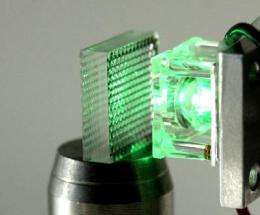
The luminous cube is the prototype of the new projector. Credit: Fraunhofer IOF

Lights off – projector on. Lecture theaters, conference halls and seminar rooms currently have to be darkened if the speaker wants to project a presentation on screen. Unfortunately, the attention of the listeners goes off with the lights, and tiredness takes over. A new technique promises to remedy this situation. The projectors of the futur will not only be small and easy to use but also shine so brightly that the images appear sharp and clear, even in a sun-filled room.

The image illuminating the wall of the Fraunhofer exhibition stand at nano tech 2011 will be produced by a luminous cube. The prototype of the new projector consists of an optical system just eleven millimeters square and three millimeters thick through which a powerful lamp shines. The images are amazingly sharp, the colors brilliant – all thanks to micro and nanotechnology. "The special thing about the new projection technology is that the image is already integrated in the microoptics. The pixels measuring just a hundred nanometers or so are stored in a chromium layer under the lens array. Such a microarray has around 250 microlenses, and under each lens there is a microimage. When all of them are projected onto the wall together, a high-quality complete image is produced from an extremely small projector," explains Marcel Sieler, physicist at the Fraunhofer Institute for Applied Optics and Precision Engineering IOF in Jena.

This pocket-sized technology has the potential to replace not only overhead and digital projectors but also cameras. "The commercial prospects for ultra-flat microoptical systems are excellent because they open up numerous new applications – like minicameras or miniprojectors" enthuses Dr. Michael Popall from the the Fraunhofer Institute for Silicate Research ISC. He adds: "The leap in manufacturing quality achieved in recent months can be compared to the advance in television from the cathode ray tube to HDTV." The IOF scientists have also developed a that is not much bigger than a box of matches. It can project presentations, video clips and movies from a cell phone or laptop onto any wall – at home, in the office or out and about. Ultra-flat cameras that are ideal for area or production monitoring in exposed locations are another application which will be demonstrated in Tokyo.

A special material composition has been developed by researchers at ISC for the manufacture of the microlens arrays used in all these applications. Organic carbon-hydrogen and oxygen compounds are enveloped in an inorganic matrix of silicon oxide or titanium oxide. This prevents the embedded plastics from changing chemically over the course of time. Such ORMOCERs are insensitive to mechanical and thermal loadings. Incidentally, the formula for stabilizing sensitive compounds is very old: The ancient Mayas mixed their natural indigo dye, which normally bleaches quickly in the sun, with a clay mineral to render it fast. As a result, the blue dye they used to decorate the walls of their houses and temples lasted for more than a thousand years.

The method employed by the Mayas was very effective but rather crude compared with modern techniques. "Today we can control the chemical bonding of the inorganic and organic substances with nanometer precision," states Popall. "Development of the material, however, is only one part of the puzzle. The shaping process and the technology needed to control it play a crucial role in lens manufacture. It was only through close cooperation between chemists and physicists at Fraunhofer that we succeeded in producing the arrays, substrates and components needed for extremely flat, high-quality optics." The resolution attainable is now almost as high as that of high-quality glass optics – but using significantly less material and space. What's more, the new material can be mass produced, which keeps the costs much lower.

Small is beautiful is the principle for the new optical world. The days of suitcase-sized projectors will be therefore numbered.

Provided by Fraunhofer-Gesellschaft search and more info website

4.2 /5 (5 votes)  

Filter


Move the slider to adjust rank threshold, so that you can hide some of the comments.


Display comments: newest first

Yogaman
Jan 21, 2011

Rank: 5 / 5 (1)
resolution? refresh rates? power consumption? light intensity? cost? ship date?
Royale
Jan 21, 2011

Rank: 1 / 5 (1)
ship date? really? It's a prototype for a novel new nanotech device. Do you really think they have a ship date? I bet they're not even sure if they can take it to market at this point.
Jimee
Jan 23, 2011

Rank: not rated yet
It seems like it should be important to include the size of the displayed image. As a monitor for laptops, or any medium sized smart device with a screen such a gadget seems like a no-brainer as a marketable technology, all else being approximately equal.
DaveGee
Jan 25, 2011

Rank: not rated yet
The evils of nano-tech strikes again... Great! Now what can I use as an excuse for falling asleep during a presentation?
Rank 4.2 /5 (5 votes)
Related Stories
created Feb 02, 2010 comments 0

Nano for the senses

created Apr 16, 2008 comments 0

Measuring in 3-D

Tags

Relevant PhysicsForums posts

More news stories

SpotterRF debuts Radar Backpack Kit (w/ Video)

(Phys.org) -- SpotterRF has announced a special radar backpack kit designed to enhance situational awareness for soldiers on the ground. The company says its special radar is designed for warfighters as part ...

Technology / Hi Tech & Innovation

created 8 hours ago | popularity 5 / 5 (2) | comments 7 | with audio podcast report

Yahoo kills 'Livestand' just 6 months after debut

(AP) -- Yahoo is killing a tablet magazine called Livestand just six months its debut on the iPad.

Technology / Business

created 23 hours ago | popularity not rated yet | comments 1

Probability of contamination from severe nuclear reactor accidents is higher than expected: study

Catastrophic nuclear accidents such as the core meltdowns in Chernobyl and Fukushima are more likely to happen than previously assumed. Based on the operating hours of all civil nuclear reactors and the number ...

Technology / Energy & Green Tech

created May 22, 2012 | popularity 3.4 / 5 (17) | comments 49 | with audio podcast

Delphi gasoline-injection engine technique rivals hybrid's edge

(Phys.org) -- Running a diesel like engine on gasoline is something Delphi is doing in notable fashion. They claim they are on to a promising way to enjoy an engine that gives the vehicle owner high efficiency ...

Technology / Energy & Green Tech

created May 21, 2012 | popularity 4.6 / 5 (17) | comments 33 | with audio podcast report

HyperSolar shows dirty water no barrier to power world

(Phys.org) -- The Santa Barbara, California, company, HyperSolar, is set to transparently share the ups and downs of its research experiences toward the company’s ultimate vision, successfully producing ...

Technology / Energy & Green Tech

created May 24, 2012 | popularity 4.8 / 5 (14) | comments 17 | with audio podcast report


Australia hails surprise super-telescope decision

Australia has hailed a surprise decision giving it a role in a radio telescope project aimed at revolutionising astronomy, vowing to draw on its decades of experience in space science.

Astronomers seize last chance in lifetime for Venus Transit

Astronomers are gearing for one the rarest events in the Solar System: an alignment of Earth, Venus and the Sun that will not be seen for another 105 years.

Thousands of shellfish found dead in Peru

Thousands of crustaceans were found dead off the coast of Lima following the mystery mass death of dolphins and pelicans, the Peruvian Navy said Friday.

SpaceX capsule has 'new car' smell, astronauts say

SpaceX's Dragon cargo vessel smells like a new car, said astronauts at the International Space Station after opening the hatches Saturday following the spacecraft's landmark mission to the orbiting lab.

Family history of Alzheimer's affects functional connectivity

(HealthDay) -- Cognitively normal individuals with a family history of late-onset Alzheimer's disease (AD) may display lower resting state functional connectivity in the default mode network (DMN) of the brain, ...

Astronauts enter world's 1st private supply ship

(AP) -- Space station astronauts floated into the Dragon on Saturday, a day after its heralded arrival as the world's first commercial supply ship.