Dynamic systems in living cells break the rules
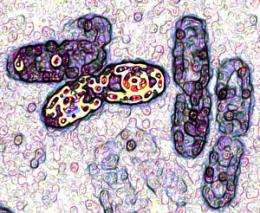
New research in the transport of fat molecules in living yeast cells show that the transport movements in living cells surprisingly break with the basic concepts of statistical physics. In order to clarify how cells communicate, researchers must find new laws for physics in living organisms. (Artistic rendering by Mette Høst)
There is considerable interest in understanding transport and information pathways in living cells. It is crucial for both the transport of, for example, medicine into cells, the regulation of cell life processes and their signalling with their environment. New research in biophysics at the Niels Bohr Institute shows surprisingly that the transport mechanisms do not follow the expected pattern. The results have been published in the scientific journal Physical Review Letters.
The researchers studied fat molecules which are naturally occurring in cells. Using a special state-of-the-art instrument, an optical tweezer, they were able to hold onto the small fat molecules inside living yeast cells using an extremely focused laser light. By measuring the movement of the fat molecules over several hours they could observe that they were not behaving as expected.
The laws of physics for motion
In the world of physics, there is something called Brownian motion. Ordinary Brownian motion describes how a substance passively spreads in a liquid. For example, when you pour a spoonful of sugar into a glass of water the sugar will distribute itself evenly after a while. Would fat molecules behave 'ordinarily' and simple distribute itself evenly in the cell fluid?
In any case, the researchers had expected that the Ergodicity theorem (tenet), which is a generally recognized law of nature, would be adhered to. The Ergodicity theorem predicts that statistically, the result of throwing 10 dice once would have the same average distribution as throwing one die 10 times.
The Ergodicity theorem is expected to apply for anomalous transport processes in unorganized materials, for example, biological systems. The researchers expected therefore, that if you observe the transport of fat molecules in many cells at once, then you would get the same result as by looking a single cell repeatedly over a long period of time. You expect a pattern.
Breaks common wisdom
"But neither the one nor the other common wisdom held true. It turned out the fat molecules broke with all the patterns. Our analysis of the spreading of liquid fat granules in living yeast cells showed that not only was the distribution abnormal, but that the movement in the relevant time period was also in conflict with the statistics for ergodicity. They almost have their own will", explains Lene Oddershede, associate professor in the biophysics group, Optical Tweezers at the Niels Bohr Institute at the University of Copenhagen. The experimental studies were performed here, while researchers from DTU as well as Germany and Israel have worked with the theoretical calculations.
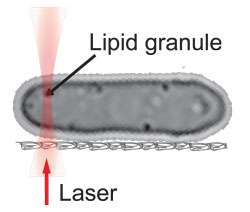
The researchers studied fat molecules which are naturally occurring in cells. Using a special state-of-the-art instrument, an optical tweezer, they were able to hold onto the small fat molecules inside living yeast cells using an extremely focused laser light.
The conclusion is that controlling living systems is more complicated than previously thought and that the basic concepts in statistical physics must be replaced when analysing certain aspects of biomolecular dynamics in cells."We have gained very important knowledge. What we thought would apply, did not hold up at all, so now we need to find a completely new law for the physics in living organisms. Our goal is to discover how the cell signals and how it communicates both internally and with its environment", explains Lene Oddershede.
More information: http://prl.aps.org … 6/i4/e048103
Provided by University of Copenhagen
-
From lemons to lemonade: Reaction uses carbon dioxide to make carbon-based semiconductor,
28 comments
-
Thioridazine kills cancer stem cells in human while avoiding toxic side-effects of conventional cancer treatments,
3 comments
-
SpaceX private rocket blasts off for space station (Update),
41 comments
-
Climate scientists say they have solved riddle of rising sea,
30 comments
-
Scotland passes turbine test to harness tidal power,
40 comments
-
How can squinting be used by both a myopic & hyperopic eye?
3 hours ago
-
The need for practical electronic and mechanical skills for aspiring experimentalists
8 hours ago
-
Refraction and splitting of a photon
10 hours ago
-
Total pressure load on a chain...
11 hours ago
-
Water under pressure and temperature effects
14 hours ago
-
Flow, different liquid, pressure
14 hours ago
- More from Physics Forums - General Physics
More news stories
Landmark calculation clears the way to answering how matter is formed
(Phys.org) -- An international collaboration of scientists, including Thomas Blum, associate professor of physics, is reporting in landmark detail the decay process of a subatomic particle called a kaon ...
May 25, 2012 |
4.8 / 5 (13) |
40
|
Is a classical electrodynamics law incompatible with special relativity?
(Phys.org) -- The laws of classical electromagnetism that were developed in the 19th century are the same laws that scientists use today. They include Maxwell’s four equations along with the Lorentz la ...
Lying in wait for WIMPs: Researchers seek to dramatically increase sensitivity of Large Underground Xenon detector
Although it's invisible, dark matter accounts for at least 80 percent of the matter in the universe. No one knows what it is, but most scientists would bet on weakly interacting massive particles, or WIMPs.
May 23, 2012 |
4 / 5 (5) |
14
|
Hall effect at the speed of light: How can you demonstrate relativistic effects with your mobile phone?
The relativistic Hall effect describing objects rotating at speeds comparable with the speed of light has been reported.
May 21, 2012 |
4.3 / 5 (3) |
8
Cloak of invisibility: Engineers use plasmonics to create an invisible photodetector
A team of engineers at Stanford and the University of Pennsylvania has for the first time used "plasmonic cloaking" to create a device that can see without being seen - an invisible machine that detects light. It is the first ...
May 21, 2012 |
4.8 / 5 (16) |
7
|
SpotterRF debuts Radar Backpack Kit (w/ Video)
(Phys.org) -- SpotterRF has announced a special radar backpack kit designed to enhance situational awareness for soldiers on the ground. The company says its special radar is designed for warfighters as part ...
Family history of Alzheimer's affects functional connectivity
(HealthDay) -- Cognitively normal individuals with a family history of late-onset Alzheimer's disease (AD) may display lower resting state functional connectivity in the default mode network (DMN) of the brain, ...
Transvaginal mesh op restores pelvic organ prolapse at price
(HealthDay) -- Transvaginal mesh (TVM) procedures are effective for anatomical restoration of pelvic organ prolapse (POP), but patients report a worsening of sexual function following surgery, according to ...
Travel to high altitudes tied to Crohn's, colitis flare-ups
(HealthDay) -- People with inflammatory bowel disease, which includes Crohn's disease and colitis, may be at increased risk for flare-ups when they fly or travel to high altitudes for skiing or mountain climbing, ...
Thousands of shellfish found dead in Peru
Thousands of crustaceans were found dead off the coast of Lima following the mystery mass death of dolphins and pelicans, the Peruvian Navy said Friday.
Astronomers seize last chance in lifetime for Venus Transit
Astronomers are gearing for one the rarest events in the Solar System: an alignment of Earth, Venus and the Sun that will not be seen for another 105 years.
Jan 26, 2011
Rank: 1 / 5 (7)
Life is certainly enormously more complicated than what can be achieved through random physical processes.
For how long will evolutionists hold onto the idea that life somehow arose spontaneously from pond scum or it's scientifically dressed and scrubbed equivalent?
Just review this statement here:
Does that sound like something arising from random non-ordered processes? Where and how does sequencing with feedback and feedforward loops arise out of unguided physical and chemical interactions? It just doesn't. Period.
Life was created by a superior intelligence.
Jan 26, 2011
Rank: 5 / 5 (2)
What does thathave to do with anything in the article? Complex systems can easily arise from simple premises. E.g. snow flakes from water droplets and cold.
You seem to be of the strange opinion that complex biological systems must have arisen fully as complex as they are now from 'pond scum'. Try to understand the mechanism of selection and the huge amounts of time involved.
Yes.
And your 'superior intelligence' was created by...? Or did that spring fully formed from... (e.g. 'pond scum')?
I think you have just HUGELY contradicted yourself.
Jan 26, 2011
Rank: 1 / 5 (1)
This only works in "text book" math and "text book" physics if you neglect force interactions between the dice themselves.
If you throw 10 dice ina group they behave quite differently than throwing 10 dice one at a time. They bounce off one another, they have partial charges, they have mass and therefore gravity affecting one another, turbulence between them, etc.
Meanwile, if you throw dice one at a time, then things have changed in the universe between throw 1, throw 2, etc: Time has passed, the moon has moved a tiny bit, the earth has rotated a tiny bit, the passing car that was north of your house is now to the south, changing air dynamics and tiny gravity changes, etc, which are different types and scale changes as compared to 10 dice simultaneously.
Jan 26, 2011
Rank: 1 / 5 (1)
However, in the real world, it is impossible to distinguish sides of the dice without physical objects representing labels. each side is painted a different color or has a different number of dots or a different symbol or numeral. The differences in size, shape, and color of these symbols has an impact on the outcome because different colors or shapes absorb and reflect different energies.
Anyway, when you consider stuff like this, it becomes obvious that textbook physics and textbook math do not even remotely reflect the real world complexity.
In the real world, the labels on the dice affect the outcome, and in the real world, ten dice thrown together affect one another according to every fundamental force, including EM radiation, because "top" dice may shade "lower" dice from light, etc.
Jan 26, 2011
Rank: 1 / 5 (1)
So 10 of D6 doesn't work in any case, because 2 at least outcomes are guaranteed to have less occurances than the mean occurences of outcomes.
So if you were throwing 10 dice, in order to not contaminate the experiment you'd need to through D10. Else to achieve a statistical mean you'd need to throw 10 dice 3 times...however throwing 10 dice 3 times vs throwing 1 dice 30 times would invalidate the experiment, because it would contaminate the "simultaneity" pool with "sequential" tosses.
So a fair experiment would be:
4D4 thrown once vs 1D4 thrown 4 times.
6D6 thrown once vs 1D6 thrown 6 times.
10D10 thrown once vs 1D10 thrown 10 times.
etc.
Even this would still only work "on paper" and only if you have a zero mass/energy labels and an otherwise static universe...
Jan 26, 2011
Rank: not rated yet
Jan 26, 2011
Rank: not rated yet
Jan 26, 2011
Rank: not rated yet
Jan 27, 2011
Rank: not rated yet