Cerium's unusual behaviour
January 27, 2011 by Anne M Stark
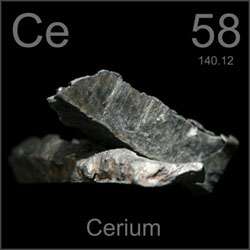
Photo courtesy of Max Whitby/Red Green & Blue Company
(PhysOrg.com) -- Livermore researchers have found that a crystal of cerium -- the chemical element that can be used for catalysts and fuel additives -- behaves in very unique ways when subjected to high pressures.
When a solid is pressurized, the internal energy at some point produces a change in the atomic arrangement, called a phase transformation. Typically when this happens, the atomic arrangement changes from one geometry to another. However, that doesn't happen in cerium.
When cerium metal is exposed to 75,000 atmospheres of pressure, the atomic arrangement of the crystal simply shrinks, is transformed into two crystals. Dan Farber, Kevin Moore, and Chantel Aracne-Ruddle showed that the two crystals are the same structure (one a large cube and the other a small cube) and have the same spatial orientation (the large and small cubes face in the same direction). This means that the two phases have the same crystal structure, but different volumes. This is entirely unique in phase transformations of solid materials.
A phase transformation with two crystals of the same structure, but different volumes is something akin to laying bricks that are the same shape, but where some of the bricks are large while some are small. Making a coherent wall with the two is difficult.
The team (which also included researchers from Université Pierre et Marie Curie, Place Jussieu and CEA, DAM, DIF, all in France) used a diamond anvil cell to create the intense pressures on the cerium crystal. They also applied the X-ray diffraction method to determine the high pressure variation of the cerium structure and volume.
"Our data clearly show that the transformation mechanism can be described on the basis of crystallographic and thermodynamic arguments, showing a fair agreement with an isomorphic scenario and the existence of a critical point," Moore said. "The equation of state of cerium near the critical temperature is determined experimentally and for the first time is shown to be well understood in the framework of the scaling theory of the liquid-gas transition of classical systems. This conclusion represents an important step forward in achieving a reliable and unambiguous picture on the mechanism of phase transformation in cerium, an element archetypical of the localization-delocalization phenomenon encountered in f-electron systems, such as plutonium."
The research is scheduled to appear in a future edition of Physical Review Letters.
Provided by
Lawrence Livermore National Laboratory
-
From lemons to lemonade: Reaction uses carbon dioxide to make carbon-based semiconductor,
28 comments
-
Thioridazine kills cancer stem cells in human while avoiding toxic side-effects of conventional cancer treatments,
3 comments
-
SpaceX private rocket blasts off for space station (Update),
41 comments
-
Climate scientists say they have solved riddle of rising sea,
30 comments
-
Scotland passes turbine test to harness tidal power,
40 comments
-
Transparency of molten substances?
May 25, 2012
-
saturated paramagnetic and ferromagnetic
May 24, 2012
-
How to calculate the bandstructure of Twisted Bilayer Graphene
May 23, 2012
-
vast computational richness from swapping one proton
May 22, 2012
-
Oscillator strength of mixed LH- and HH-excitons
May 22, 2012
-
2D Quantum Well and k-values
May 21, 2012
- More from Physics Forums - Atomic, Solid State, Comp. Physics
More news stories
Landmark calculation clears the way to answering how matter is formed
(Phys.org) -- An international collaboration of scientists, including Thomas Blum, associate professor of physics, is reporting in landmark detail the decay process of a subatomic particle called a kaon ...
May 25, 2012 |
4.6 / 5 (15) |
41
|
Is a classical electrodynamics law incompatible with special relativity?
(Phys.org) -- The laws of classical electromagnetism that were developed in the 19th century are the same laws that scientists use today. They include Maxwell’s four equations along with the Lorentz la ...
Lying in wait for WIMPs: Researchers seek to dramatically increase sensitivity of Large Underground Xenon detector
Although it's invisible, dark matter accounts for at least 80 percent of the matter in the universe. No one knows what it is, but most scientists would bet on weakly interacting massive particles, or WIMPs.
May 23, 2012 |
4 / 5 (5) |
14
|
Hall effect at the speed of light: How can you demonstrate relativistic effects with your mobile phone?
The relativistic Hall effect describing objects rotating at speeds comparable with the speed of light has been reported.
May 21, 2012 |
4.3 / 5 (3) |
8
Cloak of invisibility: Engineers use plasmonics to create an invisible photodetector
A team of engineers at Stanford and the University of Pennsylvania has for the first time used "plasmonic cloaking" to create a device that can see without being seen - an invisible machine that detects light. It is the first ...
May 21, 2012 |
4.8 / 5 (16) |
7
|
SpotterRF debuts Radar Backpack Kit (w/ Video)
(Phys.org) -- SpotterRF has announced a special radar backpack kit designed to enhance situational awareness for soldiers on the ground. The company says its special radar is designed for warfighters as part ...
Australia hails surprise super-telescope decision
Australia has hailed a surprise decision giving it a role in a radio telescope project aimed at revolutionising astronomy, vowing to draw on its decades of experience in space science.
Astronomers seize last chance in lifetime for Venus Transit
Astronomers are gearing for one the rarest events in the Solar System: an alignment of Earth, Venus and the Sun that will not be seen for another 105 years.
SpaceX capsule has 'new car' smell, astronauts say
SpaceX's Dragon cargo vessel smells like a new car, said astronauts at the International Space Station after opening the hatches Saturday following the spacecraft's landmark mission to the orbiting lab.
Family history of Alzheimer's affects functional connectivity
(HealthDay) -- Cognitively normal individuals with a family history of late-onset Alzheimer's disease (AD) may display lower resting state functional connectivity in the default mode network (DMN) of the brain, ...
Thousands of shellfish found dead in Peru
Thousands of crustaceans were found dead off the coast of Lima following the mystery mass death of dolphins and pelicans, the Peruvian Navy said Friday.
Jan 27, 2011
Rank: 2 / 5 (6)
It still boggles the mind that atoms on either side of Cerium on the periodic table can behave completely differently under such gigantic pressures. Yet they only differ by the addition or subtraction of one proton and electron: Praseodymium and Lanthanum.
Even in the same column, Thorium and Dubnium are as different as day from night under pressure. Go figure!
Jan 27, 2011
Rank: not rated yet
Why certainly :)
Jan 27, 2011
Rank: 5 / 5 (2)
Atoms have shape. Add or subtract a single electron changes the outside surface charge shape.
Jan 27, 2011
Rank: not rated yet
Pretty sure that's not the case, but then I'm not an expert on the matter. Rather, I'd expect it to change the available energy levels and the mean radius of the atom...
Actually I take that back... I just remembered that the nuclei of very large atoms are often elongated because of the nucleus energy levels. I'm not sure if that significantly changes the shape of the electron orbitals though.
Jan 27, 2011
Rank: not rated yet
Come on Physorg writers & editors, I don't normally comment on the standard of writing as it's generally ok but I think this one is really taking grammar a bit too far (admittedly because it's in the teaser as well as the article text). Something is either unique or it is not, it cannot be "very unique" nor any other qualified version of uniqueness.
Jan 27, 2011
Rank: not rated yet
Jan 27, 2011
Rank: not rated yet
I thought, Oh God! We got rid of lead in the fuel and now along comes cerium. It won't stop until we're all three eyed monsters.
Jan 27, 2011
Rank: not rated yet
Weird! You only have three eyes?
Jan 28, 2011
Rank: not rated yet
Thought-provoking article.
Jan 29, 2011
Rank: not rated yet
Jan 29, 2011
Rank: not rated yet
Should this sentence actually say "When cerium metal is exposed to 75,000 atmospheres of pressure, the atomic arrangement of the crystal doesn't simply shrink, it is transformed into two crystals."?