Tiny 3-D images shed light on origin of Earth's core
(PhysOrg.com) -- A new method of capturing detailed, three-dimensional images of minute samples of material under extreme pressures is shedding light on the evolution of the Earth's interior. Early results suggest that the early Earth did not have to be entirely molten to separate into the rocky crust and iron-rich core it has today. Researchers at Stanford University and SLAC National Accelerator Laboratory are leading the group pioneering the technique, which could lead to a wide range of new experiments.
To answer the big questions, it often helps to look at the smallest details. That is the approach Stanford mineral physicist Wendy Mao is taking to understanding a major event in Earth's inner history. Using a new technique to scrutinize how minute amounts of iron and silicate minerals interact at ultra-high pressures and temperatures, she is gaining insight into the biggest transformation Earth has ever undergone – the separation of its rocky mantle from its iron-rich core approximately 4.5 billion years ago.
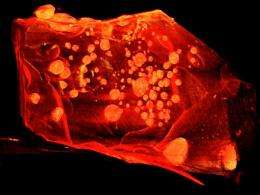
The technique, called high-pressure nanoscale X-ray computed tomography, is being developed at SLAC National Accelerator Laboratory. With it, Mao is getting unprecedented detail – in three-dimensional images – of changes in the texture and shape of molten iron and solid silicate minerals as they respond to the same intense pressures and temperatures found deep in the Earth.
Mao will present the results of the first few experiments with the technique at the annual meeting of the American Geophysical Union in San Francisco on Thursday, Dec. 16.
Tomography refers to the process that creates a three-dimensional image by combining a series of two-dimensional images, or cross-sections, through an object. A computer program interpolates between the images to flesh out a recreation of the object.
Researchers at SLAC have developed a way to combine a diamond anvil cell, which compresses tiny samples between the tips of two diamonds, with nanoscale X-ray computed tomography to capture images of material at high pressure. The pressures deep in the Earth are so high – millions of times atmospheric pressure – that only diamonds can exert the needed pressure without breaking under the force.
At present, the SLAC researchers and their collaborators from HPSync, the High Pressure Synergetic Consortium at the Advanced Photon Source at Argonne National Laboratory, are the only group using this technique.
"It is pretty exciting, being able to measure the interactions of iron and silicate materials at very high pressures and temperatures, which you could not do before," said Mao, an assistant professor of geological and environmental sciences and of photon science. "No one has ever imaged these sorts of changes at these very high pressures."
It is generally agreed that the initially homogenous ball of material that was the very early Earth had to be very hot in order to differentiate into the layered sphere we live on today. Since the crust and the layer underneath it, the mantle, are silicate-rich, rocky layers, while the core is iron-rich, it's clear that silicate and iron went in different directions at some point. But how they separated out and squeezed past each other is not clear. Silicate minerals, which contain silica, make up about 90 percent of the crust of the Earth.
If the planet got hot enough to melt both elements, it would have been easy enough for the difference in density to send iron to the bottom and silicates to the top.
If the temperature was not hot enough to melt silicates, it has been proposed that molten iron might have been able to move along the boundaries between grains of the solid silicate minerals.
"To prove that, though, you need to know whether the molten iron would tend to form small spheres or whether it would form channels," Mao said. "That would depend on the surface energy between the iron and silicate."
Previous experimental work has shown that at low pressure, iron forms isolated spheres, similar to the way water beads up on a waxed surface, Mao said, and spheres could not percolate through solid silicate material.
Mao said the results of her first high-pressure experiments using the tomography apparatus suggest that at high pressure, since the silicate transforms into a different structure, the interaction between the iron and silicate could be different than at low pressure.
"At high pressure, the iron takes a more elongate, platelet-like form," she said. That means the iron would spread out on the surface of the silicate minerals, connecting to form channels instead of remaining in isolated spheres.
"So it looks like you could get some percolation of iron at high pressure," Mao said. "If iron could do that, that would tell you something really significant about the thermal history of the Earth."
But she cautioned that she only has data from the initial experiments.
"We have some interesting results, but it is the kind of measurement that you need to repeat a couple times to make sure," Mao said.
Provided by Stanford University


