New microscopy tracks molecules in live tissue at video rate
Dec 02, 2010
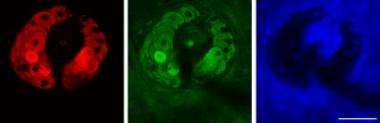
Based on characteristic vibrational spectra of endogenous molecules, many important structural components of tissue such as lipids (CH2-vibration, red), proteins (CH3-vibration, green), and water (OH-vibration, blue) can be imaged. The images show a sebaceous gland wrapping around a hair in the viable epidermis of mouse skin. (left) CH2-image in red shows the lipid-rich gland cells with sub-cellular resolution. Nuclei appear as dark circles due to the lack of lipids. (center) CH3-image in green shows residual lipid signal but also new protein-rich structures such as a hair in the center of the image, collagen fibers surrounding the gland and red blood cells in the top left. It can be seen that hair (green solid center) is surrounded by lipid-rich sebum (red circle). (right) OH-image due to water in blue shows inverse image contrast from the sebaceous gland because the lipid rich cells exclude water. Recent developments have allowed the acquisition of SRS images in reflection mode and at video-rate imaging speed in living mice and humans. Scale: 20μm. Credit: Image courtesy of Dr. Brian Saar and Christian Freudiger.

A novel type of biomedical imaging, made possible by new advances in microscopy from scientists at Harvard University, is so fast and sensitive it can capture "video" of blood cells squeezing through capillaries.

Researchers led by Harvard's Brian G. Saar, Christian W. Freudiger, and X. Sunney Xie describe the work this week in the journal Science.

The new technique, based on stimulated Raman scattering (SRS), makes a complementary partner to MRI, widely used to capture static images of organs, tumors, and other large structures. For the first time, SRS microscopy makes possible label-free chemical movies, with streaming footage at the subcellular level, catching video of proteins, lipids, and water within cells.

"When we started this project 11 years ago, we never imagined we'd have an amazing result like this," says Xie, professor of chemistry and at Harvard. "It took MRI more than 30 years to reach patients, but we're already looking forward with great anticipation to applications of SRS microscopy in hospitals. It's now clear that stimulated Raman scattering will play an important role in the future of biological imaging and medical diagnostics."

Xie says SRS microscopy could aid, and speed, surgery to remove tumors and other . Surgeons must now send excised samples for histological analysis -- a process that takes about 20 minutes -- while a patient waits on the operating table. SRS microscopy provides equivalent insights through real-time scanning.

Xie's team has already used SRS microscopy to track migration of medications in skin, shedding new light on the absorption of topical drugs. In conjunction with endoscopy, the technique can also view three-dimensional sections of tissue, layer by layer.
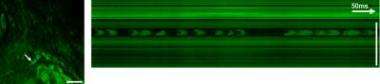
(left) SRS images of the viable epidermis at the CH3-vibration mainly highlight proteins. A capillary with individual red blood cells (arrow) is visible. The cells are imaged without motion blur due to video rate acquisition speed. (right) An x-t plot acquired by line-scanning across a capillary at the position of the arrow. Individual red blood cells are captured on the fly. Scale: 25 μm. Credit: Image courtesy of Dr. Brian Saar and Christian Freudiger.

"Previous SRS microscopy captured only about one image per minute, far too slow for use in live animals or humans," Xie says. "We were able to speed the collection of data by more than three orders of magnitude, attaining video-rate imaging."

Because SRS microscopy works by detecting the intrinsic vibrations in chemical bonds between atoms, it doesn't require intrusive fluorescent labeling. An optical technique, it compliments MRI, whose depth of penetration is better suited to imaging organs and other large objects deep within the body.

The current work greatly improves detection of signals -- backscattered by tissues in the body -- by rearranging photodetectors to surround a small aperture through which a beam of light is directed at the tissue being examined. Using this approach, the scientists were able to collect and analyze almost 30 percent of the laser light directed at a biological sample, a more than 30-fold increase over previous SRS microscopy.

Scientists currently use a variety of techniques to view biomolecules, but most have significant limitations that are sidestepped by SRS microscopy. Labeling with green fluorescent protein (GFP) provides sharp images, but the bulky protein can perturb delicate biological pathways, overwhelming smaller biomolecules. Conventional infrared (IR) microscopy has low spatial resolution and requires desiccated samples, while spontaneous Raman microscopy requires high laser power and long integration times, limiting use in live specimens. Coherent anti-Stokes Raman scattering (CARS) , pioneered by Xie's own group, lacks the contrast to image most molecules beyond lipids.

Explore further: Reading the unreadable

Related Stories

Seeing Previously Invisible Molecules for the First Time

Oct 23, 2009

(PhysOrg.com) -- A team of Harvard chemists led by X. Sunney Xie has developed a new microscopic technique for seeing, in color, molecules with undetectable fluorescence. The room-temperature technique allows ...

Fluorescent proteins illuminating biomedical research

Jan 25, 2009

Remarkable new tools that spotlight individual cellular molecules are transforming biomedical research. Scientists at the Gruss Lipper Biophotonics Center at the Albert Einstein College of Medicine of Yeshiva University have ...

Recommended for you

Making ice-cream more nutritious with meat left-overs

21 minutes ago

Food industries are now turning meat left-over into high-protein content ingredients for food supplements, or to be added to processed food. But a EU-wide regulation covering them is still lacking.

Non-wetting fabric drains sweat

15 hours ago

(Phys.org) —Waterproof fabrics that whisk away sweat could be the latest application of microfluidic technology developed by bioengineers at the University of California, Davis.

Protein study suggests drug side effects are inevitable

17 hours ago

A new study of both computer-created and natural proteins suggests that the number of unique pockets – sites where small molecule pharmaceutical compounds can bind to proteins – is surprisingly small, meaning drug side ...

Attacking MRSA with metals from antibacterial clays

May 17, 2013

In the race to protect society from infectious microbes, the bugs are outrunning us. The need for new therapeutic agents is acute, given the emergence of novel pathogens as well as old foes bearing heightened antibiotic resistance.

User comments : 0

More news stories

Protein study suggests drug side effects are inevitable

A new study of both computer-created and natural proteins suggests that the number of unique pockets – sites where small molecule pharmaceutical compounds can bind to proteins – is surprisingly small, meaning drug side ...

Non-wetting fabric drains sweat

(Phys.org) —Waterproof fabrics that whisk away sweat could be the latest application of microfluidic technology developed by bioengineers at the University of California, Davis.

Beautiful 'flowers' self-assemble in a beaker

By simply manipulating chemical gradients in a beaker of fluid, materials scientists at Harvard have found that they can control the growth behavior of crystals to create precisely tailored structures—such ...

Attacking MRSA with metals from antibacterial clays

In the race to protect society from infectious microbes, the bugs are outrunning us. The need for new therapeutic agents is acute, given the emergence of novel pathogens as well as old foes bearing heightened antibiotic resistance.

Making quantum encryption practical

One of the many promising applications of quantum mechanics in the information sciences is quantum key distribution (QKD), in which the counterintuitive behavior of quantum particles guarantees that no one can eavesdrop on ...

Evaluating a new way to open clogged arteries

Over the past few decades, scientists have developed many devices that can reopen clogged arteries, including angioplasty balloons and metallic stents. While generally effective, each of these treatments ...