New microscope reveals ultrastructure of cells
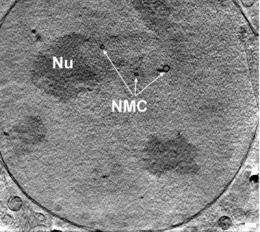
This is a slice through the nucleus of a mouse adenocarcinoma cell showing the nucleolus and the membrane channels running across the nucleus; taken by X-ray nanotomography. Credit: HZB
German researchers at Helmholtz-Zentrum Berlin have developed a new X-ray nanotomography microscope. Using their new system, they can reveal the structures on the smallest components of mammalian cells in three dimensions.
For the first time, there is no need to chemically fix, stain or cut cells in order to study them. Instead, whole living cells are fast-frozen and studied in their natural environment. The new method delivers an immediate 3-D image, thereby closing a gap between conventional microscopic techniques.
The new microscope delivers a high-resolution 3-D image of the entire cell in one step. This is an advantage over electron microscopy, in which a 3-D image is assembled out of many thin sections. This can take up to weeks for just one cell. Also, the cell need not be labelled with dyes, unlike in fluorescence microscopy, where only the labelled structures become visible. The new X-ray microscope instead exploits the natural contrast between organic material and water to form an image of all cell structures. Dr. Gerd Schneider and his microscopy team at the Institute for Soft Matter and Functional Materials have published their development in Nature Methods.
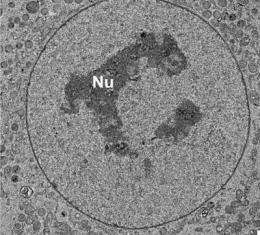
This is a conventional TEM image of a stained thin section. Credit: HZB
With the high resolution achieved by their microscope, the researchers, in cooperation with colleagues of the National Cancer Institute in the USA, have reconstructed mouse adenocarcinoma cells in three dimensions. The smallest of details were visible: the double membrane of the cell nucleus, nuclear pores in the nuclear envelope, membrane channels in the nucleus, numerous invaginations of the inner mitochondrial membrane and inclusions in cell organelles such as lysosomes. Such insights will be crucial for shedding light on inner-cellular processes: such as how viruses or nanoparticles penetrate into cells or into the nucleus, for example.This is the first time the so-called ultrastructure of cells has been imaged with X-rays to such precision, down to 30 nanometres. Ten nanometres are about one ten-thousandth of the width of a human hair. Ultrastructure is the detailed structure of a biological specimen that is too small to be seen with an optical microscope.
Researchers achieved this high 3-D resolution by illuminating the minute structures of the frozen-hydrated object with partially coherent light. This light is generated by BESSY II, the synchrotron source at HZB. Partial coherence is the property of two waves whose relative phase undergoes random fluctuations which are not, however, sufficient to make the wave completely incoherent. Illumination with partial coherent light generates significantly higher contrast for small object details compared to incoherent illumination. Combining this approach with a high-resolution lens, the researchers were able to visualize the ultrastructures of cells at hitherto unattained contrast.
The new X-ray microscope also allows for more space around the sample, which leads to a better spatial view. This space has always been greatly limited by the setup for the sample illumination. The required monochromatic X-ray light was created using a radial grid and then, from this light, a diaphragm would select the desired range of wavelengths. The diaphragm had to be placed so close to the sample that there was almost no space to turn the sample around. The researchers modified this setup: Monochromatic light is collected by a new type of condenser which directly illuminates the object, and the diaphragm is no longer needed. This allows the sample to be turned by up to 158 degrees and observed in three dimensions. These developments provide a new tool in structural biology for the better understanding of the cell structure.
More information: DOI:10.1038/nmeth.1533
Provided by
Helmholtz Association of German Research Centres
-
From lemons to lemonade: Reaction uses carbon dioxide to make carbon-based semiconductor,
28 comments
-
Every black hole contains a new universe: A physicist presents a solution to present-day cosmic mysteries,
215 comments
-
New silicon memory chip developed,
16 comments
-
Thioridazine kills cancer stem cells in human while avoiding toxic side-effects of conventional cancer treatments,
3 comments
-
SpaceX private rocket blasts off for space station (Update),
41 comments
-
Voltage and current in a series circuit
1 hour ago
-
Force on the top hinge of an open door
2 hours ago
-
Specular reflection from moving mirrors
5 hours ago
-
Setting Up a Nitrogen Laser
7 hours ago
-
Can sound fall?
8 hours ago
-
AC Electric field in the conducting media
10 hours ago
- More from Physics Forums - General Physics
More news stories
Synthetic nano-waste does not disappear
(Phys.org) -- Tiny particles of cerium oxide do not burn or change in the heat of a waste incineration plant. They remain intact on combustion residues or in the incineration system, as a new study by Swiss ...
Nanotechnology / Bio & Medicine
8 hours ago |
not rated yet |
0
|
Nanotechnology for solar energy conversion systems
EU researchers extensively characterised the self-organisation of nanotubes and developed novel compositions particularly appropriate to solar energy conversion applications.
Nanotechnology / Nanomaterials
7 hours ago |
not rated yet |
0
Nano-structured polymer-based materials from scrap
EU researchers developed polymer blends and processing techniques facilitating recovery of scrap from industrial processes. Advances in this area have the potential to decrease costs and waste while protecting ...
Nanotechnology / Nanomaterials
8 hours ago |
not rated yet |
0
Dopant gives graphene solar cells highest efficiency yet
(Phys.org) -- By taking advantage of graphenes favorable electrical and optical properties, and then adding an organic dopant, researchers have achieved the highest power conversion efficiency yet for ...
Nanomedicine: Quantum dots appear safe in pioneering study on primates
A pioneering study to gauge the toxicity of quantum dots in primates has found the tiny crystals to be safe over a one-year period, a hopeful outcome for doctors and scientists seeking new ways to battle diseases ...
Nanotechnology / Bio & Medicine
May 20, 2012 |
4.3 / 5 (3) |
8
|
Researchers solve structure of human protein critical for silencing genes
In a study published in the journal Cell on May 24, Cold Spring Harbor Laboratory (CSHL) scientists describe the three-dimensional atomic structure of a human protein bound to a piece of RNA that "guides" the pr ...
High-speed method to aid search for solar energy storage catalysts
Eons ago, nature solved the problem of converting solar energy to fuels by inventing the process of photosynthesis.
Yahoo! ditches digital newsstand for iPads
Yahoo! shuttered its fledgling digital newsstand for iPads on Friday in what it said was the start of a product purge intended to make the floundering Internet pioneer more nimble.
Of mice and mental models: Neuroscientific implications of risk-optimized behavior in the mouse
(Medical Xpress) -- Regardless of an organism’s biological complexity, every encephalized animal continuously makes under-informed behavioral choices that can have serious consequences. Despite its ubiquity, ...
Dragon arrives at space station in historic 1st (Update 2)
The privately bankrolled Dragon capsule made a historic arrival at the International Space Station on Friday, triumphantly captured by astronauts wielding a giant robot arm.
Landmark calculation clears the way to answering how matter is formed
(Phys.org) -- An international collaboration of scientists, including Thomas Blum, associate professor of physics, is reporting in landmark detail the decay process of a subatomic particle called a kaon ...

Nov 19, 2010
Rank: 2.8 / 5 (5)
They should've also converted the nanometers to a fraction of an inch, as they typically do, ha, ha ha.
Nov 19, 2010
Rank: 4 / 5 (4)