Cool star is a gem of a find
November 10, 2010 By Whitney Clavin

Cool star is a gem of a find

Enlarge

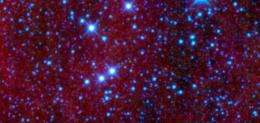
That green dot in the middle of this image might look like an emerald amidst glittering diamonds, but it is actually a dim star belonging to a class called brown dwarfs. This particular object is the first ultra-cool brown dwarf discovered by WISE. Image credit: NASA/JPL-Caltech/UCLA

NASA's Wide-field Infrared Survey Explorer, or WISE, has eyed its first cool brown dwarf: a tiny, ultra-cold star floating all alone in space.

WISE is scanning the whole sky in infrared light, picking up the glow of not just but also asteroids, stars and galaxies. It has sent millions of images down to Earth, in which infrared light of different wavelengths is color-coded in the images.

"The brown dwarfs jump out at you like big, fat, green emeralds," said Amy Mainzer, the deputy project scientist of WISE at NASA's Jet Propulsion Laboratory in Pasadena, Calif. Mainzer, who makes jewelry in her spare time, explained that the brown dwarfs appear like green gems in WISE images because the in their atmospheres absorbs the infrared light that has been coded blue, and because they are too faint to give off the infrared light that is color-coded red. The only color left is green.

Like Jupiter, brown dwarfs are made up of gas -- a lot of it in the form of methane, , and ammonia. These gases would be deadly to humans at the concentrations found around brown dwarfs. And they wouldn't exactly smell pretty.

"If you could bottle up a gallon of this object's atmosphere and bring it back to Earth, smelling it wouldn't kill you, but it would stink pretty badly -- like rotten eggs with a hint of ammonia," said Mainzer.

Mainzer and other members of the WISE team are already accumulating a quarry of brown dwarf candidates similar to this one. Brown dwarfs have masses somewhere between those of a star and a planet. They start out like stars as collapsing balls of gas, but they lack the mass to fuse atoms together at their core and shine with starlight. As time goes on, these lightweights cool off, until they can only be seen in . There could be many such objects lurking in the neighborhood of our sun, but astronomers know of only a handful so far. WISE is expected to find hundreds, including the coolest and closest of all.

To scientists, brown dwarfs represent the perfect laboratories for studying planet-like atmospheres.

"They're a great test of our understanding of atmospheric physics of planets, since they don't have solid surfaces, and there's no big, bright sun to get in the way," said co-author Michael Cushing, a postdoctoral fellow at JPL.

WISE's new brown dwarf is named WISEPC J045853.90+643451.9 for its location in the sky. It is estimated to be 18 to 30 light-years away and is one of the coolest brown dwarfs known, with a temperature of about 600 Kelvin, or 620 degrees Fahrenheit. That's downright chilly as far as stars go. The fact that this brown dwarf jumped out of the data so easily and so quickly -- it was spotted 57 days into the survey mission -- indicates that WISE will discover many, many more. The discovery was confirmed by follow-up observations at the University of Virginia's Fan Mountain telescope, the Large Binocular Telescope in southeastern Arizona, and NASA's Infrared Telescope Facility on Mauna Kea, Hawaii. The results are in press at the Astrophysical Journal.

More information: Read more about how NASA's Spitzer Space Telescope and WISE are hunting down the coldest brown dwarfs .

Provided by JPL/NASA search and more info website

4.8 /5 (9 votes)  

Filter


Move the slider to adjust rank threshold, so that you can hide some of the comments.


Display comments: newest first

Sazzle
Nov 10, 2010

Rank: 5 / 5 (2)
"smelling it wouldn't kill you, but it would stink pretty badly" - similar gasses to a particularly nasty fart? A giant fart in Space... mmmmm!
Rank 4.8 /5 (9 votes)
Relevant PhysicsForums posts

More news stories

SAfrica stops short of being disappointed over SKA verdict

South Africa stopped short of expressing disappointment after it failed to win the bid to single-handily host the world's most powerful radio telescope.

Space & Earth / Space Exploration

created 1 minute ago | popularity not rated yet | comments 0

Dragon arrives at space station in historic 1st (Update 2)

The privately bankrolled Dragon capsule arrived at the International Space Station for a historic docking Friday, captured by astronauts wielding a giant robot arm.

Space & Earth / Space Exploration

created 2 hours ago | popularity 5 / 5 (3) | comments 4

SKA super telescope to be built in Australia, South Africa (Update 2)

A long-running joust to host a radio telescope that would give mankind its farthest peek into the Universe ended on Friday with a Solomon-like judgement to split the site between Australia and South Africa.

Space & Earth / Astronomy

created 3 hours ago | popularity 5 / 5 (1) | comments 1

Organic carbon from Mars, but not biological

(Phys.org) -- Molecules containing large chains of carbon and hydrogen--the building blocks of all life on Earth--have been the targets of missions to Mars from Viking to the present day. While these molecules ...

Space & Earth / Space Exploration

created 22 hours ago | popularity 4.4 / 5 (5) | comments 2 | with audio podcast

Aliens don't want to eat us, says former SETI director

Alien life probably isn’t interested in having us for dinner, enslaving us or laying eggs in our bellies, according to a recent statement by former SETI director Jill Tarter.

Space & Earth / Space Exploration

created 3 hours ago | popularity 5 / 5 (4) | comments 7


Copy of the genetic makeup travels in a protein suitcase

Scientists from the Institute for Physical and Theoretical Chemistry at the University of Bonn have succeeded for the first time in the real time filming of the transport of an important information carrier in biological ...

Cancer may require simpler genetic mutations than previously thought

Chromosomal deletions in DNA often involve just one of two gene copies inherited from either parent. But scientists haven't known how a deletion in one gene from one parent, called a "hemizygous" deletion, can contribute ...

Oldest Jewish archaeological evidence on the Iberian Peninsula

German archaeologists of the Friedrich Schiller University Jena found one of the oldest archaeological evidence so far of Jewish Culture on the Iberian Peninsula at an excavation site in the south of Portugal, ...

Apple CEO Cook gives up $75M in stock dividends

(AP) -- Apple says CEO Tim Cook is giving up $75 million in dividends on restricted stock.

In Spain, 70 percent of women use contraceptives during their first sexual encounter

Contraceptive use in Spain during the first sexual encounter is similar to other European countries. However, there are some geographical differences between Spanish regions: women in Murcia use contraceptives ...

World Health Assembly endorses new plan to increase global access to vaccines

Ministers of Health from 194 countries at the Sixty-fifth World Health Assembly today endorsed a landmark Global Vaccine Action Plan (GVAP), a roadmap to prevent millions of deaths by 2020 through more equitable access to ...