NASA tests hardware for space by simulating the sun's power
October 25, 2010 By Kim Newton

NASA tests hardware for space by simulating the sun's power

Enlarge

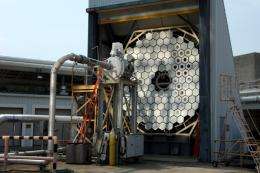
The Solar Thermal Test Facility's concentrator mirror is composed of 144 smaller hexagonal segments. When all the mirrors are fully uncovered, the mirror beams about 1,000,000 watts per square meter of solar energy intensity into the vacuum chamber at the focal point. (NASA/D. Oliver)

In the hostile environment of space, satellites could get burned by the ultra-hot sun in front of them and chilled by the frigid cold conditions of space behind them.

Researchers at NASA's Marshall Space Flight Center in Huntsville, Ala., are using their Solar Thermal Test Facility to simulate some of the harshest conditions space has to offer to learn what these can do to flight hardware close to the . They're currently testing Strofio, a unique NASA instrument that will fly aboard an upcoming mission, in this facility to test the thermal balance before the instrument is on its way to Mercury.

The facility looks like it belongs in a galaxy far, far away. A two-story tall curved mirror -- actually is made of 144 separate mirror segments, each hexagonally shaped and about 18 inches in diameter -- forms the backbone of the facility.

About 50 yards away, sitting in a field, lies another mirror tilted at a slight angle. This secondary mirror reflects the sun towards the primary mirror, which captures the energy and then focuses inside a small mounted in front of the mirror’s focal point.

The giant wall of mirrors works by capturing the light from the sun and redirecting that energy to whatever happens to be sitting in the vacuum chamber. That superheats the instrument, allowing scientists to know how their hardware will behave as it nears the sun. Of course they can't use all 144 mirror segments at once -- that would beam 5000 watts worth of energy onto whatever happens to be inside the vacuum chamber. For the Strofio tests, engineers will only need to partially uncover about 26 mirror segments. They'll reach temperatures hot enough to test their instrument, but not so high that they melt away their hard work.

But that's only half the equation. Thanks to the Southwest Research Institute, the NASA facility has installed a liquid nitrogen shroud on the inside of the vacuum chamber that will flow super-cold liquid nitrogen. That will allow engineers to chill the vacuum chamber to the freezing cold temperatures, just like those in deep space.

In the front, the mirrors expose the instrument to the hotness of the sun. In the back, the nitrogen exposes it to the coldness of a vacuum. Together they accurately mimic the conditions of space, allowing scientists to test how their instrument will perform on its actual mission.
NASA tests hardware for space by simulating the sun's power
Enlarge

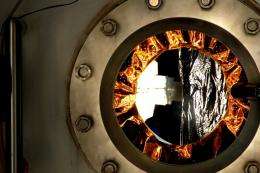
Engineers put the instrument inside this vacuum chamber where the pressure is lowered to the vacuum conditions of space. The black liquid nitrogen cooled walls simulate the super-cold conditions space has to offer. The sun is illuminating the front of the instrument bright white. (NASA/D. Oliver)

"It really gives you a good opportunity to understand how your instrument will perform in the conditions of deep space," says Dr. Jimmy Lee, mission manager for Strofio. "We're trying to understand on Earth how our tool will perform thousands of miles away in radically different conditions. That’s critical for a mission like ours."

These tests prove vital for equipment like Stofio that are destined to travel close to the sun. Strofio will fly in polar orbit around Mercury where it will determine the chemical composition of Mercury's surface using a technique called mass spectroscopy, providing a powerful new data to study the planet's geological history. It will launch with the ESA's Mercury Planetary Orbiter mission in 2014.

When Strofio reaches its orbit around mercury, the sun will expose it to temperatures over 120 degrees Celsius or 248 Fahrenheit. That's a stretch even for the relatively resilient computers which historically only operate at around 24 degrees Celsius or 75 Fahrenheit. Engineers will have to continuously test Strofio to handle the tough Mercury conditions.

For now, the Solar Thermal Test Facility's team continues to test Strofio in preparation for its upcoming mission. Hopefully, they'll continue to have the opportunity to bring the conditions of to the middle of Huntsville, Ala.

Provided by JPL/NASA search and more info website

4.5 /5 (2 votes)  

Rank 4.5 /5 (2 votes)
Relevant PhysicsForums posts

More news stories

Organic carbon from Mars, but not biological

Molecules containing large chains of carbon and hydrogen--the building blocks of all life on Earth--have been the targets of missions to Mars from Viking to the present day. While these molecules have previously ...

Space & Earth / Space Exploration

created 8 hours ago | popularity 3.5 / 5 (2) | comments 0 | with audio podcast

Asteroid nudged by sunlight: Most precise measurement of Yarkovsky effect

Scientists on NASA's asteroid sample return mission, Origins, Spectral Interpretation, Resource Identification, Security, Regolith Explorer (OSIRIS-REx), have measured the orbit of their destination asteroid, ...

Space & Earth / Space Exploration

created 4 hours ago | popularity 4.8 / 5 (5) | comments 0 | with audio podcast

New mapping of Mars shows western Medusae Fossae formation older than once thought

(Phys.org) -- Recent geologic mapping of the Medusae Fossae Formation on Mars—an intensely eroded deposit near the northern edge of the cratered highlands—has revealed a wider distribution of its ...

Space & Earth / Space Exploration

created 5 hours ago | popularity not rated yet | comments 0 | with audio podcast

Autopsy of a eruption: Linking crystal growth to volcano seismicity

A forensic approach that links changes deep below a volcano to signals at the surface is described by scientists from the University of Bristol in a paper published today in Science. The research could ultima ...

Space & Earth / Earth Sciences

created 8 hours ago | popularity 4 / 5 (1) | comments 0 | with audio podcast

Tiny planet-finding mirrors borrow from Webb Telescope playbook

NASA's next flagship mission — the James Webb Space Telescope — will carry the largest primary mirror ever deployed. This segmented behemoth will unfold to 21.3 feet in diameter once the observatory ...

Space & Earth / Space Exploration

created 4 hours ago | popularity 3 / 5 (1) | comments 0


Is a classical electrodynamics law incompatible with special relativity?

(Phys.org) -- The laws of classical electromagnetism that were developed in the 19th century are the same laws that scientists use today. They include Maxwell’s four equations along with the Lorentz la ...

HyperSolar shows dirty water no barrier to power world

(Phys.org) -- The Santa Barbara, California, company, HyperSolar, is set to transparently share the ups and downs of its research experiences toward the company’s ultimate vision, successfully producing ...

In nanorod crystal growth, nanoparticles seen as artificial atoms

In the growth of crystals, do nanoparticles act as "artificial atoms" forming molecular-type building blocks that can assemble into complex structures? This is the contention of a major but controversial theory ...

First direct observation of oriented attachment in nanocrystal growth

Berkeley Lab researchers have reported the first direct observation of nanoparticles undergoing oriented attachment, the critical step in biomineralization and the growth of nanocrystals. A better understanding ...

Global warming winner: Once rare butterfly thrives

(AP) -- Global warming is rescuing the once-rare brown Argus butterfly, scientists say.

Gene discovery points towards non-hormonal male contraceptive

A new type of male contraceptive could be created thanks to the discovery of a key gene essential for sperm development.