November 9, 2006 feature
Single-photon source may meet the needs of quantum communication systems
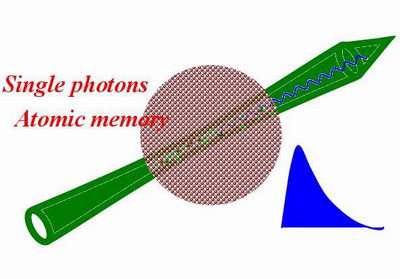
One of the largest challenges for building quantum communications networks involves having single photons, which are needed to ensure the security and efficiency of quantum systems. With an adequate supply of single photons, quantum communications systems could send information at nearly the speed of light, compared with the electron speed (and resistance) in classical systems.
Further, powerful quantum computers could solve problems that are impossible for today’s computers, and quantum cryptography could potentially provide absolute security for these systems.
In the past few years, scientists have developed single-photon sources using innovative tools: quantum dots, single atoms and ions, and color centers are a few possibilities. However, all of these potential sources have shortcomings, in either complicated setups or insufficient production.
Now, scientists Shuai Chen et al. have developed a controllable single-photon source using atomic quantum memory for generating and storing single photons to be used at a predetermined time. As they report in a recent issue of Physical Review Letters, “such a single-photon source is well-suited for future large-scale realization of quantum communication and linear optical quantum computation.”
“Single-photon sources guarantee the absolute security in quantum communication networks,” co-author Zhen-Sheng Yuan told PhysOrg.com. “While developing this single-photon source, we focused on how to obtain a long memory time of the single excitations in the atomic ensemble, and how to convert the single excitations into single photons with a high efficiency.”
In the experimental setup, the scientists used Raman scattering, shining a laser pulse at an ensemble of cold rubidium atoms. As the laser light hits the atoms, single excitations in the atomic ensemble can either be generated or they can be converted into single photons.
Detecting the newly created photons can generate single spin excitations in the cold atomic ensemble, which makes up the quantum memory—so-called because light-based information is being stored in matter. The single spin excitations can in turn be converted into single photons at a predetermined time, resulting in a controllable single-photon source. Chen et al.’s setup could produce 600 single spin excitations per second, translating to 15 single-photon detections per second.
One of the most significant advantages of this quantum memory-based single-photon source is the ability to increase the number of single photons available. With the help of a feed-back circuit, Chen et al. could significantly enhance the production rate of single photons, as their properties align with those of the laser (spatial mode, bandwidth/intensity, frequency).
“Compared with the other single-photon source without quantum memory, the greatest advantage here is that one can construct a quantum communication network with a much lower cost of resources because of the scalable property,” said Yuan.
In principle, the spin excitation can be stored for up to 300 microseconds, and generate a single photon at any time. Because of the feedback circuit, this quantum memory-based photon source could likely provide enough single photons for a large number of quantum repeaters, a requirement for long-distance quantum communication networks.
Citation: Chen, Shuai, Chen, Yu-Ao, Strassel, Thorsten, Yuan, Zhen-Sheng, Zhao, Bo, Schmiedmayer, Jorg, and Pan, Jian-Wei. “Deterministic and Storable Single-Photon Source Based on a Quantum Memory.” Physical Review Letters 97, 173004 (2006).
By Lisa Zyga, Copyright 2006 PhysOrg.com


