Scientists Announce Breakthrough in Silicon Photonics Devices
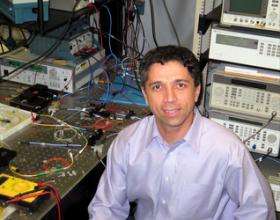
Building on a series of recent breakthroughs in silicon photonics, researchers at the UCLA Henry Samueli School of Engineering and Applied Science have developed a novel approach to silicon devices that combines light amplification with a photovoltaic - or solar panel - effect.
In a study to be presented today at the 2006 International Optical Amplifiers and Applications Conference in Vancouver, Canada, UCLA Engineering researchers report that not only can optical amplification in silicon be achieved with zero power consumption, but power can now be generated in the process.
The team's research shows that silicon Raman amplifiers possess nonlinear photovoltaic properties, a phenomenon related to power generation in solar cells. In 2004, the same group at UCLA Engineering demonstrated the first silicon laser, a device that took advantage of Raman amplification.
"After dominating the electronics industry for decades, silicon is now on the verge of becoming the material of choice for the photonics industry, the traditional stronghold of today's semiconductors," said Bahram Jalali, the UCLA Engineering professor who led researcher Sasan Fathpour and graduate student Kevin Tsia in making the recent discovery.
The amount of information that can be sent through an optical wire is directly related to the intensity of the light. In order to perform some of the key functions in optical networking - such as amplification, wavelength conversion, and optical switching - silicon must be illuminated with high intensity light to take advantage of its nonlinear properties. One example is the Raman effect, a phenomenon that occurs at high optical intensities and is behind many recent breakthroughs in silicon photonics, including the first optical amplifiers and lasers made in silicon.
The fundamental challenge in silicon photonics is the material stops being transparent at high optical intensities, making light unable to pass through.
"As light intensifies in silicon, it generates electrons through a process called two-photon-absorption. Excess electrons absorb the light and turn it into heat. Not only is the light and the data-carrying capacity lost, the phenomenon exacerbates one of the main obstacles in the semiconductor industry, which is excessive heating of chips. The optical loss also makes it all but impossible to create optical amplifiers and lasers that operate continuously," Jalali explained.
In previous attempts to deal with this challenge, a diode attached to the chip has been used to "vacuum" out the electrons which block light. This approach presents further problems, however, because the vacuum adds an additional watt of heat onto the chip - nearly a million times the power that a single transistor consumes in a digital circuit.
"In the past, two-photon absorption in silicon has resulted in significant loss for high power Raman amplifiers and lasers, reducing efficiency and necessitating complex mitigation schemes. UCLA Engineering's new development will enable recycling power that would otherwise be lost. In space and military laser systems, the impact of device efficiency on electrical power and thermal management is a prime consideration," said Dr. Robert R. Rice, senior scientist at Northrop Grumman Space Technology's Laser and Sensor Product Center.
The challenge of power dissipation in traditional silicon semiconductors already is so severe that it threatens to halt the continued advance of the technology described by Moore's law.
(Gordon Moore, one of Intel's founders, predicted in 1965 that innovative research would allow for a doubling of the number of transistors in a given space every year. In 1975, he adjusted this prediction to a doubling every two years.)
Because the UCLA Engineering team's discovery creates an advantage in heat dissipation, it represents a new perspective.
"The progress in silicon Raman lasers at UCLA Engineering by professor Bahram Jalali and his group has been very impressive, not only offering obvious benefits in photonic systems, but also opening up an entirely new approach," Rice added.
"This discovery is a step forward and makes it much more likely that the photonics and electronics will converge. If they do, many applications that silicon photonics has promised will come to fruition," Jalali said.
Silicon photonics technology has the potential to use the power of optical networking inside computers and to create new generation of miniaturized and low-cost photonic components, among other applications.
Jalali's research at UCLA Engineering has been funded by the U.S. Department of Defense through the Defense Advanced Research Project Agency (DARPA). The research was also co-sponsored by the Northrop Grumman Corporation.
Source: UCLA


