Engineers Unveil Futuristic Unmanned 'Crusher' Vehicle
April 29, 2006

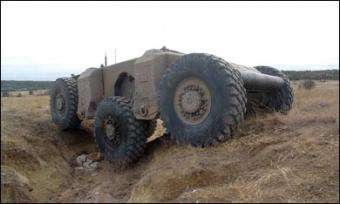
The 6.5-ton "Crusher" can function on its own in challenging off-road terrain

The 6.5-ton "Crusher" can function on its own in challenging off-road terrain.

Carnegie Mellon University's National Robotics Engineering Center (NREC) in the School of Computer Science's Robotics Institute is unveiling a unique unmanned ground vehicle that offers new strength, mobility and autonomy features for the Army's effort to keep its troops out of harm's way.

The 6.5-ton "Crusher" combines the strength and mobility of a predecessor known as Spinner with NREC-developed autonomy capabilities to create an extremely robust, unmanned vehicle that can function on its own in challenging off-road terrain. The project is known by the acronym UPI, which stands for Unmanned Ground Combat Vehicle (UGCV) PerceptOR Integration.

The UPI project, which includes extensive autonomy development, payload integration and field-testing, is funded by the U.S. Army and the Defense Advanced Research Projects Agency (DARPA) at an expenditure of $35 million to date. Experts say UPI incorporates technologies six to 10 years ahead of its time and provides an unprecedented glimpse into the future capabilities of unmanned military vehicles. The technologies developed for Crusher also have potential for commercial use in areas like construction, farming and mining.
Crusher

Crusher does not carry human crews, therefore its design offers unequaled ruggedness, mobility and payload-carrying capacity.

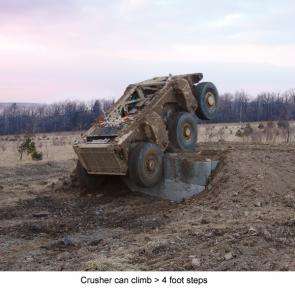
Since Crusher and its predecessor do not have to accommodate human crews, their novel designs offer unequaled ruggedness, mobility and payload-carrying capacity compared to manned vehicles in their weight class. Crusher's hull is made from high-strength aluminum tubes and titanium nodes protected by a steel skid plate that can absorb shocks from impacts with rocks or tree stumps. Its unique suspension enables it to move smoothly over extremely rough terrain and overcome obstacles like large ditches, man-made barriers or piles of boulders. It can carry more than 8,000 lbs. of payload and armor. Electric motors embedded in each of the vehicle's six wheels are powered with a hybrid system that uses a turbo diesel generator to recharge its batteries. Its top speed is currently 26 miles per hour.

NREC researchers have been working with several subcontractors to develop Crusher's special attributes. Among them are Timony Technology of Meath, Ireland, which developed the suspension; Pennsylvania-based CTC Technologies, which designed the hull; and SAFT America Battery Co, which built Crusher's lithium ion battery.

"We're developing Crusher to provide technology insights to the broader Army community—to show people what can be done and pave the way for the future," said John Bares, director of the National Robotics Engineering Center and UPI principal investigator. "Although it's not being designed for production, Crusher could be matured further to withstand the rigors of military fielding."

Bares predicts that vehicles like Crusher will first be used in convoy or support roles, then tactical roles. "In five to 10 years, we should see robots working alongside our troops to protect them and help with tasks in the field," he said.

"The Crusher vehicle is a natural outgrowth of more than 26 years of field robotics research conducted at the Robotics Institute," said Randal E. Bryant, dean of Carnegie Mellon's School of Computer Science. "Crusher demonstrates how advanced vehicle and navigation technology, developed in a university research environment, can be refined into high-quality engineering prototypes. This technology will find many applications where reliable transportation must be provided in difficult or dangerous environments."

Crusher will undergo extensive field tests under the purview of the Army and DARPA every quarter for the next two years. Much of the emphasis will be on increasing its autonomy capabilities. It's expected that the Crusher platform will influence unmanned vehicle design efforts funded by the Army's Future Combat System.

Source: Carnegie Mellon University

4.3 /5 (141 votes)  

Rank 4.3 /5 (141 votes)
Tags

Relevant PhysicsForums posts
  • Water Pump Selection
    createdMay 14, 2012
  • measuring linear velocity of a toy car
    createdMay 14, 2012
  • Oscillating pressure regulation system
    createdMay 13, 2012
  • Laptop Specs
    createdMay 13, 2012
  • Civil Engineering Structural Internship Questions
    createdMay 12, 2012
  • Lift of a Rotating Cylinder in Inviscid Flow
    createdMay 11, 2012
  • More from Physics Forums - General Engineering

More news stories

IPhone to get larger screen: A report to take with a grain of salt?

Apple has begun preparing to launch an iPhone with a larger screen than its previous models, according to a report in the Wall Street Journal.

Electronics / Consumer & Gadgets

created 11 minutes ago | popularity not rated yet | comments 0

Japan's DoCoMo to launch smart phones for elderly

Leading Japanese mobile operator NTT DoCoMo on Wednesday unveiled its first smart phone specially designed for elderly users, as the company bids to tap into an ageing consumer population.

Electronics / Consumer & Gadgets

created 1 hour ago | popularity not rated yet | comments 0

NEC unveils gesture controlling device

Japanese technology titan NEC has unveiled a gadget that allows users to control their TV, mobile phone or tablet computer using a virtual input device.

Electronics / Consumer & Gadgets

created 10 hours ago | popularity not rated yet | comments 2

AMD's Trinity is out to rattle Intel's Ivy Bridge

(Phys.org) -- AMD has announced Trinity, its second-generation A-Series accelerated processing units (APUs), which are out to rival Intel’s Ivy Bridge processors. AMD’s Trinity is an update to its ...

Electronics / Hardware

created May 15, 2012 | popularity 5 / 5 (8) | comments 8 | with audio podcast report

Buffalo shows SSDs with MRAM at Japan show

(Phys.org) -- Japan-based storage experts, Buffalo, has introduced a new line of solid state drives (SSDs) that use MRAM cache (instead of standard SDRAM). The company’s new line of solid state drives ...

Electronics / Hardware

created May 15, 2012 | popularity 4.8 / 5 (6) | comments 4 | with audio podcast report


Healthy eating can cost less, study finds

Is it really more expensive to eat healthy? An Agriculture Department study released Wednesday found that most fruits, vegetables and other healthy foods cost less than foods high in fat, sugar and salt.

"Social Network" writer to pen Steve Jobs film script

Sony Pictures Entertainment on Wednesday said that the Academy Award winning screenwriter behind "The Social Network" will write the script for a film about Apple co-founder Steve Jobs.

NY tech fest heralds Silicon Valley of the East

The Big Apple may not have California's weather, but tech fans at New York Internet Week say that in every other way the city is on course to become Silicon Valley 2.0.

How do consumers achieve self-affirmation when purchasing products?

People who feel good about themselves are less likely to choose an attractive product than a functional one, according to a new study in the Journal of Consumer Research. But choosing highly aesthetic products may make p ...

Why do consumers dislike corporate brands that get too familiar?

Although it is tempting to use the word "we" to make consumers feel like part of the family, people react negatively when brands overstep their boundaries, according to a new study in the Journal of Consumer Research.

Want to avoid ED following prostate cancer surgery? Find an experienced, gentle surgeon

Prostate cancer is the most commonly diagnosed non-skin cancer in the U.S., and radical prostatectomy, the surgical removal of the prostate gland, remains the most popular therapeutic option, accounting for ...