Younger, hotter Earth still not understood
Sep 13, 2010
Younger, hotter Earth still not understood
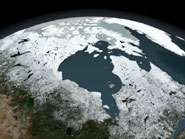
Satellite image of the Hudson Bay region. (Image by NASA)

Plate tectonics may not have operated on a younger and hotter Earth according to new research from the University of Bristol carried out on preserved remnants of ancient continental crust in the Hudson Bay region of Canada.

The processes that formed and shaped the early ’s crust are still poorly understood, and the onset of plate tectonics has been estimated as being as early as the Hadean (4.6-3.8 billion years ago) or as late as the Neoproterozoic (1,000-542 million years ago).

The Hudson Bay region represents an excellent opportunity to investigate crustal formation during the (that is from the formation of the Earth, almost 4.6 billion years ago, until 542 million years ago).  It records tectonic events leading to the formation and stabilisation of the Laurentian continent (most of modern-day North America) and also preserves crust with ages spanning around 2 billion years.

David Thompson, a PhD student in Bristol’s Department of , and colleagues from the University of Calgary and the Geological Survey of Canada analysed the structure and thickness of the crust using seismic waves to investigate what tectonic process were operating on the younger Earth.

They found that the crust between 3.9 and 2.7 billion years old had a relatively simple structure with no clear signs that it was subjected to the kind of plate tectonic processes operating now.  The crust that formed about 1.8 billion years, however, showed evidence of the collision of two continents, similar to the collision between India and Asia still ongoing today.

The researchers then compared the observed structure of the Hudson Bay crust with of a similar age found elsewhere in the world. They concluded that modern-style plate tectonics may not have been established until as late as 1.8 billion years ago.

The research is published in and was named as one of the Nature Geoscience's research highlights in their September issue.

Explore further: Alaska volcano shoots ash 15,000 feet into the air

More information: Precambrian crustal evolution: Seismic constraints from the Canadian Shield by D.A. Thompson, I.D. Bastow, G. Helffrich, J-M. Kendall, J. Wookey, D.B. Snyder, D.W. Eaton Earth and Planetary Science Letters 297 (2010) 655-666. www.sciencedirect.com/science/journal/0012821X

Related Stories

Bias in the rock record?

Jan 14, 2009

(PhysOrg.com) -- The fossil record is known to be biased by the unevenness of geographical and stratigraphical sampling, and the lack of exposed rocks containing fossils. In a recent Perspective in Science [2 Jan ...

Mapping Venus: Extreme makeover or plate tectonics?

Mar 22, 2010

(PhysOrg.com) -- Venus and Earth have long been thought of as sister planets. Given its similar size and proximity to Earth in the inner Solar System, Venus might seem like a promising candidate for having ...

Study reveals ancient rocks linked to old Earth's crust

Feb 24, 2010

(PhysOrg.com) -- A new geological study which took place in the Pilbara region of Western Australia brings us one step closer to understanding more precisely the timing of when the primordial earth crust was ...

Mediterranean Sea dried up five million years ago

Feb 16, 2009

(PhysOrg.com) -- Upward movement of the Earth's crust transformed the Straits of Gibraltar into a dam. Approximately five million years ago, the Mediterranean Sea dried up after it was sealed off from the Atlantic Ocean. ...

Recommended for you

Alaska volcano shoots ash 15,000 feet into the air

4 hours ago

(AP)—One of Alaska's most restless volcanoes has shot an ash cloud 15,000 feet into the air in an ongoing eruption that has drawn attention from a nearby community but isn't expected to threaten air traffic.

NASA sees Cyclone Mahasen hit Bangladesh

15 hours ago

NASA's Tropical Rainfall Measuring Mission satellite known as TRMM measured Cyclone Mahasen's rainfall rates from space as it made landfall on May 16. Mahasen has since dissipated over eastern India.

Rapid climate change ruled out ice age trees

21 hours ago

Short, sharp fluctuations in the Earth's climate throughout the last ice age may have stopped trees from getting a foothold in Europe and northern Asia, scientists say.

Earth's iron core is surprisingly weak, researchers say

22 hours ago

The massive ball of iron sitting at the center of Earth is not quite as "rock-solid" as has been thought, say two Stanford mineral physicists. By conducting experiments that simulate the immense pressures deep in the planet's ...

User comments : 0

More news stories

Alaska volcano shoots ash 15,000 feet into the air

(AP)—One of Alaska's most restless volcanoes has shot an ash cloud 15,000 feet into the air in an ongoing eruption that has drawn attention from a nearby community but isn't expected to threaten air traffic.

Chinese, Indian airlines face EU pollution fines

Eight Chinese and two Indian airlines face fines of up to several million euros for not paying for their greenhouse gas emissions during flights within the bloc, the European Commission said on Friday.

Bright explosion on the Moon

For the past 8 years, NASA astronomers have been monitoring the Moon for signs of explosions caused by meteoroids hitting the lunar surface. "Lunar meteor showers" have turned out to be more common than anyone ...

US seizes Bitcoin operator accounts

US authorities seized the accounts of a Bitcoin digital currency exchange operator, claiming it was functioning as an "unlicensed money service business," court documents showed Friday.