Physicists find fractal boundaries in crystals
Sep 03, 2010 By Anne Ju
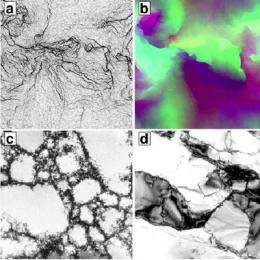
The top two images are two views of a computer-simulated fractal wall pattern after strain. The bottom two are micrographs taken from a single copper crystal and single aluminum crystal after strain.

Blacksmiths make horseshoes by heating, beating and bending iron, but what's happening to the metal's individual atoms during such a process? Cornell researchers, using computational modeling, are providing new insight into how atoms in crystals rearrange as the material is bent and shaped.

The researchers made computer-synthesized models of what such metals as aluminum and look like at the atomic level while being stretched, heated and cooled. They simulated how crystals, whose start in a regular grid, transform as they are bent into different shapes.

Such new theories could lead to a better understanding of structural materials, from buildings to bridges, to make them less susceptible to tearing or breaking.

"We're really at the beginning stages of trying to develop a systematic theory of how materials evolve as we vary strain and temperature," said James Sethna, Cornell professor of physics, who leads the research.

The work is published in the Sept. 1 edition (Vol. 105 Issue 10) of , a publication of the American Physical Society.

When a single crystal is bent, portions of the crystal shift and create defects in the lattice called dislocations. The researchers found that their crystals exhibited starkly contrasting properties depending on temperature.

When hot were bent, the dislocations arranged into grain boundaries, which are the places where lattice planes suddenly tilt. At low temperatures, the dislocations formed self-similar, random patterns known as fractals.

Explore further: Promising doped zirconia

Related Stories

Quasicrystal mystery unraveled with computer simulation

Mar 06, 2008

The method to the madness of quasicrystals has been a mystery to scientists. Quasicrystals are solids whose atoms aren't arranged in a repeating pattern, as they are in ordinary crystals. Yet they form intricate patterns ...

Paving the Way for Crystal Growth

Mar 07, 2007

In order to study the properties of LBCO superconductors, scientists need to produce large, single crystals of the material - a difficult task that wasn't possible until recently. At the state-of-the-art crystal ...

Recommended for you

Promising doped zirconia

May 17, 2013

Materials belonging to the family of dilute magnetic oxides (DMOs)—an oxide-based variant of the dilute magnetic semiconductors—are good candidates for spintronics applications. This is the object of ...

Bringing life into focus

May 17, 2013

Spinning-disk confocal microscopy is an optical imaging technique that can be used to generate detailed three-dimensional fluorescence images of living cells and their contents. Although a powerful tool for ...

Nanocrystals grow from liquid interface

May 17, 2013

An international collaboration of scientists has discovered a unique crystalizing behavior at the interface between two immiscible liquids that could aid in sustainable energy development.

User comments : 2

Adjust slider to filter visible comments by rank

Display comments: newest first

Kedas
5 / 5 (1) Sep 05, 2010
If they say that a and c is a match then they need glasses.
julesruis
not rated yet Sep 06, 2010
For more information about fractals, see:
http://www.fractal.org

More news stories

New principle may help explain why nature is quantum

Like small children, scientists are always asking the question 'why?'. One question they've yet to answer is why nature picked quantum physics, in all its weird glory, as a sensible way to behave. Researchers ...

Manipulating Lorentz and Fano spectral line shapes

(Phys.org) —It is widely known that the optical properties of certain materials can be modified by using lasers to control the quantum states of their optical electrons. Lasers that can generate ultra-short ...

Morocco to harness the wind in energy hunt

Morocco is ploughing ahead with a programme to boost wind energy production, particularly in the southern Tarfaya region, where Africa's largest wind farm is set to open in 2014.

Galaxy's Ring of Fire

Johnny Cash may have preferred this galaxy's burning ring of fire to the one he sang about falling into in his popular song. The "starburst ring" seen at center in red and yellow hues is not the product of ...