Gaming for a cure: Computer gamers tackle protein folding

Aug 04, 2010
This is the Foldit logo. Credit: University of Washington

Computer scientists and biochemists at the University of Washington two years ago launched an ambitious project harnessing the brainpower of computer gamers to solve medical problems.

The , Foldit, turns one of the hardest problems in into a game a bit reminiscent of Tetris. Thousands of people have now played a game that asks them to fold a protein rather than stack colored blocks or rescue a princess.

Results published Thursday (Aug. 5) in the journal Nature show that Foldit is a success. It turns out that people can, indeed, compete with supercomputers in this arena. Analysis shows that players bested the computers on problems that required radical moves, risks and long-term vision - the kinds of qualities that computers do not possess.

"People in the scientific community have known about Foldit for a while, and everybody thought it was a great idea, but the really fundamental question in most scientists' minds was 'What can it produce in terms of results? Is there any evidence that it's doing something useful?'" said principal investigator Zoran Popović, a UW associate professor of computer science and engineering.

"I hope this paper will convince a lot of those people who were sitting on the sidelines, and the whole genre of scientific discovery games will really take off," he said.

Scientists know the pieces that make up a protein but cannot predict how those parts fit together into a 3-D structure. And since proteins act like locks and keys, the structure is crucial.
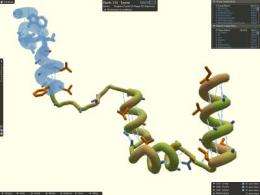
Foldit players have control over which parts of the protein they want to move. In this picture, a player has frozen some spirals to immobilize them while the player adjusts the rest of the protein. Credit: University of Washington

At any moment, thousands of computers are working away at calculating how physical forces would cause a protein to fold. But no computer in the world is big enough, and computers may not take the smartest approach. So the UW team tried to make it into a game that people could play and compete. Foldit turns protein-folding into a game and awards points based on the internal energy of the 3-D protein structure, dictated by the laws of physics.

Tens of thousands of players have taken the challenge. The author list for the paper includes an acknowledgment of more than 57,000 Foldit players, which may be unprecedented on a scientific publication.

"We had to talk to the editors a bit about getting that in there," said first author Seth Cooper, a UW doctoral student in computer science. "I think it's not the standard style of doing things."

The author list is a first step toward the original goal of having many people contribute to scientific research. Players come from all over the world, and are of all ages and educational backgrounds.

"I don't think that there's any sort of real demographic profile that would be a typical Foldit player," Cooper said.

A major challenge in developing the game was to make it fun while still producing valid scientific results, Cooper said. There was a constant back-and-forth between scientists, game developers and players to achieve the best balance.

The class of problems in which humans were able to do better than computers required intuitive leaps or major shifts in strategy. Future work will aim to better combine the strengths of experts, computers and thousands of game players.

"It's a new kind of collective intelligence, as opposed to individual intelligence, that we want to study," Popović said. "We're opening eyes in terms of how people think about human intelligence and group intelligence, and what the possibilities are when you get huge numbers of people together to solve a very hard problem."
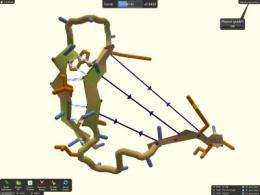
Foldit players can use different tools to interactively twist, jiggle and reshape proteins. In this picture, a player uses rubber bands (purple) to pull together two sheets, or long flat regions of the protein. Credit: University of Washington

The Foldit blog lets players know about updates to the game, upcoming competitions, and special events like online chats with the scientists or game developers.

The Foldit energy calculations are carried out by Rosetta, the procedure for computing protein structures developed by David Baker, a UW biochemistry professor and co-author of the new paper. Baker's group has previously used donated computer cycles through Rosetta@home to help crunch through the trillions of possible orientations for the chains of amino acid molecules that make up proteins.

The human thinking patterns may now help bolster Rosetta's skills. Researchers in Baker's group are analyzing the most successful Foldit strategies and trying to replicate them in the computer-powered version.

This summer the Foldit community has been focused on problems in the Critical Assessment of Techniques for Protein Structure Prediction competition, the world's largest comparison of protein-folding computation strategies. Last year Foldit competed as part of the Baker lab team. This year for the first time Foldit players have their own team, taking on the most sophisticated supercomputers in the world. Contest results will be announced in December.

Now, Foldit players will focus on designing novel proteins. Last year a Texas player who goes by the name "BootsMcGraw" was the first Foldit player to have his new design synthesized in the Baker lab. Although this particular structure did not work, the researchers plan to try again and are optimistic about the possibilities.

"I think that design problems are an area where human computing has huge potential," Baker said. "People are good at building things, so I'm expecting that people will be very good at building proteins for different purposes. That's where I'm expecting really great things from Foldit."

Players may someday design proteins to disable the flu virus or tackle HIV, or perform tasks outside the body such as cleaning up waste or generating energy.

Cooper has years of experience with computer games and says he "might be classified as a gamer." Now he's found a way to turn this global pastime to the benefit of science.

"We're taking the effort that people put into games and channeling that into something productive and useful for humanity," he said. "We're combining computational power and human brainpower to tackle important problems that neither one of them can do alone."

Explore further: RNA capable of catalyzing electron transfer on early earth with iron's help, study says

Related Stories

Leveling the gaming field

May 13, 2008

A new computer game developed by MIT and Singaporean students makes it possible for visually impaired people to play the game on a level field with their sighted friends.

OnLive game streaming service to start in June

Mar 10, 2010

(AP) -- In an industry first, a new gaming service will start allowing people to "stream" popular games over the Internet in June, similar to checking Web-based e-mail or listening to music online.

Gaming - step by step

Mar 19, 2010

(PhysOrg.com) -- For one University of Alberta professor, making the move from California to Edmonton turned out to be the first step in becoming involved with an award-winning video game.

Recommended for you

Attacking MRSA with metals from antibacterial clays

May 17, 2013

In the race to protect society from infectious microbes, the bugs are outrunning us. The need for new therapeutic agents is acute, given the emergence of novel pathogens as well as old foes bearing heightened antibiotic resistance.

Keeping fruit, vegetables and cut flowers fresh longer

May 15, 2013

New technology offers the promise of reducing billions of dollars of losses that occur each year from the silent, invisible killer of fruits, vegetables and cut flowers—a gas whose effects are familiar to everyone who has ...

Why don't beetles freeze in the winter?

May 14, 2013

For 37 years, Queen's University Biochemistry professor Peter Davies has been unraveling the mystery of why some organisms including insects and fish don't freeze in the winter. His research into insect antifreeze protein ...

The molecular basis of strawberry aroma

May 13, 2013

You know that summer is here when juicy red strawberries start to appear on the shelves. In Germany, this seasonal fruit has never been more popular: on average 3.5 kilos per head were consumed in 2012—a ...

A new dimension for 3-D protein structures

May 13, 2013

(Phys.org) —3D structures of biological molecules like proteins directly affect the way they behave in our bodies. EPFL scientists have developed a new infrared-UV laser method to more accurately determine ...

User comments : 3

Adjust slider to filter visible comments by rank

Display comments: newest first

bottomlesssoul
not rated yet Aug 04, 2010
I don't see any mention of actual numbers, how many man hours over the 57,000 participants? In any case this is a fantastic result given that had these problems remained inside the numerical protein folding community; whose total population numbers no more than a few thousand, they might have found the same results themselves in 40 years or so. A wonderfully unique strategy to reach for impossibly high hanging fruit, get 57,000 people to watch and help, feedback and advice filtered through higher level super computers.

A truly surprising result for me is this deeper hybridization of distributed super computing with humans actively participating at the problem level with their brain power at each node.

I still can't get my head around it. Is it a one off or did a new powerful tool come into being, emerging from humanity + internet in a strange feedback loop?
maxcypher
not rated yet Aug 04, 2010
Not a 'one off'. It is yet another step in the emergence of global intelligence.
Palli
5 / 5 (2) Aug 05, 2010
If we ever get free from capitalism, we'll be freeing up gobbles of brain resources that can further benefit researches like these. Think of all the productivity that can be acquired from people that today are totally useless: bankers, accountants, lawyers, marketing...by converting pencil-pushing to dna-folding we can get premium from these people :)

More news stories

Beautiful 'flowers' self-assemble in a beaker

By simply manipulating chemical gradients in a beaker of fluid, materials scientists at Harvard have found that they can control the growth behavior of crystals to create precisely tailored structures—such ...

Attacking MRSA with metals from antibacterial clays

In the race to protect society from infectious microbes, the bugs are outrunning us. The need for new therapeutic agents is acute, given the emergence of novel pathogens as well as old foes bearing heightened antibiotic resistance.

Making gold green: New non-toxic method for mining gold

Northwestern University scientists have struck gold in the laboratory. They have discovered an inexpensive and environmentally benign method that uses simple cornstarch—instead of cyanide—to isolate gold from raw materials ...

Engineers' nanoantennas improve infrared sensing

(Phys.org) —A team of University of Pennsylvania engineers has used a pattern of nanoantennas to develop a new way of turning infrared light into mechanical action, opening the door to more sensitive infrared ...

Mapping a route to stem cell therapies

Monash University researchers are shedding light on the complex processes that underpin the creation and differentiation of stem cells, bringing closer the promise of 'miracle' therapies.

Lymphatic fluid takes detour

When tumours metastasise, they can block lymphatic vessels, as researchers from ETH Zurich have discovered using a new method. The lymphatic fluid subsequently has to find a new path through the tissue. Such ...

Tiny ancient bandicoot shines light on future

(Phys.org) —A 20 million-year-old fossil skull identified as a 'pocket-sized' ancestor of the bandicoot will give insights into the future of Australia's modern endangered animals.