Trawl fishing surviving through sale of previously discarded fish
Aug 03, 2010
Trawl fishing surviving through sale of previously discarded fish

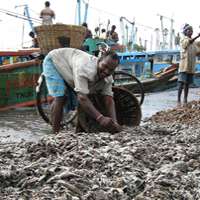
 Fishermen barely eking out a profit because of overfishing of their target stock, shrimp, are now surviving by selling their bycatch (the low-value fish also caught in the large, indiscriminate nets). Although good for the fishermen, scientists warn that the prolonged trawl fishing along certain areas will lead to an ‘ecological catastrophe’ and the ‘permanent loss of livelihoods for fishers’ as well as other individuals who work in the industry.

A paper published in the current issue of the journal Conservation Letters by researchers from the University of Cambridge shows that the drivers for the use of this once discarded resource are twofold: declining shrimp stocks and profits, and the development of alternative markets, which include the rapidly growing poultry-feed industry.

Trawl fishing is a technique employed the world over in which a fishing vessel drags a gaping net along the . Unfortunately, though trawlers target a limited number of species such as shrimp and some fish, trawl nets capture anything in their path and seriously damage the as well. It's been estimated that trawlers in the tropics capture an average of 10 kilos of bycatch for every kilo of shrimp.

When trawl fishing first began in South and Southeast Asia, trawlers discarded large quantities of bycatch. The lead author of the study, Aaron Savio Lobo from the Department of Zoology, says this is now changing, "Recently there has been a shift in this trend and an increase in the use of the previously discarded bycatch."

Several species of bycatch which were traditionally discarded are now being sold for local consumption. Additionally, there has been increased demand for 'trash fish' to feed the region's rapidly growing , a consequence of the country's rising affluence.

The Cambridge team's research demonstrates that even though the profits obtained from the original target catch have fallen almost to nothing, the development of new markets for bycatch now means that trawlers can continue fishing and still remain profitable.

Looking to the policy implications of the study, Lobo says: "If appropriate measures are not taken immediately to limit  then the outcomes could be catastrophic for the ecosystem and result in the permanent loss of livelihoods for the fishers in the region."

Explore further: Climate change may have little impact on tropical lizards

add to favorites email to friend print save as pdf

Related Stories

Commercial fishing estimated to kill millions of sea turtles

Apr 06, 2010

The number of sea turtles inadvertently snared by commercial fishing gear over the past 20 years may reach into the millions, according to the first peer-reviewed study to compile sea turtle bycatch data from gillnet, trawl ...

West Coast fishermen embark on new wave of fishing

Sep 06, 2009

(AP) -- The West Coast groundfish fleet has struggled to stay afloat during major cutbacks to reverse long-standing problems with overfishing and to protect the seafloor from damage caused by bottom trawling ...

'Bycatch' whaling a growing threat to coastal whales

Jun 23, 2009

Scientists are warning that a new form of unregulated whaling has emerged along the coastlines of Japan and South Korea, where the commercial sale of whales killed as fisheries "bycatch" is threatening coastal stocks of minke ...

Recommended for you

Climate change may have little impact on tropical lizards

May 17, 2013

A new Dartmouth College study finds human-caused climate change may have little impact on many species of tropical lizards, contradicting a host of recent studies that predict their widespread extinction in a rapidly warming ...

Wetlands: value to locals matters most

May 17, 2013

A new way of valuing ecosystem services, incorporating the local perspective, is the driving force behind a project assessing aquatic ecosystems in highland areas of Asia

Symbolic saviour of an endangered species

May 16, 2013

In 2006 Berlin Zoo saw the birth of their first polar bear cub in 33 years. A retired circus polar bear gave birth to two cubs at the zoo. One of them died soon after, but Knut survived. At only a month old he became the ...

User comments : 1

Adjust slider to filter visible comments by rank

Display comments: newest first

Semmster
not rated yet Aug 03, 2010
All we care about are the effects of our actions on us. Doesn't anyone see something wrong with this picture? We, mankind, are going to pay for what we've done...

More news stories

Honeybees trained in Croatia to find land mines

(AP)—Mirjana Filipovic is still haunted by the land mine blast that killed her boyfriend and blew off her left leg while on a fishing trip nearly a decade ago. It happened in a field that was supposedly ...

Bold action, big money needed to curb Asia floods

Asia's flood-prone megacities should fund major drainage, water recycling and waste reduction projects to stem deluges and secure clean supply for their booming populations, experts said Sunday.