James Webb Space Telescope Completes Cryogenic Mirror Test
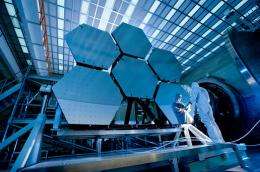
Recently, six James Webb Space Telescope beryllium mirror segments completed a series of cryogenic tests at the X-ray & Cryogenic Facility at NASA's Marshall Space Flight Center in Huntsville, Ala.
During testing, the mirrors were subjected to extreme temperatures dipping to -415 degrees Fahrenheit, permitting NASA contractor engineers to measure in extreme detail how the shape of the mirror changes as it cools.
With those measurements, the mirrors will be shipped to Tinsley Corp. in Redmond, Calif., for final surface polishing at room temperature. Using those "surface error" measurements, each mirror will then be polished in the opposite of the surface error values observed, so when the mirror goes through the next round of cryogenic testing, at Marshall, it should "distort" into a perfect shape.
The facility at Marshall is the world’s largest X-ray telescope test facility and a unique site for cryogenic, clean-room optical testing.
The next set of mirrors are due to arrive at NASA Marshall in August.
The Webb telescope has a total of 18 mirrors. Each of the 18 mirror segments will be cryogenically tested twice in the Marshall Center's X-ray & Cryogenic Facility to ensure that the mirror will maintain its shape in a space environment -- once with bare polished beryllium and then again after a thin coating of gold is applied.
The cryogenic test gauges how each mirror changes temperature and shape over a range of operational temperatures in space. This helps predict how well the telescope will image infrared sources.
The mirrors are designed to stay cold to allow scientists to observe the infrared light they reflect using a telescope and instruments optimized to detect this light. Warm objects give off infrared light, or heat. If the Webb telescope mirror is too warm, the faint infrared light from distant galaxies may be lost in the infrared glow of the mirror itself. Thus, the Webb telescope's mirrors need to operate in a deep cold or cryogenic state, at around -379 degree Fahrenheit.
Northrop Grumman is the prime contractor for the Webb telescope, leading a design and development team under contract to NASA's Goddard Space Flight Center in Greenbelt, Md.
The James Webb Space Telescope is NASA's next-generation premier space observatory, exploring deep space phenomena from the formation of distant galaxies to the behavior and interrelationships of nearby planets and stars. The Webb telescope will give scientists clues about the formation of the universe and the evolution of our own solar system, from the first light after the Big Bang to the formation of star systems capable of supporting life on planets like Earth.
Provided by JPL/NASA


