Clean Genes: Chemists Cull the Good Synthetic DNA from the Bad
Jul 23, 2010 By Marcia Goodrich
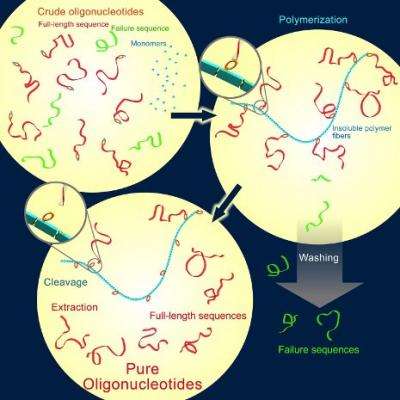
Synthetic DNA purification process developed by Shiyue Fang, Michigan Tech Chemistry Department image

(PhysOrg.com) -- Birds do it, bees do it. Even scientists in labs do it. But the scientists can't hold a candle to the birds and the bees, who can make gobs of primo DNA without even thinking about it.

DNA is a critical element of , and scientists working to develop cures for diseases make it with synthesizers. Unfortunately, synthesizers don’t do nearly as good a job as cells in stringing together to make DNA, and many of the resulting sequences—called truncated DNA—are too short and must be discarded.

Isolating perfect DNA sequences is very expensive, so expensive that some clinical trials for gene therapy drugs have been put on hold for lack of funding. A discovery by Shiyue Fang, an assistant professor of chemistry at Michigan Technological University, could change that.

“Our method can provide high-quality, pure by the kilogram at a much lower cost,” he says. It could also be used to purify RNA and other biological molecules such as peptides that have potential as pharmaceuticals.

Fang adds —molecules that can link together into polymers—to the nucleic acids in a stock DNA synthesizer. Truncated DNA won’t attach to the monomers, but all other strands of DNA will. Then, once the synthesis is complete, the monomers join together to form a long polymer hanging with perfect DNA sequences, like clean laundry on a clothesline. “Then we just snip them off,” says Fang. “It’s a nice trick.”

Fang’s process does not weed out those few that are too long or are missing a nucleic acid. “Fortunately, these impurities exist only in minute quantities,” he says.

Fang is now tweaking the process so that the monomers attach only to the truncated DNA. It’s relatively easy to wash the polymers out of solution, leaving behind the perfect strands.

Fang has filed a patent application on the process and hopes it can soon be put to good use by medical researchers. And, as DNA drugs enter the market, his purification method could drastically reduce manufacturing costs, benefiting patients with genetic and many other diseases and their insurers, including Medicare.Fang’s work has been funded by the National Science Foundation and published in the American Chemical Society Journal -- Organic Letters as a rapid communication.

PhD student Suntara Fueangfung is a coauthor on the paper, “Scalable Synthetic Oligodeoxynucleotide Purification with Use of a Catching by Polymerization, Washing, and Releasing Approach.”

Explore further: RNA capable of catalyzing electron transfer on early earth with iron's help, study says

Related Stories

DNA molecules can detect pathogens, deliver drugs

May 20, 2009

(PhysOrg.com) -- First, Cornell researchers created DNA "bar codes" -- strands of the genetic material that quickly identify the presence of different molecules by fluorescing. Now, they have created new DNA ...

Purdue researchers use enzyme to clip 'DNA wires'

Mar 01, 2005

Researchers at Purdue University have attached magnetic "nanoparticles" to DNA and then cut these "DNA wires" into pieces, offering the promise of creating low-cost, self-assembling devices for future computers. ...

DNA constraints control structure of attached macromolecules

Jun 28, 2005

A new method for manipulating macromolecules has been developed by researchers at the University of Illinois at Urbana-Champaign. The technique uses double-stranded DNA to direct the behavior of other molecules. In previous ...

Rapid, Inexpensive DNA Sequencing Moves Closer to Reality

Feb 19, 2010

As efforts such as The Cancer Genome Atlas and others generate vast quantities of information about the genetic makeup of different types of cancer, it is becoming increasingly clear that such information has great potential ...

Recommended for you

Attacking MRSA with metals from antibacterial clays

May 17, 2013

In the race to protect society from infectious microbes, the bugs are outrunning us. The need for new therapeutic agents is acute, given the emergence of novel pathogens as well as old foes bearing heightened antibiotic resistance.

Keeping fruit, vegetables and cut flowers fresh longer

May 15, 2013

New technology offers the promise of reducing billions of dollars of losses that occur each year from the silent, invisible killer of fruits, vegetables and cut flowers—a gas whose effects are familiar to everyone who has ...

Why don't beetles freeze in the winter?

May 14, 2013

For 37 years, Queen's University Biochemistry professor Peter Davies has been unraveling the mystery of why some organisms including insects and fish don't freeze in the winter. His research into insect antifreeze protein ...

The molecular basis of strawberry aroma

May 13, 2013

You know that summer is here when juicy red strawberries start to appear on the shelves. In Germany, this seasonal fruit has never been more popular: on average 3.5 kilos per head were consumed in 2012—a ...

A new dimension for 3-D protein structures

May 13, 2013

(Phys.org) —3D structures of biological molecules like proteins directly affect the way they behave in our bodies. EPFL scientists have developed a new infrared-UV laser method to more accurately determine ...

User comments : 0

More news stories

Attacking MRSA with metals from antibacterial clays

In the race to protect society from infectious microbes, the bugs are outrunning us. The need for new therapeutic agents is acute, given the emergence of novel pathogens as well as old foes bearing heightened antibiotic resistance.

Beautiful 'flowers' self-assemble in a beaker

By simply manipulating chemical gradients in a beaker of fluid, materials scientists at Harvard have found that they can control the growth behavior of crystals to create precisely tailored structures—such ...

Heat-related deaths in Manhattan projected to rise

Residents of Manhattan will not just sweat harder from rising temperatures in the future, says a new study; many may die. Researchers say deaths linked to warming climate may rise some 20 percent by the 2020s, ...

Kinks and curves at the nanoscale

One of the basic principles of nanotechnology is that when you make things extremely small—one nanometer is about five atoms wide, 100,000 times smaller than the diameter of a human hair—they are going ...