NASA TRMM satellite data show areas of Alex's heavy rainfall
Jul 01, 2010
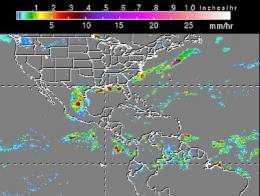
This flood map was created on July 1 at 1200 UTC (8 a.m. EDT) from TRMM data, and shows estimated rainfall from Hurricane Alex. The red areas indicate as much as 10 inches of rainfall, while the yellow areas indicate up to 5 inches. The heaviest rainfall is apparent in northeastern Mexico. Credit: NASA/SSAI, Hal Pierce

Areas of northeastern Mexico were slammed with heavy rainfall, and NASA's Tropical Rainfall Measuring Mission Satellite estimated more than 10 inches of rainfall fell in various locations and that data was used to create a rainfall map.

Heavy rain amounts from satellites and flood inundation calculations from a hydrological are updated every three hours globally with the results shown on the "Global Flood and Landslide Monitoring" area of NASA's Measuring Mission (TRMM) web page.

A flood map created on July 1 at 1200 UTC (8 a.m. EDT) from TRMM data, and shows estimated rainfall from Hurricane Alex. The map is color coded where red areas indicate as much as 10 inches of rainfall, while the yellow areas indicate up to 5 inches. The heaviest rainfall appeared in northeastern Mexico on the latest flood map.

The (TMI) showed that Alex had a well defined eye containing powerful thunderstorms that were dropping extreme amounts of rain as it was making landfall. The analysis indicates that an area in southeastern Texas, that was away from the center of the hurricane, had the most intense rainfall with rain rates over 36 mm/hr (~1.41 inches/hour).

Explore further: Astonishing hi-resolution satellite views of the destruction from the Moore, Oklahoma tornado

add to favorites email to friend print save as pdf

Related Stories

NASA's TRMM satellite sees heavy rainfall in Choi-Wan

Sep 17, 2009

NASA and the Japanese Space Agency's Tropical Rainfall Measuring Mission (TRMM) satellite flew over the center of Super Typhoon Choi-Wan at 2:34 EDT on September 17, 2009 and captured heavy rainfall around ...

TRMM satellite doesn't need 3-D glasses for Magda

Jan 22, 2010

People may need 3-D glasses to see life-like images, but rainfall and cloud data from the Tropical Rainfall Measuring Mission or TRMM satellite gives scientists a three-dimensional look at tropical cyclones ...

NASA Scans Ivan Inside for 3D Image

Sep 16, 2004

On the morning of September 15, 2004, NASA's Tropical Rainfall Measuring Mission (TRMM) satellite captured a 3-D look inside Hurricane Ivan, still a Category 4 storm. This unique look at Ivan shows the struct ...

Recommended for you

Strong earthquake at exceptional depth

21 hours ago

This morning at 05:45 CEST, the earth trembled beneath the Okhotsk Sea in the Pacific Northwest. The quake, with a magnitude of 8.2, took place at an exceptional depth of 605 kilometers. Because of the great ...

Marine forecasting on the horizon for Indian Ocean Rim

21 hours ago

Nearly all of the member countries of the Indian Ocean Rim Association for Regional Cooperation (IOR-ARC) will attend the week-long workshop to further cooperation and understanding on international ocean ...

Russia evacuates drifting Arctic research station

May 23, 2013

Russia has ordered the urgent evacuation of the 16-strong crew of a drifting Arctic research station after ice floe that hosts the floating laboratory began to disintegrate, officials said Thursday.

User comments : 0

More news stories

Galaxies fed by funnels of fuel

(Phys.org) —Computer simulations of galaxies growing over billions of years have revealed a likely scenario for how they feed: a cosmic version of swirly straws.

Source of life running out: water scientists

The majority of people on Earth people will face severe water shortages within a generation or two if pollution and waste continues unabated, scientists warned at a conference in Bonn Friday.

Dark, massive asteroid to fly by Earth on May 31

It's 1.7 miles long. Its surface is covered in a sticky black substance similar to the gunk at the bottom of a barbecue. If it impacted Earth it would probably result in global extinction. Good thing it is ...

Drones may violate international law

(Phys.org) —As President Obama gives a speech on national security—including defending U.S. use of drones to combat terrorism—Leila Sadat, JD, international law expert and professor of law at Washington University in ...