Genetic Code 2.0: Novel artificial proteins for industry and science
Jun 29, 2010
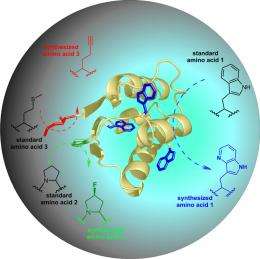
For the first time, three amino acids of one protein could be changed at the same time in a single experiment. Image: Nediljko Budisa / MPI of Biochemistr

(PhysOrg.com) -- The creation of synthetic proteins plays an important role for economy and science. By the integration of artificial amino acids in proteins (genetic code engineering), their already existing qualities can be systematically improved, allowing new biological features to arise.

Now, scientists at the Max Planck Institute of Biochemistry (MPIB) in Martinsried near Munich, Germany, have succeeded in taking another important step in this research area: For the first time, they were able to integrate three different synthetic amino acids into one protein in a single experiment. (Angewandte Chemie, June 24, 2010).

Proteins are the main actors in our body: They transport substances, convey messages or carry out vital processes in their role as molecular machines. The "helmsmen of the cell" are composed of amino acids, whose sequence is already defined by the heritable information in every living being. The translation of this information during the production of proteins () is determined by the . 20 amino acids form the standard set of which proteins are built. In natural conditions, however, several hundred amino acids can be found and, of course, new amino acids can also be produced in the laboratory.

With regard to their properties, they differ from the 20 standard amino acids, because of which, by their integration in proteins, specific structural and biological characteristics of proteins can be systematically changed. So far, only one type of synthetic amino acid could be inserted into a protein during a single experiment in a residue-specific manner; thus, only one property of a protein could be modified at once.

Nediljko Budisa, head of the research group at the MPIB, has now made important methodical progress in the area of genetic code engineering. The scientists were able to substitute three different natural amino acids by synthetic ones at the same time in a single experiment. The biochemist is pleased: "The research area of genetic code engineering and code extension has with this result reached a new development phase."

Budisa’s method could be of great importance, particularly for the industry and economy, because the production of artificial proteins by genetic code engineering in his view demonstrates a solid basis for the development of new technologies. "During integration, synthetic amino acids confer their characteristics to proteins. Thus, the development will allow the synthesis of totally new classes of products, whose chemical synthesis has not been possible so far by conventional engineering using only the 20 standard ", explains Budisa regarding to future prospects. "Thanks to our method, in the future it will be possible to tailor industrial relevant proteins with novel properties: for example proteins containing medical components."

Explore further: Long distance calls by sugar molecules

More information: S. Lepthien, L. Merkel, N. Budisa, In vivo double and triple labeling of proteins using synthetic amino acids. Angewandte Chemie, June 24, 2010. DOI:10.1002/anie.201000439

Related Stories

Research breakthrough for the protein factories of tomorrow

Sep 22, 2006

Using a kind of molecular ‘hip joint operation,’ researchers at Uppsala University have succeeded in replacing a natural amino acid in a protein with an artificial one. This step forward opens the possibility of creating ...

'Fishy' clue helps establish how proteins evolve

Jan 27, 2009

(PhysOrg.com) -- Three billion years ago, a "new" amino acid was added to the alphabet of 20 that commonly make up proteins in organisms today. Now researchers at Yale and the University of Tokyo have demonstrated ...

Core tenets of the 'histone code' are universal

Sep 06, 2007

In one of biology’s most impressive engineering feats, specialized proteins called histones package some six-and-a-half feet of human DNA into a nucleus that averages just five microns in diameter.

Unfolding 'nature's origami'

Mar 02, 2009

Sometimes known as "nature's origami", the way that proteins fold is vital to ensuring they function correctly. But researchers at the University of Leeds have discovered this is a 'hit and miss' process, with proteins potentially ...

Recommended for you

Long distance calls by sugar molecules

13 hours ago

All our cells wear a coat of sugar molecules, so-called glycans. ETH Zurich and Empa researchers have now discovered that glycans rearrange water molecules over long distances. This may have an effect on ...

Researchers discover a way to detect new viruses

Jun 17, 2013

(Phys.org) —In research published in Biochemical and Biophysical Research Communications, Saint Louis University researchers describe a technology that can detect new, previously unknown viruses. The te ...

Genomic assay as an alternative to animal testing

Jun 14, 2013

The method developed by the group in Lund is based on human cells grown in a laboratory. The cells are exposed to a chemical and then parts of their genetic content are filtered out and transferred to a microchip.

User comments : 1

Adjust slider to filter visible comments by rank

Display comments: newest first

kevinrtrs
1 / 5 (1) Jun 30, 2010
I'm all for scientists discovering new ways to use biological materials.
I just hope that they are equally diligent in checking for and creating safety firewalls to prevent harm to other biological systems.

More news stories

Long distance calls by sugar molecules

All our cells wear a coat of sugar molecules, so-called glycans. ETH Zurich and Empa researchers have now discovered that glycans rearrange water molecules over long distances. This may have an effect on ...

Counting small RNA in disease-causing organisms

Small molecules of RNA (tens to hundreds of nucleotides in length) play a key regulatory role in bacteria. Due to their small size, directly measuring the number of small RNA (sRNA) present in a single bacterium ...

New Zealand emerges as guinea pig for global tech firms

When Google chose New Zealand to unveil secret plans for a balloon-driven wi-fi network last weekend, it cemented the country's reputation as a test bed for global tech companies looking to trial their latest innovations, ...