Baby corals dance their way home
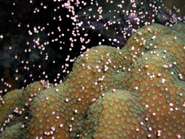
(PhysOrg.com) -- Baby corals find their way home in their first days as free-swimming larvae by listening to the noise of animals on the reef and actively swimming towards it, an international team of researchers working in the Caribbean has discovered. These findings raise new concerns for the future of coral reefs as increasing human noise pollution in the world's oceans is masking reef sounds.
Dr Steve Simpson, Senior Researcher in the University of Bristol's School of Biological Sciences discovered several years ago that baby reef fish use sound as a cue to find coral reefs, but was amazed when his Dutch collaborators in Curaçao started finding that coral larvae - which must quickly find a safe place to land and establish a colony or they will die - can do the same thing.
The team designed a 'choice chamber' (a device that offers small invertebrates two or more contrasting conditions and allows them to move freely towards the one they prefer), put coral larvae into it and played them recordings of a coral reef. The results clearly showed that the flea-sized larvae were strongly attracted to the noise as they seek a suitable habitat.
Coral larvae look like tiny eggs covered in hairs, and come from the same group of animals (Cnidaria) that also includes sea anemones. How these simple creatures detect sound is unknown, but Dr Simpson said: "At close range sound stirs up water molecules, and this could waggle tiny hair cells on the surface of the larvae, providing vital directional information for baby corals."
Corals aggregate to form vast reefs, which are now one of the most threatened ecosystems in the world. Due to global warming and ocean acidification, some experts have suggested coral reefs are now on Death Row. Understanding how these vulnerable animals complete their life-cycle is essential to ensure appropriate management.
Since corals, like fish, respond to reef sounds then the masking effects of human noise pollution in coral environments is of extra concern. "Anthropogenic noise has increased dramatically in recent years, with small boats, shipping, drilling, pile driving and seismic testing now sometimes drowning out the natural sounds of fish and snapping shrimps," Dr Simpson said.
More information: www.plosone.org/
Provided by University of Bristol


