The Carbon Cycle Before Humans
Geoengineering -- deliberate manipulation of the Earth's climate to slow or reverse global warming -- has gained a foothold in the climate change discussion. But before effective action can be taken, the Earth's natural biogeochemical cycles must be better understood.
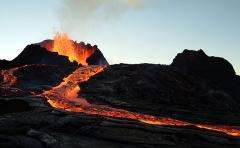
Two Northwestern University studies, both published online recently by Nature Geoscience, contribute new -- and related -- clues as to what drove large-scale changes to the carbon cycle nearly 100 million years ago. Both research teams conclude that a massive amount of volcanic activity introduced carbon dioxide and sulfur into the atmosphere, which in turn had a significant impact on the carbon cycle, oxygen levels in the oceans and marine plants and animals.
Both teams studied organic carbon-rich sediments from the Western Interior Seaway, an ancient seabed stretching from the Gulf of Mexico to the Arctic Ocean, to learn more about a devastating event 94.5 million years ago when oxygen levels in the oceans dropped so low that one-third of marine life died.
The authors of the first paper, titled "Volcanic triggering of a biogeochemical cascade during Oceanic Anoxic Event 2," reveal that before oxygen levels dropped so precipitously there was a massive increase in oceanic sulfate levels. Their conclusion is based on analyses of the stable isotopes of sulfur in sedimentary minerals from the central basin of the Western Interior Seaway, located in Colorado.
The researchers theorize that a massive amount of volcanic activity caused this sulfate spike, which triggered a cascade of biogeochemical events. More sulfate led to an abundance of the nutrient phosphorous, which allowed phytoplankton populations in the oceans to multiply. The phytoplankton thrived and then died. Their decomposing bodies depleted oxygen levels in the oceans, leading to the widespread death of marine animals.
The sedimentary burial of marine organic carbon during this event was so large, some prior studies hypothesized that it caused a decrease in atmospheric carbon dioxide levels. In the second Nature Geoscience paper, titled "Carbon sequestration activated by a volcanic carbon dioxide pulse during ocean anoxic event 2," the researchers tested the carbon dioxide drawdown prediction. By studying fossil plant cuticle material, they determined the amount of carbon dioxide in the atmosphere at the time the plants were growing. (The cuticle samples were collected from sites representing the western shore of the Western Interior Seaway, in present-day southwestern Utah.)
This work found that before the onset of ocean anoxia, the level of carbon dioxide in the atmosphere increased by approximately 20 percent. This significant increase is consistent with the volcanic activity invoked by the first Northwestern study (described above). The paleo-carbon dioxide reconstruction also detected two episodes of marked decrease in carbon dioxide levels -- up to 200 parts per million -- at the time of the early phase of marine carbon burial. This observation provides strong support for the carbon dioxide drawdown hypothesis.
"Our research highlights the previously unappreciated role that the sulfur cycle plays in regulating nutrient cycling, the carbon cycle and climate," said Matthew Hurtgen, assistant professor of Earth and planetary sciences in the Weinberg College of Arts and Sciences at Northwestern and lead researcher of the first study.
"These two complementary studies provide a much clearer picture of how the Earth's carbon cycle was dramatically affected by catastrophic natural events long ago," said Bradley Sageman, professor and chair of Earth and planetary sciences at Northwestern and a co-author of both papers. "Although these events played out over hundreds or thousands of years, the magnitude of the changes, in carbon dioxide levels for example, are similar to those of the last 150 years resulting from human influence on the carbon cycle. The evidence demonstrates that the modern carbon cycle has been accelerated by orders of magnitude."
More information: The sulfur work reported in the paper "Volcanic triggering of a biogeochemical cascade during Oceanic Anoxic Event 2" was conducted by Derek D. Adams, a doctoral candidate in Hurtgen's research group. Adams is first author of the paper; Hurtgen and Sageman are the paper's other authors.
Provided by Northwestern University


