Taiwan unveils super-tiny microchip
Dec 16, 2009
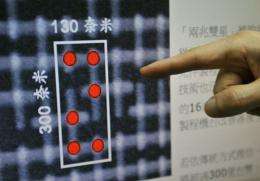
An electronic image shows six transistors installed in a space measuring 300 nanometres by 130 nanometres on a microchip developed by State-backed National Nano Device Laboratories.

Taiwan has developed tiny microchips that could lead to lighter and cheaper laptops or mobile phones, researchers and observers said Wednesday.

State-backed National Nano Device Laboratories in northern Hsinchu city said it had succeeded in packing more into smaller chip space than anyone else so far.

"Electronic gadgets like cellphones and laptops could become smaller, lighter and cheaper with this technology," Yang Fu-liang, the lab's chief, told AFP.

Currently, laptops seldom weigh less than about 1.5 kilograms (3.3 pounds) but the latest development could see notebook computers weighing as little as 500 grams.

"It's indeed the most advanced ever," said Nobunaga Chai, an analyst at Digitimes, a Taipei-based industry publication.

The field Yang and his team are working on is called 16-nanometre technology, referring to the space between transistors on a chip. The smaller the space, the more transistors can be fitted on to the .

An average human finger nail is 25 million nanometres long. Researching new technologies at this microscopic level poses formidable challenges to scientists.

"Sixteen nanometres used to be considered the final frontier," said Yang.


Join PhysOrg.com on Facebook!
Follow PhysOrg.com on Twitter!

Explore further: Organic CMOS image sensor technology using organic photoelectric conversion layer

add to favorites email to friend print save as pdf

Related Stories

Intel Microchip Packs Two Billion Transistors

Feb 04, 2008

Intel has just announced the first microchip that contains more than two billion transistors - tiny switches that together perform the calculations in computers. The chip, known as Tukwila, marks a milestone ...

Freescale, University of Florida advance Moore's law

Jun 01, 2005

Industry’s first double-gate transistor model enables smaller, more powerful silicon products that use less energy Freescale Semiconductor and the University of Florida have created the industry's first double-gate tra ...

James Bond-style technologies are closer to reality

Jul 21, 2004

James Bond-style technologies such as cell phones the size of earpieces and invisible sensors sprinkled about to detect toxins are closer to reality. University of Michigan researchers have figured out how to build wireless ...

Recommended for you

Kim Dotcom slams Megaupload 'data massacre'

56 minutes ago

Megaupload founder Kim Dotcom Thursday condemned a Dutch company's decision to delete million of files belonging to users of his defunct website, calling it "the largest data massacre in the history of the ...

US seizure of journalist records called 'chilling'

1 hour ago

The US government's secret seizure of Associated Press phone records had a "chilling effect" on newsgathering by the agency and other news organizations, AP's top executive said Wednesday.

Microsoft mulled buying Nokia unit

1 hour ago

Microsoft was in talks to boost its position in the mobile phone market by buying the devices business from Nokia but failed to seal a deal, the Wall Street Journal reported Wednesday.

User comments : 1

Adjust slider to filter visible comments by rank

Display comments: newest first

Buyck
not rated yet Dec 17, 2009
Whit this scale we can achieve amazing things. I think for possibilities in consumer electronics, supercomputers and brain implants and so on!

More news stories

Kim Dotcom slams Megaupload 'data massacre'

Megaupload founder Kim Dotcom Thursday condemned a Dutch company's decision to delete million of files belonging to users of his defunct website, calling it "the largest data massacre in the history of the ...

Microsoft mulled buying Nokia unit

Microsoft was in talks to boost its position in the mobile phone market by buying the devices business from Nokia but failed to seal a deal, the Wall Street Journal reported Wednesday.

The broken symphony of swinging metronomes

An experiment with 30 metronomes reveals chimera states which combine aspects of synchrony and of disorder. Researchers had been looking for such states for ten years.