Microscopy reveals structure of calcite shells
Nov 30, 2009 By Anne Ju
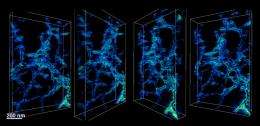
This image shows the 3-D nanoscale structure of the inside of a synthetic calcite crystal, which was grown in an agarose gel. In this environment, the crystal grows around the polymeric fibers. The structure gives insight into the formation of single crystals by biological organisms. Image: Estroff/Muller labs

(PhysOrg.com) -- Lara Estroff and colleagues have taken a deep, detailed look at the way lab-created calcite crystals, similar to those found in nature, grow in tandem with proteins and other large molecules.

Single crystals of the mineral calcite -- the chief material in limestone -- are predictable, homogeneous and, well, a little boring.

But scientists have long marveled at how biological crystals of calcite grow together with other organic materials to form, for example, shells and sea urchin spines. Biologists and materials scientists would love to know exactly how to re-create such natural composites in the lab.

Lara Estroff, assistant professor of materials science and engineering, and colleagues have taken a deep, detailed look at the way lab-created calcite crystals, similar to those found in nature, grow in tandem with proteins and other large molecules, and they report their findings in the Nov. 27 issue of the journal Science. The journal also features the work as a "Perspective" written by Kansas State University's Mark Hollingsworth.

"We knew the organics were in there, but what no one had been able to do up until now was actually see what that organic-inorganic interface looked like," said Estroff, whose lab focuses on the synthesis and characterization of bio-inspired materials.

Estroff and graduate student Hanying Li grew samples of calcite in a called agarose -- a common dessert additive -- that mimics the way calcite grows in living things. In previously published work, Li and Estroff had determined that this gel environment made the crystals grow very differently than in solution.

In collaboration with associate professor of applied and engineering physics David Muller and physics graduate student Huolin Xin, the researchers prepared their crystals with Focused (FIB) technology, which uses high-energy ions to slice samples thin enough for an to pass through for imaging.

Scanning transmission electron microscopy methods developed by Xin and Muller revealed detailed, three-dimensional pictures of the internal structure of calcite crystals grown in the gel. They found that the trap large molecules by growing around them.

Studying this complex natural process may be a key step toward giving materials scientists like Estroff clues on how to make and manipulate nature-inspired composite materials. Applications could range from electronics to photovoltaics to completely new classes of materials.

Provided by Cornell University (news : web)

Explore further: New filtration material could make petroleum refining cheaper, more efficient

add to favorites email to friend print save as pdf

Related Stories

Sea Urchins' Digging Teeth are Designed to Stay Sharp

May 04, 2009

(PhysOrg.com) -- Sea urchins dig themselves hiding holes in the limestone of the ocean floor using teeth that don’t go blunt. Weizmann Institute scientists have now revealed their secrets, which might give engineers insights ...

Sea urchin yields a key secret of biomineralization

Oct 27, 2008

(PhysOrg.com) -- The teeth and bones of mammals, the protective shells of mollusks, and the needle-sharp spines of sea urchins and other marine creatures are made-from-scratch wonders of nature.

Scientists confirm how crystals form

Nov 03, 2005

A team of researchers at Yale University is the first to devise a way to predict the microstructure of crystals as they form in materials, according to a report in the September issue of Applied Physics Letters.

Recommended for you

Unique method creates correct mirror image of molecule

May 22, 2013

Many molecules have a right and a left form, just like shoes. In pharmaceuticals, it is important that the correct form of the molecule is used. Researchers at the University of Gothenburg, Sweden, have been ...

New method for producing clean hydrogen

May 21, 2013

Duke University engineers have developed a novel method for producing clean hydrogen, which could prove essential to weaning society off of fossil fuels and their environmental implications.

Non-wetting fabric drains sweat

May 20, 2013

(Phys.org) —Waterproof fabrics that whisk away sweat could be the latest application of microfluidic technology developed by bioengineers at the University of California, Davis.

User comments : 0

More news stories

Chemists find new compounds to curb staph infection

(Phys.org) —In an age when microbial pathogens are growing increasingly resistant to the conventional antibiotics used to tamp down infection, a team of Wisconsin scientists has synthesized a potent new ...

Controlling mood through the motions of mitochondria

(Medical Xpress)—Regulating the distribution of power in neurons is done by a system that makes the national electric grid look simple by comparison. Each neuron has several thousand mitochondria confined ...

Google Drive sports new view and scan enhancements

(Phys.org) —Google Drive has a new look and functions. The makeover in Google Drive features scanning and interface enhancements that put the user into "card" mode. The enhancements make it easy for the ...

Future doctors unaware of their obesity bias

Two out of five medical students have an unconscious bias against obese people, according to a new study by researchers at Wake Forest Baptist Medical Center. The study is published online ahead of print in the Journal of ...

WHO: Scientific red tape mars efforts vs. virus

International efforts to combat a new pneumonia-like virus that has now killed 22 people are being slowed by unclear rules and competition for the potentially profitable rights to disease samples, the head ...