Breakthrough uses light to manipulate cell movement
Aug 19, 2009
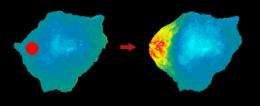
A photoactivatable protein enables control of cell movement in living cells. Activation of Rac in the red circle led to localized cell protrusion and translocation of the kinase PAK to the cell edge (right hand image, Pak in red). Credit: Yi Wu, UNC-Chapel Hill.

One of the biggest challenges in scientists' quest to develop new and better treatments for cancer is gaining a better understanding of how and why cancer spreads. Recent breakthroughs have uncovered how different cellular proteins are turned 'on' or 'off' at the molecular level, but much remains to be understood about how protein signaling influences cell behavior.

A new technique developed by Klaus Hahn, Ph.D. and his colleagues uses light to manipulate the activity of a protein at precise times and places within a living cell, providing a new tool for scientists who study the fundamentals of protein function.

In a paper published today in the journal Nature, Hahn, who is the Thurman Professor of Pharmacology at the University of North Carolina at Chapel Hill and a member of UNC Lineberger Comprehensive Cancer Center, described the technique, which uses light to control protein behavior in and animals simply by shining light on the cells where they want the protein to be active.

"The technology has exciting applications in basic research - in many cases the same protein can be either cancer-producing or beneficial, depending on where in a cell it is activated. Now researchers can control where that happens and study this heretofore inaccessible level of cellular control," said Hahn.

"Because we first tested this new technology on a that initiates cell movement, we can now use light to control where and how cells move. This is quite valuable in studies where cell movement is the focus of the research, including embryonic development, nerve regeneration and ," he added.

The new technology is an advance over previous light-directed methods of cellular control that used toxic wavelengths of life, disrupted the cell membrane or could switch proteins 'on' but not 'off'.

Source: University of North Carolina School of Medicine (news : web)

Explore further: Protein study suggests drug side effects are inevitable

add to favorites email to friend print save as pdf

Related Stories

Yale scientists map cell signaling network

Nov 30, 2005

Yale University scientists have mapped, for the first time, the proteins and kinase signaling network that control how cells of higher organisms operate.

Researchers turn cancer friend into cancer foe

Oct 07, 2008

Burnham Institute for Medical Research today announced that scientists have created a peptide that binds to Bcl-2, a protein that protects cancer cells from programmed cell death, and converts it into a cancer cell killer. ...

Recommended for you

New method for producing clean hydrogen

9 hours ago

Duke University engineers have developed a novel method for producing clean hydrogen, which could prove essential to weaning society off of fossil fuels and their environmental implications.

Making ice-cream more nutritious with meat left-overs

17 hours ago

Food industries are now turning meat left-over into high-protein content ingredients for food supplements, or to be added to processed food. But a EU-wide regulation covering them is still lacking.

Non-wetting fabric drains sweat

May 20, 2013

(Phys.org) —Waterproof fabrics that whisk away sweat could be the latest application of microfluidic technology developed by bioengineers at the University of California, Davis.

Protein study suggests drug side effects are inevitable

May 20, 2013

A new study of both computer-created and natural proteins suggests that the number of unique pockets – sites where small molecule pharmaceutical compounds can bind to proteins – is surprisingly small, meaning drug side ...

Attacking MRSA with metals from antibacterial clays

May 17, 2013

In the race to protect society from infectious microbes, the bugs are outrunning us. The need for new therapeutic agents is acute, given the emergence of novel pathogens as well as old foes bearing heightened antibiotic resistance.

User comments : 1

Adjust slider to filter visible comments by rank

Display comments: newest first

Ethelred
5 / 5 (1) Aug 19, 2009
Wow, the spammer was exhausted by that last three sentence SPAM and is back to the usual one. This one even more inane than usual.

Ethelred

Sorry for the new signature. But It Needed Killun.

From QubitTamer's fake profile

Quantum Physicist, torturer of AGW religious zealots like Ethelred because i laugh at his hysterics.


Qubitwit gets the rest of August in my signature for aiming his idiocy at me. Again.

More news stories

New method for producing clean hydrogen

Duke University engineers have developed a novel method for producing clean hydrogen, which could prove essential to weaning society off of fossil fuels and their environmental implications.

Protein study suggests drug side effects are inevitable

A new study of both computer-created and natural proteins suggests that the number of unique pockets – sites where small molecule pharmaceutical compounds can bind to proteins – is surprisingly small, meaning drug side ...

Beautiful 'flowers' self-assemble in a beaker

By simply manipulating chemical gradients in a beaker of fluid, materials scientists at Harvard have found that they can control the growth behavior of crystals to create precisely tailored structures—such ...

Attacking MRSA with metals from antibacterial clays

In the race to protect society from infectious microbes, the bugs are outrunning us. The need for new therapeutic agents is acute, given the emergence of novel pathogens as well as old foes bearing heightened antibiotic resistance.

Encouraging signs for bee biodiversity

Declines in the biodiversity of pollinating insects and wild plants have slowed in recent years, according to a new study. Researchers led by the University of Leeds and the Naturalis Biodiversity Centre in the Netherlands ...

If you can remember it, you can remember it wrong

(Medical Xpress)—Native peoples in regions where cameras are uncommon sometimes react with caution when their picture is taken. The fear that something must have been stolen from them to create the photo ...

B vitamins could delay dementia

(Medical Xpress)—Despite spending billions of dollars on research and development, drug companies have been unable to come up with effective treatments for dementia and Alzheimer's Disease (AD). Now, A. ...