Salmonella's sweet tooth predicts its downfall
May 19, 2009
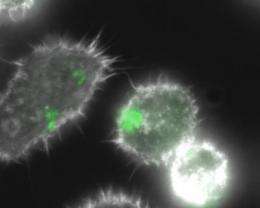
This is Salmonella, colored green, inside macrophage cells. Credit: Isabelle Hautefort, IFR

For the first time UK scientists have shown what the food poisoning bug Salmonella feeds on to survive as it causes infection: glucose.

Their discovery of 's weakness for sugar could provide a new way to vaccinate against it. The discovery could also lead to vaccine strains to protect against other disease-causing , including superbugs.

"This is the first time that anyone has identified the nutrients that sustain Salmonella while it is infecting a host's body," says Dr Arthur Thompson from the Institute of Food Research.

The nutrition of bacteria during infection is an emerging science. This is one of the first major breakthroughs, achieved in collaboration with Dr. Gary Rowley at the University of East Anglia.

Salmonella food poisoning causes infection in around 20 million people worldwide each year and is responsible for about 200,000 human deaths. It also infects farm animals and attaches to .

During infection, Salmonella bacteria are engulfed by immune cells designed to kill them. But instead the bacteria multiply.

Salmonella must acquire nutrients to replicate. The scientists focused on glycolysis, the process by which sugars are broken down to create . They constructed Salmonella mutants unable to transport glucose into the immune cells they occupy and unable to use glucose as food. These mutant strains lost their ability to replicate within , rendering them harmless

"Our experiments showed that glucose is the major sugar used by Salmonella during infection," said Dr Thompson.

The mutant strains still stimulate the immune system, and the scientists have filed patents on them which could be used to develop vaccines to protect people and animals against poisoning by fully virulent Salmonella.

Glycolysis occurs in most organisms including other bacteria that occupy host cells. Disrupting how the bacteria metabolise glucose could therefore be used to create vaccine strains for other pathogenic bacteria, including superbugs.

The harmless strains could also be used as vaccine vectors. For example, the flu gene could be expressed within the harmless Salmonella strain and safely delivered to the immune system.

The next stage of the research will be to test whether the mutants elicit a protective immune response in mice.

In Germany the nutrition of bacteria is the subject of a six-year priority programme of research to investigate why bacteria are able to multiply inside a host's body to cause disease.

Source: Norwich BioScience Institutes

Explore further: Researchers conduct first genomic survey of human skin fungal diversity

add to favorites email to friend print save as pdf

Related Stories

Salmonella in garden birds responsive to antibiotics

Jun 02, 2008

Scientists at the University of Liverpool have found that Salmonella bacteria found in garden birds are sensitive to antibiotics, suggesting that the infection is unlike the bacteria found in livestock and humans.

Researchers develop cross-protective vaccine

Oct 21, 2008

(PhysOrg.com) -- Doctors have always hoped that scientists might one day create a vaccination that would treat a broad spectrum of maladies. They could only imagine that there might be one vaccine that would protect against, ...

Snakes poisoned at birth

Feb 23, 2006

Scientists in Germany have found that a significant route of transmission of Salmonella in non egg-laying snakes is from the mother to the offspring during pregnancy and birth.

Salmonella: Trickier than we imagined

Jun 13, 2008

Salmonella is serving up a surprise not only for tomato lovers around the country but also for scientists who study the rod-shaped bacterium that causes misery for millions of people.

Recommended for you

Fast new, one-step genetic engineering technology

22 hours ago

A new, streamlined approach to genetic engineering drastically reduces the time and effort needed to insert new genes into bacteria, the workhorses of biotechnology, scientists are reporting. Published in ...

100K Pathogen Genome Project maps first genomes

22 hours ago

(Phys.org) —Striking a blow at foodborne diseases, the 100K Pathogen Genome Project at the University of California, Davis, today announced that it has sequenced the genomes of its first 10 infectious microorganisms, including ...

New DNA cattle test beefs up dairy and meat quality

23 hours ago

(Phys.org) —A genomics technique developed at Cornell to improve corn can now be used to improve the quality of milk and meat, according to research published online May 17 in the journal PLOS ONE.

Strawberry fields forever and fungus-free

23 hours ago

(Phys.org) —Strawberries are one of the most economically important berry crops in the world, and a high value export crop for the Australian horticultural industry.For the first time, researchers at The ...

User comments : 1

Adjust slider to filter visible comments by rank

Display comments: newest first

PPihkala
not rated yet May 19, 2009
To me this suggests that if one gets salmonella, then it helps to fast in order to limit it's ability to multiply by restricting it's glucose supply. This again shows why animals don't eat while they are sick.

More news stories

Unlocking secrets of cell reproduction

Research published in Open Biology today identifies, for the first time, nearly all the genes required for reproduction of a cell in a living organism.

Scientists announce Top 10 New Species from 2012

An amazing glow-in-the-dark cockroach, a harp-shaped carnivorous sponge and the smallest vertebrate on Earth are just three of the newly discovered top 10 species selected by the International Institute for ...

US teen birth rate drops to record low

US teen births have dropped to a record low, but the country still has one of the highest rates among developed nations, the US Centers for Disease Control and Prevention said Thursday.

Very Large Telescope celebrates 15 years of success

(Phys.org) —With this new view of a spectacular stellar nursery ESO is celebrating 15 years of the Very Large Telescope—the world's most advanced optical instrument. This picture reveals thick clumps ...

US House sends message on Keystone pipeline

US lawmakers agreed to a bill that would speed construction of a Canada-US oil pipeline and circumvent the need for President Barack Obama's approval for the $5 billion project.

Be prepared for weather extremes

Unsettled weather is an Iowa mainstay, and so is Inside's annual reminder of the university's severe weather safety and preparedness guidelines—for storms, extreme heat, flooding and more.