320-year-old mystery solved thanks to ancient DNA
Mar 05, 2013
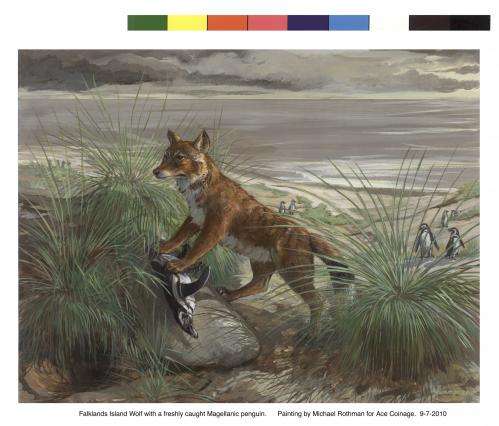
Painting of a Falkland Islands wolf by Michael Rothman, Ace Coinage Inc. Credit: Michael Rothman, Ace Coinage Inc

University of Adelaide researchers have found the answer to one of natural history's most intriguing puzzles – the origins of the now extinct Falkland Islands wolf and how it came to be the only land-based mammal on the isolated islands – 460km from the nearest land, Argentina.

Previous theories have suggested the wolf somehow rafted on ice or vegetation, crossed via a now-submerged land bridge or was even semi-domesticated and transported by early South American humans.

The 320-year-old mystery was first recorded by early British explorers in 1690 and raised again by following his encounter with the famously tame species on his Beagle voyage in 1834.

Researchers from the University's Australian Centre for (ACAD) extracted tiny pieces of tissue from the skull of a specimen collected personally by Darwin. They also used samples from a previously unknown specimen, which was recently re-discovered as a stuffed exhibit in the attic of Otago Museum in New Zealand.

The findings were published in Nature Communications today and concluded that, unlike earlier theories, the Falkland Islands wolf (Dusicyon australis) only became isolated about 16,000 years ago around the peak of the last .

"Previous studies used ancient DNA from to suggest that the Falkland Islands wolf diverged genetically from its closest living relative, the South American maned wolf (Chrysocyon brachyurus) around seven million years ago. As a result, they estimated that the wolf colonised the islands about 330,000 years ago by unknown means," says Associate Professor Jeremy Austin, Deputy Director of ACAD and co-lead author with Dr Julien Soubrier.

"Critically, however, these early studies hadn't included an extinct relative from the mainland, the fox-like Dusicyon avus. We extracted ancient DNA from six specimens of D. avus collected across Argentina and Chile, and made comparisons with a wide group of extinct and living species in the same family."

ACAD's analyses showed that D. avus was the closest relative of the Falkland Islands wolf and they separated only 16,000 years ago – but the question of how the island colonisation came about remained. The absence of other mammals argued against any connection to the mainland.

"The Eureka moment was finding evidence of submarine terraces off the coast of Argentina," says study leader Professor Alan Cooper. "They recorded the dramatically lowered sea levels during the Last Glacial Maximum (around 25-18,000 years ago)."

"At that time, there was a shallow and narrow (around 20km) strait between the islands and the mainland, allowing the wolf to cross when the sea was frozen over, probably while pursuing marine prey like seals or penguins. Other small mammals like rats weren't able to cross the ice."

Explore further: Anthropologist suggests Mediterranean islands inhabited much earlier than thought

Related Stories

New clues to the Falklands wolf mystery

Nov 02, 2009

Ever since the Falklands wolf was described by Darwin himself, the origin of this now-extinct canid found only on the Falkland Islands far off the east coast of Argentina has remained a mystery. Now, researchers ...

Lonesome George may not be so lonesome after all

May 02, 2007

A Macquarie University scientist has helped prove that Lonesome George, named by the Guinness Book of Records as the world's rarest living creature may in fact have relatives living nearby.

Raft or bridge: How did iguanas reach tiny Pacific islands?

Jan 11, 2010

Scientists have long puzzled over how iguanas, a group of lizards mostly found in the Americas, came to inhabit the isolated Pacific islands of Fiji and Tonga. For years, the leading explanation has been that progenitors ...

South Atlantic map plots Falklands claims

May 13, 2010

Researchers at Durham University have drawn up new maps to show the competing claims of Argentina and the UK for resources in the South Atlantic and Southern Oceans.

Recommended for you

Lovelorn frogs bag closest crooner

48 minutes ago

What lures a lady frog to her lover? Good looks, the sound of his voice, the size of his pad or none of the above? After weighing up their options, female strawberry poison frogs (Oophaga pumilio) bag th ...

Honeybees trained in Croatia to find land mines

18 hours ago

(AP)—Mirjana Filipovic is still haunted by the land mine blast that killed her boyfriend and blew off her left leg while on a fishing trip nearly a decade ago. It happened in a field that was supposedly ...

Front-row seats to climate change

May 17, 2013

By day, insects provide the white noise of the South, but the night belongs to the amphibians. In a typical year, the Southern air hangs heavy from the humidity and the sounds of wildlife.

User comments : 1

Adjust slider to filter visible comments by rank

Display comments: newest first

PJS
4 / 5 (1) Mar 05, 2013
nice detective work

More news stories

Lovelorn frogs bag closest crooner

What lures a lady frog to her lover? Good looks, the sound of his voice, the size of his pad or none of the above? After weighing up their options, female strawberry poison frogs (Oophaga pumilio) bag th ...

Engineered microbes grow in the dark

Scientists at the University of California, Davis have engineered a strain of photosynthetic cyanobacteria to grow without the need for light. They report their findings today at the 113th General Meeting of the American ...

Why we need to put the fish back into fisheries

Overfishing has reduced fish populations and biodiversity across much of the world's oceans. In response, fisheries are increasingly reliant on a handful of highly valuable shellfish. However, new research by the University ...

Honeybees trained in Croatia to find land mines

(AP)—Mirjana Filipovic is still haunted by the land mine blast that killed her boyfriend and blew off her left leg while on a fishing trip nearly a decade ago. It happened in a field that was supposedly ...

Blame your parents for bunion woes

A novel study reports that white men and women of European descent inherit common foot disorders, such as bunions (hallux valgus) and lesser toe deformities, including hammer or claw toe. Findings from the Framingham Foot ...