Skulls of early humans carry telltale signs of inbreeding, study says
Mar 18, 2013
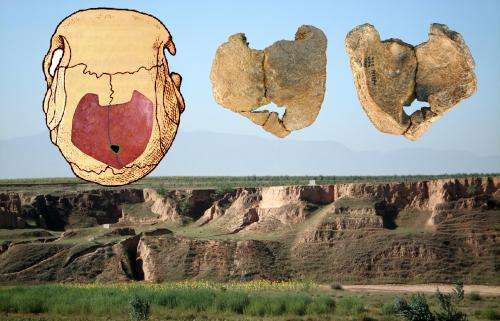
This is a view of the Xujiayao site (below) and internal and external view of the Xujiayao 11 skull piece with its position indicated on the drawing of a complete skull (above). Credit: Erik Trinkaus

Buried for 100,000 years at Xujiayao in the Nihewan Basin of northern China, the recovered skull pieces of an early human exhibit a now-rare congenital deformation that indicates inbreeding might well have been common among our ancestors, new research from the Chinese Academy of Sciences and Washington University in St. Louis suggests.

The skull, known as Xujiayao 11, has an unusual perforation through the top of the brain case—an enlarged parietal foramen (EPF) or "hole in the skull"—that is consistent with modern humans diagnosed with a rare genetic mutation in the homeobox genes ALX4 on and MSX2 on chromosome 5.

These specific interfere with bone formation and prevent the closure of small holes in the back of the prenatal braincase, a process that is normally completed within the first five months of fetal development. It occurs in about one out of every 25,000 modern human births.

Although this genetic abnormality is sometimes associated with cognitive deficits, the older adult age of Xujiayao 11 suggests that any such deficits in this individual were minor.

Traces of , such as EPF, are seen unusually often in the skulls of Pleistocene humans, from early Homo erectus to the end of the Paleolithic.

"The probability of finding one of these abnormalities in the small available sample of human fossils is very low, and the cumulative probability of finding so many is exceedingly small," suggests study co-author Erik Trinkaus, the Mary Tileston Hemenway Professor of Anthropology in Arts & Sciences at Washington University in St. Louis.

"The presence of the Xujiayao and other Pleistocene human abnormalities therefore suggests unusual population dynamics, most likely from high levels of inbreeding and local population instability." It therefore provides a background for understanding populational and cultural dynamics through much of human evolution.

Published March 18 in the journal PLOS ONE, the study is co-authored by Xiu-Jie Wu and Song Xing of the Institute of Vertebrate Paleontology and Paleoanthropology, Beijing. Its findings are based on the analysis of the fossilized partial skull of an adult late archaic human from the Xujiayao site, in the Nihewan Basin of .

Explore further: Eastern Eurasian archaic humans featured a bi-level nasal floor as seen in Neandertals

Related Stories

New evidence for the earliest modern humans in Europe

Nov 02, 2011

The timing, process and archeology of the peopling of Europe by early modern humans have been actively debated for more than a century. Reassessment of the anatomy and dating of a fragmentary upper jaw with ...

Human skull study causes evolutionary headache

Dec 20, 2011

Scientists studying a unique collection of human skulls have shown that changes to the skull shape thought to have occurred independently through separate evolutionary events may have actually precipitated each other.

Handsome by Chance

Aug 02, 2007

Chance, not natural selection, best explains why the modern human skull looks so different from that of its Neanderthal relative, according to a new study led by Tim Weaver, assistant professor of anthropology at UC Davis.

Recommended for you

Wooden beam could be detached part of shipwreck

1 hour ago

A wooden beam that has long been the focus of the search for a 17th century shipwreck in northern Lake Michigan was not attached to a buried vessel as searchers had suspected, but still may have come from the elusive Griffin ...

Prehistoric rock art maps cosmological belief

8 hours ago

It is likely some of the most widespread and oldest art in the United States. Pieces of rock art dot the Appalachian Mountains, and research by University of Tennessee, Knoxville, anthropology professor Jan ...

User comments : 0

More news stories

The broken symphony of swinging metronomes

An experiment with 30 metronomes reveals chimera states which combine aspects of synchrony and of disorder. Researchers had been looking for such states for ten years.

Wooden beam could be detached part of shipwreck

A wooden beam that has long been the focus of the search for a 17th century shipwreck in northern Lake Michigan was not attached to a buried vessel as searchers had suspected, but still may have come from the elusive Griffin ...

Prehistoric rock art maps cosmological belief

It is likely some of the most widespread and oldest art in the United States. Pieces of rock art dot the Appalachian Mountains, and research by University of Tennessee, Knoxville, anthropology professor Jan ...

Gay marriage ruling unlikely to cause anti-gay backlash

Concerns that a U.S. Supreme Court ruling favorable to gay marriage might produce a backlash that would impede efforts to achieve equality are unfounded, according to a study by researchers at University of California campuses ...