Large theropod metatarsal found in Jurassic Shishugou Formation, Junggar Basin, China
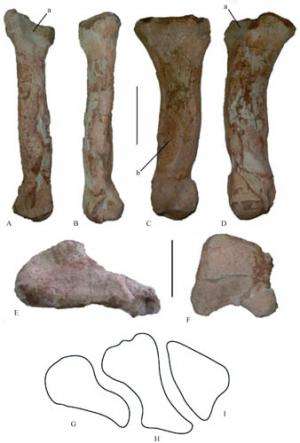
The Sino-American field expedition in the Junggar Basin north of the Tian Shan in the Xinjiang Autonomous Region have produced a number of dinosaur fossils, including several species of small- to medium-bodied theropod. Recently, a large isolated theropod left metatarsal from the upper part of the Middle to Upper Jurassic Shishugou Formation, exposed at the Wucaiwan Locality in the northeastern part of the Junggar Basin, was discovered and reported in the latest issue of Vertebrata PalAsiatica 2013 (1). The finding adds to the diversity of theropods present at Wucaiwan Locality.
Researchers compared the new specimen with the fourth metatarsals of other theropods, and assigned this specimen to Allosauroidea. Similarities to the equivalent bone in other allosauroids include: the proximal end has a subtriangular outline with a tongue-like, posteriorly directed posteromedial process; the shaft has a gentle outward curve; a semi-lunate concave of muscle attachment is present on the posterolateral side of the shaft; and the cross-section of the shaft is triangular.
"Within Allosauroidea, the new specimen is most similar to the fourth metatarsal of Sinraptor dongi, a taxon that occurs in the same formation in the Jiangjunmiao area of the Junggar Basin. It displays several specific resemblances to S. dongi: the outline of the distal end is subtrapezoidal, the depression for muscle attachment on the posterior side of the shaft that borders the shaft's lateral side lacks a well-defined ridge", said first author HE Yiming, a paleontology graduate student of the IVPP.
However, the new specimen also differs in some respects from the fourth metatarsal of S. dongi. It is much more robust, and the lateral condyle on the distal end is smaller than the medial one. These morphological differences could be ontogenetic variation or due to sexual dimorphism, taxonomical variations. Considering the result of cladistic analysis based on the morphology of metatarsal IV, researchers prefer the interpretation that it is a new species that has a close relationship to S. dongi.
The new finding suggests that the theropods from the Shishugou Fauna are more diversified during the Mid-Late Jurassic than previously thought. "The presence of different sinraptorid species in the neighboring areas of Wucaiwan and Jiangjunmiao points to the possibility that these two regions within the Junggar Basin were geographically isolated or ecologically distinct from one another during the Mid-Late Jurassic", said XU Xing, co-author and supervisor of the study.
"The theropod fauna in the earliest Late Jurassic of China was at least as diverse as that of other Late Jurassic localities, such as the Cleveland-Lloyd Dinosaur Quarry", said James M. Clark, co-author, from the Department of Biological Sciences at the George Washington University.
More information: english.ivpp.cas.cn/sp/PalAsia … t20130131_98741.html
Journal information: Vertebrata PalAsiatica


