UC Santa Barbara researcher to receive Academy Award for technical achievement
Only minutes into the 2011 summer sci-fi blockbuster Super 8, there is a massive train crash –– a thunderous, fiery, and frighteningly realistic scene described by one writer as the film's "most intense and spectacular sequence."
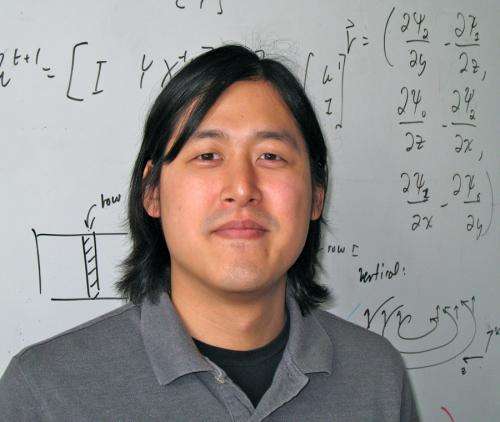
UC Santa Barbara researcher Theodore Kim had a hand in making it so.
By creating a new smoke-and-fire visual effects technique, Kim and three former colleagues played a collaborative key role in Super 8 and dozens of other major motion pictures—including Oscar winners Avatar, Alice in Wonderland, and Hugo. Now they're picking up their own Academy Award.
For their invention of the simulation method known as wavelet turbulence –– and the resulting contribution to filmmaking –– the quartet including Kim, an assistant professor in UCSB's Media Arts & Technology Program, will receive an Academy Award in Technical Achievement. They are among 25 recipients being honored at The Academy of Motion Picture Arts and Sciences's Scientific and Technical Awards Presentation on February 9.
Kim becomes the first sitting UCSB faculty to earn an Oscar. Materials professor Shuji Nakamura won a Technology & Engineering Emmy Award in 2012.
"It feels good. And I never really anticipated that this would happen, so it is a very nice surprise," Kim said of the accolade he will share with Nils Thuerey, of effects studio ScanLineVFX; Doug James, of Cornell University; and Markus Gross, of the Swiss Federal Institute of Technology (ETH Zurich). "I suppose, like a lot of people in my generation, I saw Toy Story and said, 'Wow that looks like a lot of fun. Maybe one day I'll get to do something like that.' So the goal was maybe I'll get to do something like that. Getting an award for something like that is a bonus on top of it."
Wavelet turbulence allows for faster, better, and more easily "art-directable" simulation of large-scale fluid smoke effects –– formerly time-consuming and tough to artistically control –– such as volcanic eruptions, explosions, and other pyrotechnics.
"In order to do this, you have to have literally millions of tiny details on the surface of the smoke that actually make it look extremely large … and that used to be extremely difficult," Kim explained. "What we developed was a very fast way of synthesizing all these details very quickly. And it was quick enough that it enabled artists to get the look they wanted for fireballs or volcanic explosions in enough time that it fit into their workflow."
The algorithm was developed in 2008 at Cornell, where Kim, who joined UCSB's faculty in 2011, was then a postdoctoral scholar. It was first presented publicly that same year, at the annual SIGGRAPH (Special Interest Group on Computer Graphics and Interactive Techniques) conference, considered the world's premier computer graphics gathering. Subsequently released by the foursome for free download, the method quickly caught fire in the industry and started showing up on movie screens in 2009.
"We were very surprised," Kim said of the invention's quick ascension as a go-to graphics tool. "Usually you present a paper to 100 or 200 peers, maybe release the source code into the public domain, there is interest for a little bit, then it dissipates. In this case, there was quite a bit of interest from beginning. And because the source code was distributed for free, it turns out a lot of people were downloading and integrating it into their own software. Now it's used in places all over the world."
That includes major studios Dreamworks Animation and Industrial Light and Magic, to name just two, as well as in dozens of movies.
Monsters vs. Aliens. Transformers. Megamind. The Amazing Spider-Man. Wavelet turbulence's resume, which also includes the forthcoming Iron Man 3 and Superman: Man of Steel, reads like a laundry list of recent effects and animation successes. The technique has been used in at least 26 films to date, though the true number could be far larger. The inclusion of wavelet turbulence in widely used commercial software packages such Houdini and FumeFX makes precise tracking tough, Kim said.
Not that he's complaining. A prize as prestigious as an Academy Award –– widely held to be the film industry's top honor –– is recognition enough, Kim said, for a computer science-trained academic who started programming as a kid looking to meld his artistic and technical interests.
The Oscars were likely the furthest thing from his mind when a young Kim first saw Toy Story, the movie that launched his animation aspirations. Now they're front and center and requiring decisions he never expected to make –– like what to wear when he picks up his first Academy Award at the Beverly Hills Hotel.
"A tuxedo for me," Kim said. "My wife has a more difficult choice ahead of her."
Provided by University of California - Santa Barbara


