NASA sees massive rainfall totals from Tropical Storm Oswald
Jan 23, 2013
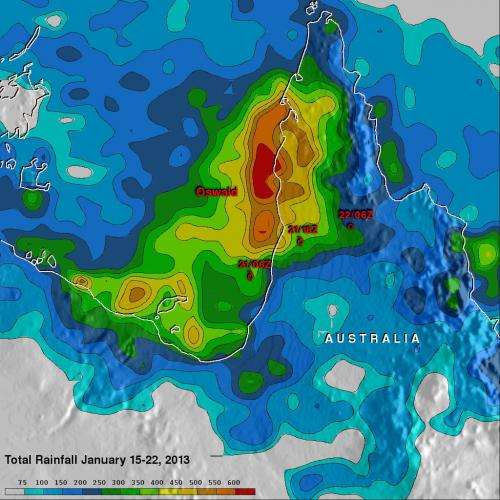
This TRMM satellite rainfall analysis covers the period from Jan. 15-22, 2013. The analysis showed that Oswald and its remnants have already dropped over 600 mm (~23.6 inches) of rain in areas of the Cape York Peninsula near the Gulf of Carpentaria. Credit: NASA/SSAI, Hal Pierce

Tropical Storm Oswald's heavy rains have caused flooding in Queensland, Australia and NASA's TRMM satellite measured almost two feet of rain fell in certain areas.

Tropical cyclone Oswald's sustained winds have never been greater than 35 knots (~40.2 mph) but the storm's has resulted in widespread flooding in Australia over northern Queensland. Many roads have been reported flooded resulting in some communities being cut off.

NASA's Measuring Mission (TRMM) is a satellite that can measure rainfall from space. TRMM-based satellite precipitation estimates are created at NASA's Goddard Space Flight Center in Greenbelt, Md. within about seven hours of observation time. Hal Pierce of NASA Goddard created a rainfall image from a Multi-satellite Precipitation Analysis (MPA) for the period from January 15 to 22, 2013. The analysis showed that Oswald and its remnants had dropped over 600 mm (~23.6 inches) of rain in areas of the Cape York Peninsula near the Gulf of Carpentaria.

According to a report on news.com.au, travelers were requested to cancel plans to go to the Cape York Peninsula, Queensland. Many rivers have flooded and dirt roads are mired in mud over a distance of 560 kilometers (348 miles) that stretch from Laura to Bamaga. Rainfall totals over the Cape York Peninsula to Cardwell were as high as 200mm (7.8 inches) to 300 mm (11.8 inches), which fell south of the town of Innisfail.

Explore further: NASA sees Tropical Cyclone Oswald weaken over Queensland's Cape York Peninsula

add to favorites email to friend print save as pdf

Related Stories

NASA's TRMM satellite sees deadly rainfall over Thailand

Mar 31, 2011

Data from NASA's Tropical Rainfall Measuring Mission or TRMM satellite was used to create a rainfall map of the severe rains that fell in Thailand recently. More than 20 people have been killed in southern ...

Recommended for you

Strong earthquake at exceptional depth

5 hours ago

This morning at 05:45 CEST, the earth trembled beneath the Okhotsk Sea in the Pacific Northwest. The quake, with a magnitude of 8.2, took place at an exceptional depth of 605 kilometers. Because of the great ...

Marine forecasting on the horizon for Indian Ocean Rim

6 hours ago

Nearly all of the member countries of the Indian Ocean Rim Association for Regional Cooperation (IOR-ARC) will attend the week-long workshop to further cooperation and understanding on international ocean ...

Russia evacuates drifting Arctic research station

May 23, 2013

Russia has ordered the urgent evacuation of the 16-strong crew of a drifting Arctic research station after ice floe that hosts the floating laboratory began to disintegrate, officials said Thursday.

User comments : 0

More news stories

Dark, massive asteroid to fly by Earth on May 31

It's 1.7 miles long. Its surface is covered in a sticky black substance similar to the gunk at the bottom of a barbecue. If it impacted Earth it would probably result in global extinction. Good thing it is ...

Source of life running out: water scientists

The majority of people on Earth people will face severe water shortages within a generation or two if pollution and waste continues unabated, scientists warned at a conference in Bonn Friday.

Storm chasers: born to be wild?

(HealthDay)—We've all seen them: the surfers who race to the beach when a hurricane hits, the guy who decides to ride out the storm in his overmatched boat, the tornado chasers who fearlessly steer their ...