IBM: Our new gel can kill superbugs
Jan 25, 2013 by Sunanda Creagh
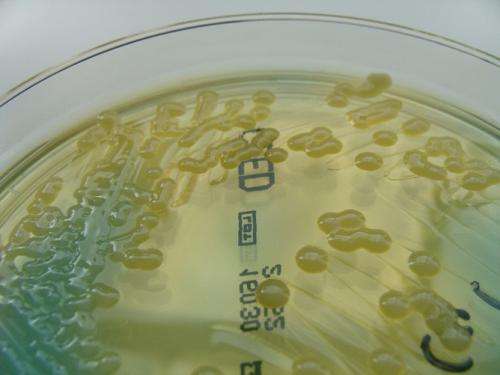
Hospitals around the world are battling new drug-resistant bacteria that often grow on medical devices like valves or joint implants. Credit: http://www.flickr.com/photos/nathanreading

Researchers from computer firm IBM say they have invented a new non-toxic gel that can kill deadly drug-resistant bacteria by cutting through the sludge that shelters them and attacking the germ's cell membrane.

If verified, the finding could herald a breakthrough in the fight against the that infect hospitals everywhere and add billions annually to public health bills worldwide.

In a press release issued overnight, the computer firm said researchers from IBM and the Institute of Bioengineering and Nanotechnology in Singapore had developed "an antimicrobial hydrogel that can break through diseased and completely eradicate drug-resistant bacteria upon contact."

"The synthetic hydrogel, which forms spontaneously when heated to body temperature, is the first-ever to be biodegradable, biocompatible and non-toxic, making it an ideal tool to combat serious facing hospital workers, visitors and patients," the statement said.

Biofilms are the that harbour germs and often form around medical devices implanted in the body, such as catheters, and .

Biofilms are notoriously difficult to penetrate with common antibiotics but the researchers said their new water-based gel would break through biofilms and attack the bacteria's .

This video is not supported by your browser at this time.
IBM and IBN create antimicrobial hydrogels.

Professor Peter Collignon, an infectious diseases and microbiology expert at the Australian National University said the finding was potentially very interesting.

"They don't give any evidence it works—this is a press release for a company on the stock exchange—but having said that, it's good a large company is into this," said Professor Collignon, who was not involved in the research.

"It could have its uses and also abuses. We are using too much disinfectant in kitchens and homes and that goes into the waterways and has the potential to induce resistance," he said.

"Their claim they can penetrate a biofilm is good, if it turns out to be verified independently by others. If they can inject [the gel] that's a major step."

Professor Collignon said that if the new could damage the germ's cell membranes, it may damage cell membranes in the body as well.

Dr Marc Pellegrini, an infectious diseases researcher at the Walter and Eliza Hall Institute said the discovery "has a lot of potential."

"A lot of the bugs in hospitals at the moment are resistant to the drugs that we have. In places like intensive care units, patients have a lot of devices implanted in them like or tubes to deliver drugs and these tubes often get contaminated with microbes. This is hard to treat," said Dr Pellegrini, who was not involved in the research by IBM.

"This new discovery looks like it may well have application in preventing these surfaces becoming contaminated but it's quite a few steps away from being put into practice in a hospital."

Some antimicrobials that worked well in the lab presented unforeseen problems when used in humans, he said.

"It's still early days."

Explore further: Novel antimicrobial hydrogel prevents antibiotic-resistant microbes from forming on wounds, medical devices and implants

Related Stories

Breakthrough for MRSA treatment found

Apr 04, 2011

(PhysOrg.com) -- Researchers from IBM and the Institute of Bioengineering and Nanotechnology discovered a nanomedicine breakthrough in which new types of polymers were shown to physically detect and destroy ...

Fighting fungal infections with bacteria

May 01, 2010

A bacterial pathogen can communicate with yeast to block the development of drug-resistant yeast infections, say Irish scientists writing in the May issue of Microbiology. The research could be a step toward ...

Recommended for you

Researcher admits mistakes in stem cell study

May 23, 2013

A blockbuster study in which US researchers reported that they had turned human skin cells into embryonic stem cells contained errors, its lead author has acknowledged. ...

Scientists discover how rapamycin slows cell growth

May 23, 2013

University of Montreal researchers have discovered a novel molecular mechanism that can potentially slow the progression of some cancers and other diseases of abnormal growth. In the May 23 edition of the prestigious journal ...

Unlocking secrets of cell reproduction

May 23, 2013

Research published in Open Biology today identifies, for the first time, nearly all the genes required for reproduction of a cell in a living organism.

What the smallest infectious agents reveal about evolution

May 22, 2013

Radically different viruses share genes and are likely to share ancestry, according to research published in BioMed Central's open access journal Virology Journal this week. The comprehensive phylogenomic analysis compar ...

User comments : 5

Adjust slider to filter visible comments by rank

Display comments: newest first

wiyosaya
5 / 5 (1) Jan 25, 2013
This sounds like a promising discovery. However, I have to wonder whether the bugs they are trying to kill with this will mutate to become resistant to this, too.

Perhaps IBM should keep this in the lab for several years to determine whether any kind of mutation will happen.
Myno
not rated yet Jan 25, 2013
Mutation will happen. That's reason to apply this new tech with care, but no reason to withhold it completely.
FrankHerbert
1.6 / 5 (7) Jan 25, 2013
In 10 years nobody is going to remember this while they are purchasing their iGel. Wait... Apple won't be around in 10 years :)
bottomlesssoul
4 / 5 (1) Jan 25, 2013
Since when has IBM been studying bio-hazards?
sirchick
1 / 5 (1) Jan 25, 2013
Do all mutations remember the previous drugs ? For example after X amount of mutations perhaps the first method to kill them is no longer resistant and thus would work again. So something that we stopped using 10 years ago, they might not be resistant to any more ?? Or do they remember all methods we use from the past regardless of time pass.

More news stories

Yahoo, pay-TV operators among Hulu bidders

Online video site Hulu is again up for sale, with Yahoo and pay TV operators DirecTV and Time Warner Cable among the seven bidders, according to a person with direct knowledge of the matter.

Galaxies fed by funnels of fuel

(Phys.org) —Computer simulations of galaxies growing over billions of years have revealed a likely scenario for how they feed: a cosmic version of swirly straws.