Study offers insight into converting wood to bio-oil
Dec 14, 2012 by Mick Kulikowski
Study offers insight into converting wood to bio-oil
A paper that offers insight into converting wood to useful bio-oils appears as the cover article in the Journal of Physical Chemistry A.

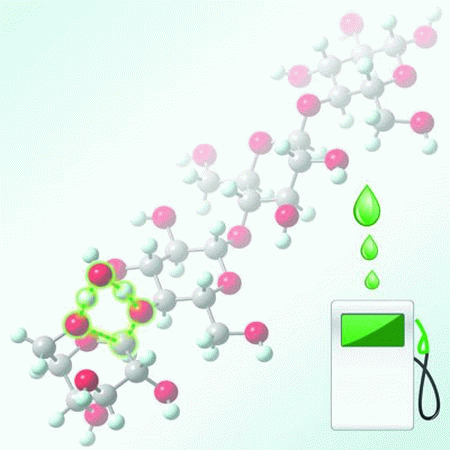
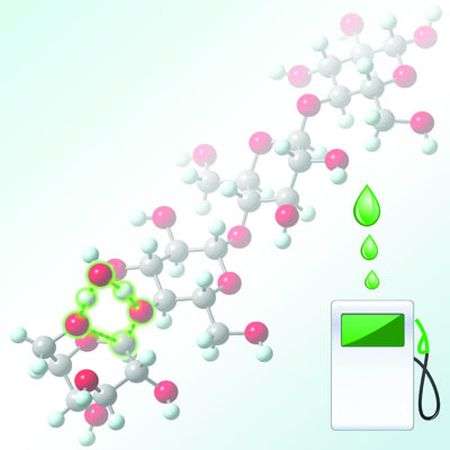
(Phys.org)—New research from North Carolina State University provides molecular-level insights into how cellulose – the most common organic compound on Earth and the main structural component of plant cell walls – breaks down in wood to create "bio-oils" which can be refined into any number of useful products, including liquid transportation fuels to power a car or an airplane.

Using a supercomputer that can perform functions thousands of times faster than a standard desktop computer, NC State chemical and biomolecular engineer Dr. Phillip Westmoreland and doctoral student Vikram Seshadri calculate what's occurring at the molecular level when wood is rapidly heated to high temperatures in the absence of oxygen, a decomposition process known as pyrolysis.
Study offers insight into converting wood to bio-oil
A paper that offers insight into converting wood to useful bio-oils appears as the cover article in the Journal of Physical Chemistry A.

The results, which could help spur more effective and efficient ways of converting farmed and waste wood into useful bio-oils, appear in a feature article on the cover of the Dec. 13 print edition of the A.

Much of the energy that can be extracted from wood exists in the cellulose found in cell walls. Cellulose is a stiff, rodlike substance consisting of chains of a specific type of a simple sugar called glucose. The paper describes a mechanism for how glucose decomposes when heated. The mechanism is somewhat surprising, Westmoreland says, because it reveals how and even the glucose itself can trigger this decomposition.

"The calculations in the paper show that although the decomposition products and rates differ in glucose and cellulose, the various elementary steps appear to be the same, but altered in their relative importance to each other," Westmoreland says.

Knowing the specifics of the will allow researchers to make predictions about the ease of extracting energy from different types of wood from various soil types.

The researchers are now conducting experiments to verify their calculations.

Explore further: Wood completely broken down into its component parts

More information: Concerted Reactions and Mechanism of Glucose Pyrolysis and Implications for Cellulose Kinetics

Authors: Vikram Seshadri and Phillip Westmoreland, North Carolina State University

Published: Dec. 13, 2012, in Journal of Physical Chemistry A

Abstract: Concerted reactions are proposed to be keys to understanding thermal decomposition of glucose in the absence of ionic chemistry, including molecular catalysis by ROH molecules such as H2O, other glucose molecules, and most of the intermediates and products. Concerted transition states, elementary-reaction pathways, and rate coefficients are computed for pyrolysis of ?-D-glucose (?-Dglucopyranose), the monomer of cellulose, and for related molecules, giving an improved and elementary-reaction interpretation of the reaction network proposed by Sanders et al. (J. Anal. Appl. Pyrolysis, 2003, 66, 29?50). Reactions for ring-opening and formation, ring contraction, retro-aldol condensation, keto?enol tautomerization, and dehydration are included. The dehydration reactions are focused on bicyclic ring formations that lead to levoglucosan and 1,6-?-D-anhydrousglucofuranose. The bimolecular ROH-assisted reactions are found to have lower activation energy compared to the unimolecular reactions. The same dehydration reaction to levoglucosan should occur for cellulose going to cellosan (e.g., cellotriosan) plus a shortened cellulose chain, a hypothesis supported by the very similar activation energies computed when alternate groups were substituted at the C1 glycosidic oxygen. The principles of Sanders et al. that distinguish D-glucose, D-fructose, sucrose, and cellulose pyrolysis prove useful in providing qualitative insights into cellulose pyrolysis.

Related Stories

'Mini-cellulose' molecule unlocks biofuel chemistry

Feb 16, 2012

A team of chemical engineers at the University of Massachusetts Amherst has discovered a small molecule that behaves the same as cellulose when it is converted to biofuel. Studying this 'mini-cellulose' molecule reveals for ...

Improved Reaction Data Heat Up the Biofuels Harvest

Aug 06, 2008

High food prices, concern over dwindling supplies of fossil fuels and the desire for clean, renewable energy have led many to seek ways to make ethanol out of cellulosic sources such as wood, hay and switchgrass. ...

Wood completely broken down into its component parts

Oct 24, 2012

Crude oil is getting scarce. This is why researchers are seeking to substitute petroleum-based products - like plastics - with sustainable raw materials. Waste wood, divided into lignin and cellulose, could ...

Recommended for you

Attacking MRSA with metals from antibacterial clays

22 hours ago

In the race to protect society from infectious microbes, the bugs are outrunning us. The need for new therapeutic agents is acute, given the emergence of novel pathogens as well as old foes bearing heightened antibiotic resistance.

Keeping fruit, vegetables and cut flowers fresh longer

May 15, 2013

New technology offers the promise of reducing billions of dollars of losses that occur each year from the silent, invisible killer of fruits, vegetables and cut flowers—a gas whose effects are familiar to everyone who has ...

Why don't beetles freeze in the winter?

May 14, 2013

For 37 years, Queen's University Biochemistry professor Peter Davies has been unraveling the mystery of why some organisms including insects and fish don't freeze in the winter. His research into insect antifreeze protein ...

The molecular basis of strawberry aroma

May 13, 2013

You know that summer is here when juicy red strawberries start to appear on the shelves. In Germany, this seasonal fruit has never been more popular: on average 3.5 kilos per head were consumed in 2012—a ...

A new dimension for 3-D protein structures

May 13, 2013

(Phys.org) —3D structures of biological molecules like proteins directly affect the way they behave in our bodies. EPFL scientists have developed a new infrared-UV laser method to more accurately determine ...

User comments : 0

More news stories

Attacking MRSA with metals from antibacterial clays

In the race to protect society from infectious microbes, the bugs are outrunning us. The need for new therapeutic agents is acute, given the emergence of novel pathogens as well as old foes bearing heightened antibiotic resistance.

Beautiful 'flowers' self-assemble in a beaker

By simply manipulating chemical gradients in a beaker of fluid, materials scientists at Harvard have found that they can control the growth behavior of crystals to create precisely tailored structures—such ...

Making gold green: New non-toxic method for mining gold

Northwestern University scientists have struck gold in the laboratory. They have discovered an inexpensive and environmentally benign method that uses simple cornstarch—instead of cyanide—to isolate gold from raw materials ...

Galaxy's Ring of Fire

Johnny Cash may have preferred this galaxy's burning ring of fire to the one he sang about falling into in his popular song. The "starburst ring" seen at center in red and yellow hues is not the product of ...

Morocco to harness the wind in energy hunt

Morocco is ploughing ahead with a programme to boost wind energy production, particularly in the southern Tarfaya region, where Africa's largest wind farm is set to open in 2014.