NASA sees Tropical Storm Bopha intensifying in Micronesia
Nov 27, 2012
NASA sees Tropical Storm Bopha intensifying in Micronesia
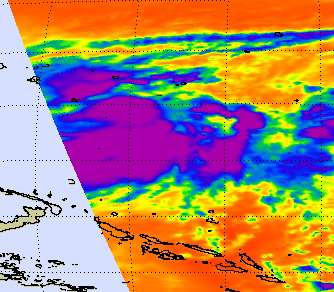
This infrared image of the eastern side of Tropical Storm Bopha was captured on Nov. 27 at 0241 UTC by the AIRS instrument that flies aboard NASA's Aqua satellite. The purple areas indicate coldest, highest cloud top temperatures that have the potential for dropping heavy rainfall. Credit: NASA JPL/Ed Olsen

Tropical storm warnings are in effect in Micronesia as NASA and other satellite imagery indicates that Tropical Storm Bopha continues to intensify.

The Atmospheric Infrared Sounder (AIRS) instrument that flies aboard NASA's Aqua satellite captured an infrared image of Tropical Storm Bopha on Nov. 27 at 0241 UTC that indicated a lot of power exists in the strengthening tropical storm. The AIRS image captured the eastern half of the tropical storm and showed a large area of very cold, very high , where temperatures colder than -63 Fahrenheit (-52 Celsius) have the potential for dropping heavy rainfall.

On Nov. 27, the in Tiyan, Guam noted that "Residents of Satawal in Yap State should closely monitor the progress of Tropical Storm Bopha, as a tropical storm watch could be required Wednesday, Nov. 28." A tropical storm warning remained in effect for Nukuoro in Pohnpei State and Lukunor in Chuuk State. A tropical storm watch remains in effect for Losap, the Chuuk Lagoon Islands and Puluwat in Chuuk State.

At 1500 UTC (10 a.m. EST/1 a.m. CHST local time) the center of Tropical Storm Bopha was located near latitude 4.7 degrees north and longitude 155.2 degrees east, only 55 miles north-northeast of Nukuoro. Bopha was also about105 miles southeast of Lukunor and 225 miles southeast of Losap. Tropical Storm Bopha was nearly stationary but the National Weather Service expects Bopha to start moving westward.

Bopha's have increased to 50 mph and Tropical Storm Bopha is expected to continue intensifying. extend outward up to 45 miles from the center, making the storm almost 100 miles in diameter.

Explore further: NASA spots heavy rainfall in Tropical Depression 26W threatening Micronesia

More information: For specific information on effects to individual islands, visit the National Weather Service website: www.prh.noaa.gov/data/GUM/HLSPQ1

add to favorites email to friend print save as pdf

Related Stories

Infrared NASA imagery shows a weaker Tropical Storm 13W

Aug 07, 2012

Infrared satellite imagery from shows how cold cloud top temperatures are in a tropical cyclone, and recent imagery from NASA's Aqua satellite shows the cloud-top temperatures have been warming in Tropical ...

Recommended for you

Alaska volcano shoots ash 15,000 feet into the air

May 18, 2013

(AP)—One of Alaska's most restless volcanoes has shot an ash cloud 15,000 feet into the air in an ongoing eruption that has drawn attention from a nearby community but isn't expected to threaten air traffic.

NASA sees Cyclone Mahasen hit Bangladesh

May 17, 2013

NASA's Tropical Rainfall Measuring Mission satellite known as TRMM measured Cyclone Mahasen's rainfall rates from space as it made landfall on May 16. Mahasen has since dissipated over eastern India.

Rapid climate change ruled out ice age trees

May 17, 2013

Short, sharp fluctuations in the Earth's climate throughout the last ice age may have stopped trees from getting a foothold in Europe and northern Asia, scientists say.

Earth's iron core is surprisingly weak, researchers say

May 17, 2013

The massive ball of iron sitting at the center of Earth is not quite as "rock-solid" as has been thought, say two Stanford mineral physicists. By conducting experiments that simulate the immense pressures deep in the planet's ...

User comments : 0

More news stories

Galaxy's Ring of Fire

Johnny Cash may have preferred this galaxy's burning ring of fire to the one he sang about falling into in his popular song. The "starburst ring" seen at center in red and yellow hues is not the product of ...

Earth's center is out of sync

(Phys.org) —We all know that the Earth rotates beneath our feet, but new research from ANU has revealed that the center of the Earth is out of sync with the rest of the planet, frequently speeding up and ...