Ancient microbes discovered in bitter-cold Antarctic brine
Nov 26, 2012
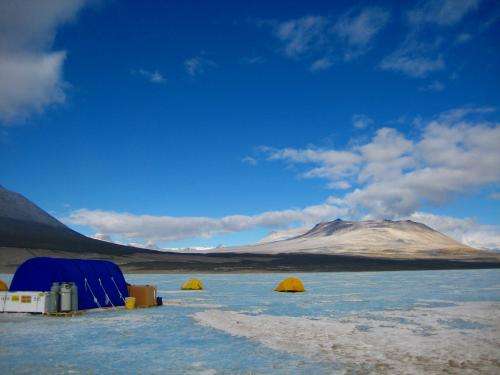
While Antarctica's Lake Vida will never be a vacation destination, it is home to some newly discovered hearty microbes. Credit: Desert Research Institute.

Where there's water there's life – even in brine beneath 60 feet of Antarctic ice, in permanent darkness and subzero temperatures.

While Lake Vida, located in the northernmost of the McMurdo Dry Valleys of , will never be a vacation destination, it is home to some newly discovered hearty microbes. In the current issue of the , Nathaniel Ostrom, Michigan State University zoologist, has co-authored " at -13ºC in the Brine of an Ice-Sealed Antarctic Lake."

Ostrom was part of a team that discovered an ancient thriving colony, which is estimated to have been isolated for more than 2,800 years. They live in a brine of more than 20 percent salinity that has high concentrations of ammonia, nitrogen, sulfur and supersaturated nitrous oxide—the highest ever measured in a natural aquatic environment.

"It's an – the thickest lake ice on the planet, and the coldest, most stable cryo-environment on Earth," Ostrom said. "The discovery of this ecosystem gives us insight into other isolated, frozen environments on Earth, but it also gives us a potential model for life on other icy planets that harbor saline deposits and subsurface oceans, such as Jupiter's ."

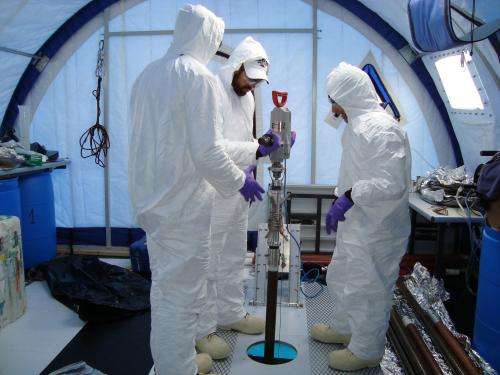
Members of the 2010 Lake Vida expedition team, Dr. Peter Doran (professor, University of Illinois, Chicago), Dr. Chris Fritsen (research professor, Desert Research Institute, Reno, Nev.) and Jay Kyne (an ice driller) use a sidewinder drill inside a secure, sterile tent on the lake’s surface to collect an ice core and brine existing in a voluminous network of channels 16 meters and more below the lake surface. Credit: Desert Research Institute, Emanuele Kuhn

On the Earth's surface, water fuels life. Plants use photosynthesis to derive energy. In contrast, at thermal vents at the ocean bottom, out of reach of the sun's rays, chemical energy released by hydrothermal processes supports life.

Life in Lake Vida lacks sunlight and oxygen. Its high concentrations of , nitrate, nitrite and nitrous oxide likely provide the used to support this novel and isolated microbial ecosystem. The high concentrations of hydrogen and nitrous oxide gases are likely derived from chemical reactions with the surrounding iron-rich rocks.

Consequently, it is likely that the chemical reactions between the anoxic brine and rock provide a source of energy to fuel microbial metabolism. These processes provide new insights into how life may have developed on Earth and function on other planetary bodies, Ostrom said.

The research team comprised scientists from the Desert Research Institute (Reno, Nev.), the University of Illinois-Chicago, NASA, the University of Colorado, the Jet Propulsion Laboratory, Montana State University, the University of Georgia, the University of Tasmania and Indiana University.

Explore further: Alaska volcano shoots ash 15,000 feet into the air

More information: "Microbial life at −13 °C in the brine of an ice-sealed Antarctic lake," by Alison E. Murray et al. PNAS, 2012. www.pnas.org/content/early/2012/11/21/1208607109.abstract

Related Stories

Digging deeper below Antarctica's Lake Vida

Sep 14, 2009

(PhysOrg.com) -- Antarctica's Lake Vida, a geologic curiosity that is essentially an ice bottle of brine, is home to some of the oldest and coldest living organisms on Earth. Perpetually covered by more than 60 feet of ice, ...

Life in Antarctic lake? It's everywhere else

Feb 09, 2012

If scientists find microbes in a frigid lake two miles beneath the thick ice of Antarctica, it will illustrate once again that somehow life finds a way to survive in the strangest and harshest places.

Researchers discover new microbial life in the Mediterranean

Mar 13, 2006

Researchers from the University of Essex have discovered a deep-sea oasis with new microbial life forms that could have significant implications for biotechnology. The findings have been published this week in the journal ...

Recommended for you

Alaska volcano shoots ash 15,000 feet into the air

18 hours ago

(AP)—One of Alaska's most restless volcanoes has shot an ash cloud 15,000 feet into the air in an ongoing eruption that has drawn attention from a nearby community but isn't expected to threaten air traffic.

NASA sees Cyclone Mahasen hit Bangladesh

May 17, 2013

NASA's Tropical Rainfall Measuring Mission satellite known as TRMM measured Cyclone Mahasen's rainfall rates from space as it made landfall on May 16. Mahasen has since dissipated over eastern India.

Rapid climate change ruled out ice age trees

May 17, 2013

Short, sharp fluctuations in the Earth's climate throughout the last ice age may have stopped trees from getting a foothold in Europe and northern Asia, scientists say.

Earth's iron core is surprisingly weak, researchers say

May 17, 2013

The massive ball of iron sitting at the center of Earth is not quite as "rock-solid" as has been thought, say two Stanford mineral physicists. By conducting experiments that simulate the immense pressures deep in the planet's ...

User comments : 2

Adjust slider to filter visible comments by rank

Display comments: newest first

Silverhill
5 / 5 (3) Nov 26, 2012
hearty (adjective)
---exuberant; unrestrained

hardy (adjective)
---capable of enduring fatigue, hardship, exposure, etc.; sturdy; strong

s/hearty/hardy
Jonseer
4 / 5 (2) Nov 26, 2012
hearty (adjective)
---exuberant; unrestrained

hardy (adjective)
---capable of enduring fatigue, hardship, exposure, etc.; sturdy; strong

s/hearty/hardy


Considering that the microbial colonies were described as "thriving" it is plausable that they were also quite "hearty" ;)

Now if had been one of those types of microbes that divide 1x every 1000 years, then...

More news stories

Galaxy's Ring of Fire

Johnny Cash may have preferred this galaxy's burning ring of fire to the one he sang about falling into in his popular song. The "starburst ring" seen at center in red and yellow hues is not the product of ...

Alaska volcano shoots ash 15,000 feet into the air

(AP)—One of Alaska's most restless volcanoes has shot an ash cloud 15,000 feet into the air in an ongoing eruption that has drawn attention from a nearby community but isn't expected to threaten air traffic.

Chinese, Indian airlines face EU pollution fines

Eight Chinese and two Indian airlines face fines of up to several million euros for not paying for their greenhouse gas emissions during flights within the bloc, the European Commission said on Friday.

Morocco to harness the wind in energy hunt

Morocco is ploughing ahead with a programme to boost wind energy production, particularly in the southern Tarfaya region, where Africa's largest wind farm is set to open in 2014.

US seizes Bitcoin operator accounts

US authorities seized the accounts of a Bitcoin digital currency exchange operator, claiming it was functioning as an "unlicensed money service business," court documents showed Friday.