Halving food losses would feed an additional billion people
Oct 10, 2012
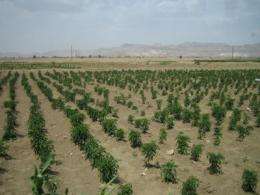
More efficient food production and the reduction of food losses matter greatly both to the environment and future food security. Credit: Matti Kummu

More efficient use of the food production chain and a decrease in the amount of food losses will dramatically help maintaining the planet's natural resources and improve people's lives. Researchers in Aalto University, Finland, have proved a valid estimation, for the first time, for how many people could be fed with reducing food losses. The world's population is an estimated seven billion people. An additional one billion can be fed from our current resources, if the food losses could be halved. This can be achieved if the lowest loss percentage achieved in any region could be reached globally.

- There isn't enough clean water everywhere on Earth. Significantly more cannot be cleared as well as certain raw material minerals for are running low. At the same time, a quarter of the amount of calories in produced food is lost or wasted at different stages of food production chain, which results in unnecessary resources loss, says Matti Kummu, post-doctoral researcher at Aalto University in Finland.

The new study is the first to evaluate the impact of food losses and its relationship to resources on a global scale. Annually 27 m3 of clean water, 0.031 hectares of agricultural land and 4.3 kilos of fertilizers per every in the world is wasted in food losses.

- Agriculture uses over 90 percent of the fresh water consumed by humans and most of the raw materials used in fertilizers. More efficient food production and the reduction of food losses are very important matters for the environment as well as future food security, Kummu adds.

Further, for the first time, the global food losses in terms of kilocalories per person were estimated.

As a result of food loss in the food production chain, it was determined that globally 614 kilocalories per every person a day are lost. Without this loss, present would yield 2,609 kilocalories of edible food a day for every inhabitant in the world. Thus, by halving the food losses, we could feed 8 billion people with the currently used resources.

This study was published in Science of the Total Environment.

Explore further: One in seven suffer malnourishment: UN food agency

add to favorites email to friend print save as pdf

Related Stories

One in seven suffer malnourishment: UN food agency

May 30, 2012

One in seven people suffer from malnourishment, the head of the UN's food agency said Wednesday in a report released ahead of a summit on sustainable development to be held in Rio de Janeiro June 20-22.

New projection shows global food demand doubling by 2050

Nov 21, 2011

Global food demand could double by 2050, according to a new projection by David Tilman, Regents Professor of Ecology in the University of Minnesota's College of Biological Sciences, and colleagues, including ...

Recommended for you

Chinese, Indian airlines face EU pollution fines

May 18, 2013

Eight Chinese and two Indian airlines face fines of up to several million euros for not paying for their greenhouse gas emissions during flights within the bloc, the European Commission said on Friday.

Fracking risks to ground water assessed

May 17, 2013

(Phys.org) —Extraction of "unconventional" gas from sedimentary rocks such as shale could provide a clean energy source and help some regions to become energy independent, but concerns have been raised ...

User comments : 0

More news stories

Russia retrieves mice, newts from space

A Russian capsule filled with 45 mice and 15 newts along with other small animals returned from a month's mission in orbit on Sunday with data scientists hope will pave the way for a manned flight to Mars.

Galaxy's Ring of Fire

Johnny Cash may have preferred this galaxy's burning ring of fire to the one he sang about falling into in his popular song. The "starburst ring" seen at center in red and yellow hues is not the product of ...

German energy shift faces headwinds

Tense engineers have their eyes peeled on complex colour-coded diagrams on a wall-sized screen that makes their control room look like the inside of a spaceship.

Honeybees trained in Croatia to find land mines

(AP)—Mirjana Filipovic is still haunted by the land mine blast that killed her boyfriend and blew off her left leg while on a fishing trip nearly a decade ago. It happened in a field that was supposedly ...

Internet in 'coma' as Iran election looms

Iran is tightening control of the Internet ahead of next month's presidential election, mindful of violent street protests that social networkers inspired last time around over claims of fraud, users and ...

China police billions spell profit opportunity

Mannequins in riot gear, armoured cars and drones line a police equipment and "anti-terrorism technology" trade fair in Beijing as vendors seek to profit from China's huge internal security budget.