Evolutionary capacity of many fruit fly species will lag behind pace of climate change, researchers say
Sep 18, 2012
Evolutionary capacity of many fruit fly species will lag behind pace of climate change, researchers say
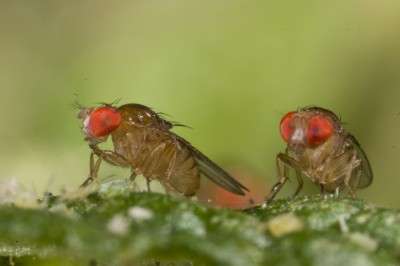
Fruit flies are ill-equipped to adapt to increases in global temperatures.

(Phys.org)—Many species of fruit fly lack the ability to adapt effectively to predicted increases in global temperatures and may face extinction in the near future, according to new research.

In a study published today in , researchers from Monash University, The University of Melbourne and Danish collaborators showed that many species of fruit fly appear to be constrained within an evolutionary straitjacket and can't readily adapt to climate change-related temperature increases.

Dr Vanessa Kellermann from Monash University's School of Biological Sciences said current projections predict a 3ºC increase in mean in the next century and even greater increases in extremes.

"Given our findings, these expected increases pose a major threat to biodiversity in the near future. Particularly as Drosophila or fruit fly findings are often more broadly applicable," Dr Kellermann said. 

By examining nearly 100 species of fruit fly from around the world, the researchers showed that species had evolved to the and humidity of their environments. However, they had very little flexibility in being able to change their levels of and seem unable to adapt to increased temperatures in the future.

High heat resistance is a feature of only some branches of the phylogeny - the tree that shows how species are related through evolution - of Drosophila. Other branches had very limited ability to change their levels of heat resistance; even when flies native to cooler areas grew up in a warm environment, their was not significantly altered.

"The problem is that only a handful of species have adapted to hot environments while most species have not and it seems very difficult to switch once you are stuck on a phylogenetic branch," Dr Kellermann said. 

The researchers looked at species' prospects for dealing with projected temperature increases in the near future.

"If a species can only withstand temperatures of 36ºC and the maximum temperature of the environment is already 36ºC, an increase of even 1ºC would already put this species over the edge towards extinction," Dr Kellermann said. 

Using this method, the researchers identified at-risk species and found that most tropical and mid-latitude species fell into this category.

"Without rapid adaptation, which now seems very unlikely, a lot of species may fall over under even a mild increase in temperature," Dr Kellermann said.

Explore further: Some like it hot: Tropical species 'not as vulnerable' to climate change extinction

Related Stories

New study reveals contrasting consequences of warmer Earth

Sep 03, 2012

A new study, by scientists from the Universities of York, Glasgow and Leeds, involving analysis of fossil and geological records going back 540 million years, suggests that biodiversity on Earth generally increases as the ...

Recommended for you

Getting to the bottom of the zombie ant phenomenon

11 minutes ago

(Phys.org) —While unraveling a dramatic case of mind control, biologist David Hughes is taking calls from Hollywood—and gaining new insights into the role behavior plays in spreading disease.

Coral reefs 'ruled by earthquakes and volcanoes'

1 hour ago

(Phys.org) —Titanic forces in the Earth's crust explain why the abundance and richness of corals varies dramatically across the vast expanse of the Indian and Pacific Oceans, a world-first study from the ...

Designer eucalypts for urban landscapes

1 hour ago

University of Adelaide researchers are working with the Australian nursery industry to produce 'designer eucalypts' more suitable for our home gardens and urban landscapes than many trees currently available.

User comments : 1

Adjust slider to filter visible comments by rank

Display comments: newest first

Tausch
3 / 5 (2) Sep 18, 2012
Predicting adaptions. Based on past extinctions or failure to adapt?
We are back to global changes of climate - the past, present and future.

Is there an alternative to adaptation (besides extinction)when viewed in the light of past, present, and future global changes?

More news stories

Fast new, one-step genetic engineering technology

A new, streamlined approach to genetic engineering drastically reduces the time and effort needed to insert new genes into bacteria, the workhorses of biotechnology, scientists are reporting. Published in ...

Drought makes Borneo's trees flower at the same time

Tropical plants flower at supra-annual irregular intervals. In addition, mass flowering is typical for the tropical forests in Borneo and elsewhere, where hundreds of different plant timber species from the ...

100K Pathogen Genome Project maps first genomes

(Phys.org) —Striking a blow at foodborne diseases, the 100K Pathogen Genome Project at the University of California, Davis, today announced that it has sequenced the genomes of its first 10 infectious microorganisms, including ...

Strawberry fields forever and fungus-free

(Phys.org) —Strawberries are one of the most economically important berry crops in the world, and a high value export crop for the Australian horticultural industry.For the first time, researchers at The ...

Theorists weigh in on where to hunt dark matter

(Phys.org) —Now that it looks like the hunt for the Higgs boson is over, particles of dark matter are at the top of the physics "Most Wanted" list. Dozens of experiments have been searching for them, but ...

DNA damage: The dark side of respiration

(Phys.org) —Adventitious changes in cellular DNA can endanger the whole organism, as they may lead to life-threatening illnesses like cancer. Researchers at LMU now report how byproducts of respiration cause mispairing ...