Research team develops high performance flexible solid state battery
Aug 06, 2012
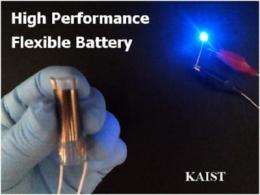
This shows a blue LED emission operated by flexible solid state battery. Credit: Korea Advanced Institute of Science and Technology

The Korean team of Professor Keon Jae Lee from the Department of Materials Science and Engineering, KAIST has developed a high performance flexible all-solid-state battery, an essential energy source for flexible displays.

The technological advance of thin and light flexible display has encouraged the development of flexible batteries with a high and thermal stability. Although rechargeable lithium-ion batteries (LIB) have been regarded as a strong candidate for a high-performance flexible energy source, compliant electrodes for bendable LIBs are restricted to only a few materials (e.g., organic materials or nano/micro structured inorganic materials mixed with polymer binders). The performance of LIBs has not been sufficient either, thereby difficult to apply to flexible consumer electronics including rollable displays.

In addition, lithium used as a cathode electrode have to be treated in high temperature (e.g., ~ 700 degrees for lithium ). However, it is not possible to anneal the metal oxides, an active material, at this high temperature on substrates.

This video is not supported by your browser at this time.
Flexible battery turns on blue LED and maintains voltage during bending/unbending conditions.

Recently, Professor Lee's research team has developed a high performance flexible LIB structured with high density inorganic thin films by using a universal transfer approach. The thin film LIB fabricated on a mica substrate with high annealing temperature is transferred onto polymer substrates through a simple physical delamination of sacrificial substrates.

Professor Lee said, "The advent of a high performance flexible thin film battery will accelerate the development of next-generation fully flexible electronic systems in combination with existing flexible components such as display, memory, and LED."

The research team is currently investigating a laser lift-off technology to facilitate the mass production of flexible LIBs and 3D stacking structures to enhance charge density of batteries.

Explore further: Largest flexible color organic light emitting display produced

More information: See paper in Nano Letters: "Bendable Inorganic Thin-Film Battery for Fully Flexible Electronic Systems"

add to favorites email to friend print save as pdf

Related Stories

Cancer detection from an implantable, flexible LED

Sep 19, 2011

Can a flexible LED conformably placed on the human heart, situated on the corrugated surface of the human brain, or rolled upon the blood vessels, diagnose or even treat various diseases? These things might ...

OLED Displays on Flexible Metallic Substrates

Jun 23, 2004

Universal Display Corporation, a leading developer of organic light emitting device (OLED)technologies for flat panel displays, lighting and other opto-electronic applications, and Palo Alto Research Center (PARC), a subsidiary ...

Recommended for you

User comments : 0

More news stories

Scientists develop cheaper, more efficient fuel cells

(Phys.org) —Using the Canadian Light Source (CLS) synchrotron, researchers have discovered a way to create cheaper fuel cells by dividing normally expensive platinum metal into nanoparticles (or even single ...

New rhythm for El Nino discovered

El Niño wreaks havoc across the globe, shifting weather patterns that spawn droughts in some regions and floods in others. The impacts of this tropical Pacific climate phenomenon are well known and documented.

Moon may harbour alien minerals, study says

Minerals found in craters on the Moon may be remnants of asteroids that slammed into it and not, as long believed, the satellite's innards exposed by such impacts, a study said Sunday.

Conductive paint lands in pens and pots for creatives

London-based Bare Conductive Ltd. makes electrically conductive paint called Bare Paint. The substance allows the painting of "liquid wiring" on any surface. Except for skin, you can apply its paint on walls ...

Scientists discover the origin of a giant synapse

Humans and most mammals can determine the spatial origin of sounds with remarkable acuity. We use this ability all the time—crossing the street; locating an invisible ringing cell phone in a cluttered bedroom. ...