NASA sees Tropical Storm Kirogi headed for cooler waters
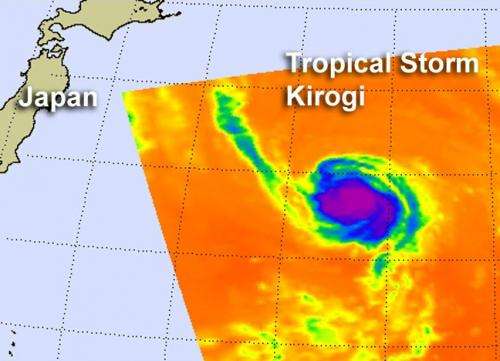
Sea surface temperatures cooler than 80 degrees Fahrenheit can sap the strength from a tropical cyclone and Tropical Storm Kirogi is headed toward waters below that threshold on its track through the northwestern Pacific Ocean, according to data from NASA's Aqua satellite.
NASA's Aqua satellite passed over Tropical Storm Kirogi on August 9 at 0241 UTC. The Atmospheric Infrared Sounder (AIRS) instrument captured an infrared image of the cloud temperatures that showed a concentrated area of strongest storms and heaviest rainfall west of the center of circulation. Vertical wind shear is currently at 10-15 knots, which is helping to prevent the storm from intensifying. The center of circulation also appears elongated from northwest to southeast in satellite imagery, which is a sign the storm is weakening. Whenever a tropical storm's center cannot "stack up" in the atmosphere, it begins to weaken.
On August 9, 2012 at 11 a.m. EDT (1500 UTC), Tropical Storm Kirogi had maximum sustained winds near 35 knots (40 mph/64.8 kmh). It was located about 550 nautical miles (633 miles/1,019 km) east-southeast of Misawa, Japan, near 38.5 North and 151.9 East. Kirogi was moving to the northwest at 20 knots (23 mph/37 kmh).
AIRS data indicates that the sea surface temperatures in the direction that Kirogi is moving are too cool to maintain a tropical cyclone. Kirogi is forecast to track over sea surface temperatures cooler than 25 Celsius once it nears 38 degrees north later on August 9, which will weaken the storm. The forecasters at the Joint Typhoon Warning Center note that the cooler waters will also help transform Kirogi's warm core to a cold core, making the storm into an extra-tropical one as it heads toward the two southernmost Kuril Islands.
Provided by NASA's Goddard Space Flight Center


