Millipede family added to Australian fauna
Aug 30, 2012
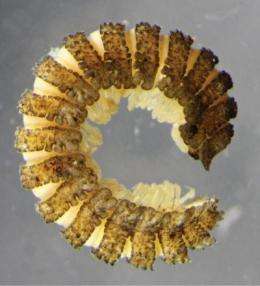
This image shows a Nephopyrgodesmus eungella male, one of the newly found species. Credit: Robert Mesibov

An entire group of millipedes previously unknown in Australia has been discovered by a specialist – on museum shelves. Hundreds of tiny specimens of the widespread tropical family Pyrgodesmidae have been found among bulk samples in two museums, showing that native pyrgodesmids are not only widespread in Australia's tropical and subtropical forests, but are also abundant and diverse. The study has been published in the open access journal ZooKeys.

"Most pyrgodesmid species are so small they could be easily overlooked," explained millipede specialist Dr Robert Mesibov, of the Queen Victoria Museum and Art Gallery in Launceston, Tasmania. "What's interesting is how thoroughly overlooked they've been. We now know there are dozens of of these millipedes in our warm, wet forests, stretching over more than 2000 km on Australia's east coast."
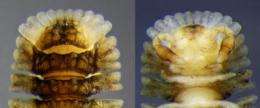
This image shows the top (left) and bottom (right) views of the head end of one of the new pyrgodesmid species. This millipede is only 1.3 mm wide. Credit: Robert Mesibov

Six new species and three new genera of the colorful, curiously sculptured have now been described from Australia, all from the state of Queensland.

"It's a great example of the value of museum collections," said Dr Mesibov. "Scientists from the Queensland Museum and CSIRO Entomology collected bagfuls of in hundreds of places over many years. They extracted bugs in bulk from the fresh litter and took out just the ones they were studying, usually . The remaining bugs are in 'residues' stored in the Queensland Museum and the Australian National Insect Collection."

Dr Mesibov said it's not generally appreciated that zoological specialists find most of their new species in museums. "Sure, biological expeditions to previously unexplored places turn up exciting new species. But there are plenty of surprises waiting when you go rummaging through the residues on museum shelves. In this case, it was a whole family of animals not known from Australia."

Explore further: Navy dolphins discover rare old torpedo off Calif. coast near Coronado

More information: Mesibov R (2012) The first native Pyrgodesmidae (Diplopoda, Polydesmida) from Australia. ZooKeys 217: 63. doi: 10.3897/zookeys.217.3809

add to favorites email to friend print save as pdf

Related Stories

Millipede border control better than ours

Dec 23, 2011

A mysterious line where two millipede species meet has been mapped in northwest Tasmania, Australia. Both species are common in their respective ranges, but the two millipedes cross very little into each other's ...

Millipede feared extinct is found

Jul 31, 2006

U.S. biologists say Illacme plenipes, a millipede with up to 750 legs that was last seen 80 years ago, has been found in California.

New dolphin species discovered in Australia

Sep 15, 2011

Researchers in Australia have discovered that dolphin colonies living around Melbourne are a species unlike any other in the world, they revealed on Thursday.

Recommended for you

Scientists take a new look at an ancient crop

13 hours ago

Though the price makes you wince, you might just buy that bottle of your favorite olive oil anyway. Perhaps it's exactly what you want for the salad dressing you're making tonight and for your special stir-fry ...

Bittersweet: Bait-averse cockroaches shudder at sugar

May 23, 2013

Sugar isn't always sweet to German cockroaches, especially to the ones that avoid roach baits. In a study published May 24 in the journal Science, North Carolina State University entomologists show the ne ...

White tiger mystery solved

May 23, 2013

White tigers today are only seen in zoos, but they belong in nature, say researchers reporting new evidence about what makes those tigers white. Their spectacular white coats are produced by a single change ...

User comments : 0

More news stories

EU bans three pesticides harmful to bees

The European Commission said Friday that it will ban for two years beginning in December pesticides blamed for killing the bees that pollinate food and fruit crops.

Galaxies fed by funnels of fuel

(Phys.org) —Computer simulations of galaxies growing over billions of years have revealed a likely scenario for how they feed: a cosmic version of swirly straws.

Google eyes emerging markets networks

Google has become deeply involved in a series of projects to build and operate wireless networks in emerging markets including sub-Saharan Africa and Southeast Asia, a report said Friday.